
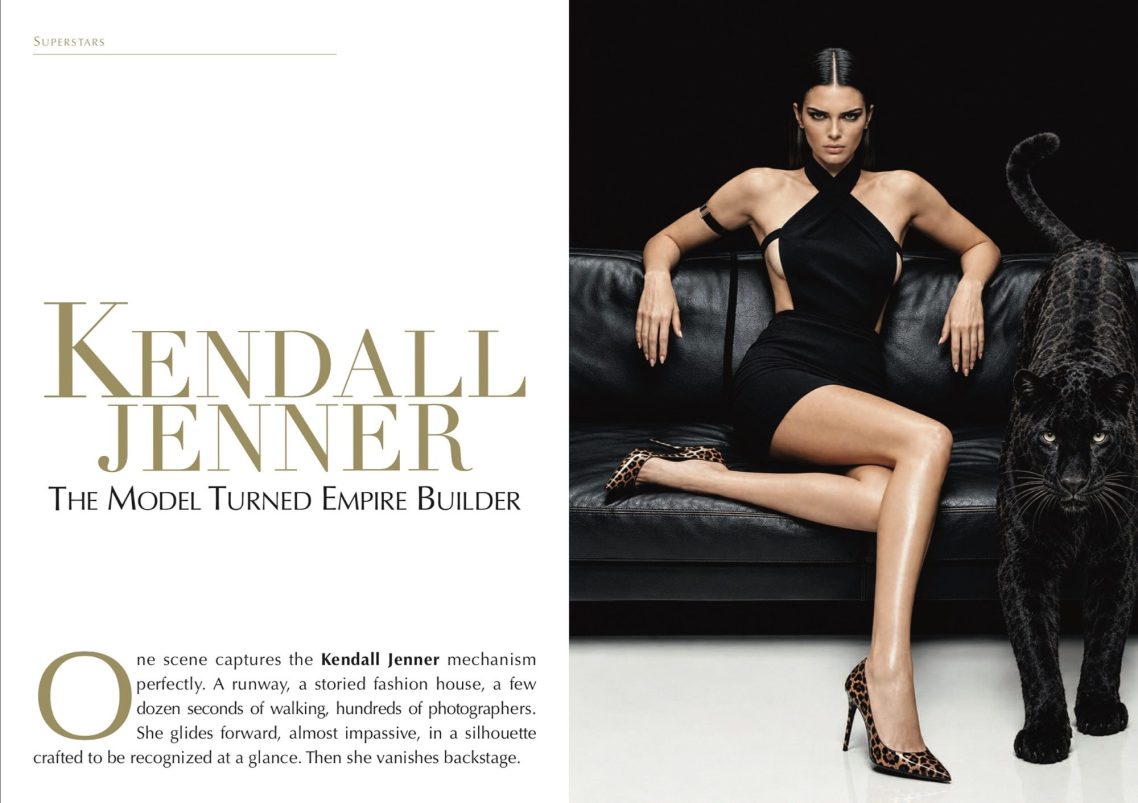
KENDALL JENNER
The Model turned empire builder
One scene captures the Kendall Jenner mechanism perfectly. A runway, a storied fashion house, a few dozen seconds of walking, hundreds of photographers. She glides forward, almost impassive, in a silhouette crafted to be recognized at a glance. Then she vanishes backstage. But the real show begins elsewhere Today, Kendall Jenner's worth is no longer measured only by the number of shows she agrees to walk. It is measured by what her name can generate when she is, quite deliberately, nowhere near a runway. Therein lies what makes her singular.
Kendall Jenner has become one of the most accomplished examples of a new modeling economy, one in which the face, the image, the audience and, above all, the ability to turn that audience into businesses are an asset almost as valuable as beauty itself. Her story is all the more compelling because she entered fashion with a formidable advantage... one that could just as easily have become her greatest liability. The Impossible Gamble Kendall Jenner never had to become famous. She already was. At eleven, she was on Keeping Up with the Kardashians, under the constant eye of the cameras. When she decided to become a model, she was therefore not starting from scratch: she arrived with a globally recognized name, a ready-made audience and a level of media exposure that most girls walking into an agency could only dream of. But fashion is not quite the world of reality TV.
When Kendall booked the Marc Jacobs Fall-Winter 2014 show, she knew at once that something had shifted. She would later recall that she went into that season with no idea whether she would actually make it, and that this one show alone would have made her happy. Then came Givenchy, Chanel and the other major houses. Her ascent was dazzling. The paradox is delicious: the Kardashian-Jenner name opens doors, yet she then has to convince an industry that is deeply suspicious of celebrities made by television. Riccardo Tisci, then at Givenchy, took note of her professionalism and work ethic. Vogue also reports that her agency was adamant that she did not see modeling as a pastime: she wanted a career built to last. Kendall has no interest in being "a Kardashian who models." She wants to be a model whose name belongs to fashion in its own right. In 2014, aged just 18, she also became the face of Estée Lauder.
Even then, her digital clout was extraordinary: Vogue cast her as the new generation of model, one able to turn social media straight into a professional tool. The runway, then, is merely the first piece of a far larger system. The Day Modeling Became a Business In 2017, the market gave its first dramatic answer. Forbes crowned Kendall Jenner the world's highest-paid model, with an estimated $22 million in annual earnings, edging out Gisele Bündchen and ending her long dominance of the ranking. In 2018, Jenner kept the number one spot with around $22.5 million. These numbers are fascinating because they reveal a profession being reinvented. Kendall does not earn $22 million just because she walks better than the rest. She earns it because she has become a global commercial platform. Calvin Klein, Estée Lauder, Adidas, Victoria's Secret, fashion campaigns, appearances, social media: her business model is a stack of deals that all mine the same raw material, her image. The classic model sold her face to the houses. Kendall Jenner sells something far bigger: entry into her world. A magazine cover is gone in a matter of weeks. A digital campaign can be shared millions of times. A brand collaboration can become an ownership stake. And a company she holds a piece of can keep creating value whether she is in Paris, in Los Angeles, or simply at home. The real luxury, for her, is now this: never relying on a single source of income. 818: The Turning Point In 2021, she made the most intriguing move of her career.
Kendall Jenner unveiled 818 Tequila, named for the area code of Calabasas, the part of California where she grew up. Yet the cleverest detail is elsewhere: at launch, she deliberately kept her own name out of the spotlight. Put differently, she does nearly the reverse of what a traditional celebrity would do. No "Kendall Jenner Tequila" splashed across the label in giant letters. The product has to stand on its own without her. It is an intriguing strategy, and above all one that makes people judge the bottle before they judge the star. Forbes put 818's sales at roughly $25 million in 2022, as the brand pushed into new markets, notably China and Dubai. Then, in 2026, the story took on a new dimension: Sazerac, the American group behind Buffalo Trace and Fireball, acquired a minority stake in 818 and a strategic role in its U.S. distribution. The financial terms were not disclosed. It may well be the most significant moment in Jenner's financial journey. A campaign pays a fee. A stake in a company can appreciate. That is the entire difference between being paid for your image and owning a share of the machine that puts it to work. A Fortune That Resists a Single Number One classic pitfall of celebrity profiles deserves caution here: announcing a fortune with the precision of a bank statement.
Kendall Jenner has, of course, never published an audited statement of her personal wealth. The estimates available in 2026 diverge considerably, with some publications placing her at around $60 to $80 million, while Celebrity Net Worth now puts the figure at $150 million, factoring in a hypothetical valuation of her stake in 818. A range is therefore more honest than a single figure. And above all, it reveals something interesting: Kendall Jenner's wealth is now much harder to calculate because it no longer sits solely in her paychecks. It is divided among modeling earnings, brand deals, television, digital ventures, equity stakes, real estate and, most of all, the potential value of her businesses. The shifting nature of her wealth probably matters more than the exact figure. Beverly Hills, or the Art of Buying Calm Her property purchases show yet another side of her. At 18, Kendall bought her first apartment in Beverly Hills for about $1.3 million, then sold it a few years later. In 2016 came a house in the Hollywood Hills, for around $6.5 million, formerly owned by John Krasinski and Emily Blunt.
She let it go after an especially unsettling spell, security concerns among them. In 2017, she bought the home she lives in today, in the gated enclave of Mulholland Estates, for $8.55 million. Once owned by Charlie Sheen, the roughly 6,600-square-foot house has five bedrooms, six bathrooms, a pool, a tennis court and even a screening room. Yet size is not the most telling part. Kendall has said she wanted a quiet, almost sheltering home, a counterweight to a life of travel, photographers, runways and relentless exposure. Inside, she has assembled a serious collection of contemporary art, with works by James Turrell, Barbara Kruger, Richard Prince, Raymond Pettibon and Sterling Ruby among them. That detail deserves to stick. For Kendall Jenner, money does not appear to be about simply acquiring more. More and more, it is about building a world of her own. The Model Who Wants to Be More Than a Model In 2021, Kendall added a new title to her résumé: creative director of FWRD, the luxury fashion platform owned by Revolve. It is far from a ceremonial post. She has a hand in the site's visual identity, picks the designers it carries, curates trend edits and is involved in collaborations and brand activations.
She is no longer only wearing what someone else has chosen. She is starting to do the choosing. Then came L'Oréal Paris, where she became a global ambassador in 2023, bringing into her orbit a beauty giant whose commercial reach goes well beyond modeling. Her relationship with the catwalk has shifted as well. Kendall no longer feels the need to do it all. In 2024, Le Monde observed that she was walking far fewer shows than in her early years, saving herself for select high-profile moments. Even in 2026, she still turns up on the most strategic runways: Bottega Veneta in Milan and L'Oréal Paris in Paris during September's Fashion Week are recent examples. The choice speaks volumes. She no longer needs to be everywhere. Rarity has become part of her value. The Real Luxury: Choosing Perhaps this, in the end, is what sets Kendall Jenner apart from so many models of her generation. She is part of the first generation for which the boundaries between model, celebrity, influencer, entrepreneur and creative director have practically dissolved.
Yet she has one more distinguishing trait: she appears to have grasped early that a career does not have to mean piling up appearances. She can pick one show over another. One campaign over another. One house over another. A company over a simple ad deal. Above all, she can invest in what she stands for. Here her story reads almost like a lesson in modern capitalism: fame draws attention, but attention on its own is not wealth. It has to be converted into assets. Kendall Jenner began with a face. Today she holds a portfolio. What comes next may be the most fascinating chapter: seeing how far she can go when her name is no longer merely the signature on a campaign, but the signature on businesses in which she holds an ever-larger stake. In fashion, faces pass. Brands remain. And Kendall Jenner seems to have realized, perhaps sooner than most, that it is far more compelling to own a piece of the brand than merely to be photographed in front of its logo.
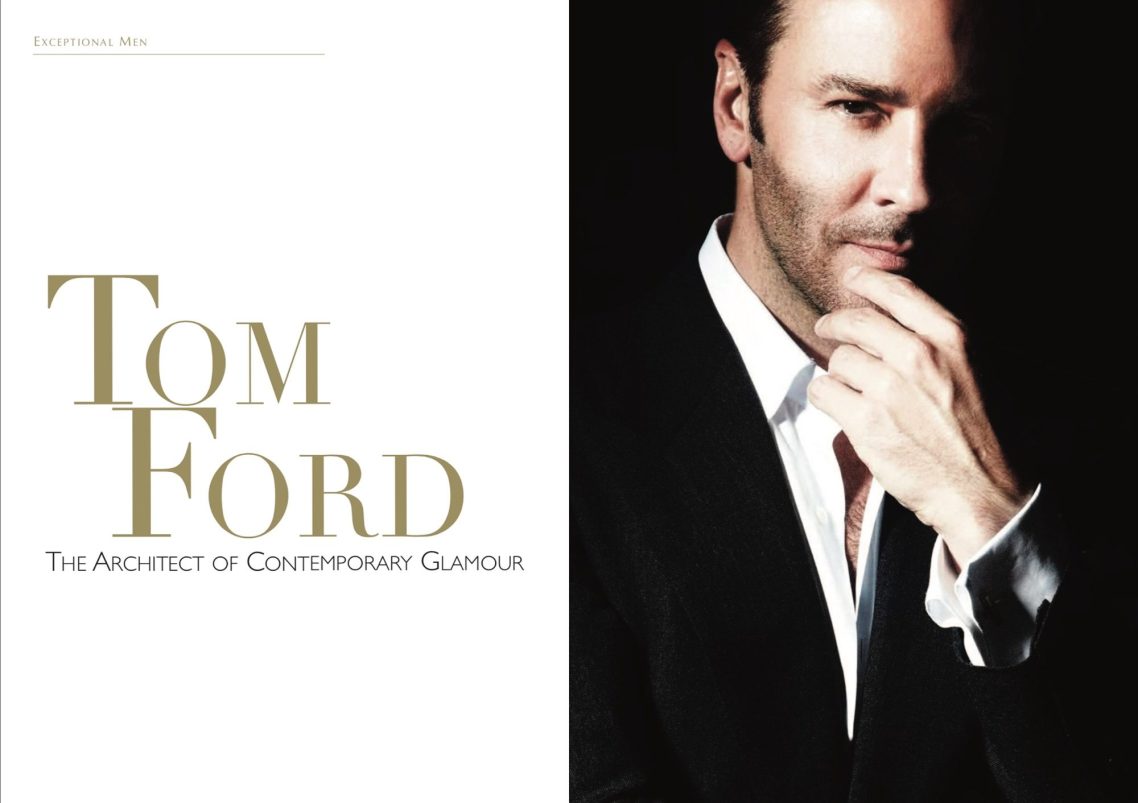
TOM FORD
The architect of contemporary glamour
Thomas Carlyle Ford, better known as Tom Ford, embodies the very essence of modern elegance. This American fashion designer, who is also a renowned filmmaker, has established himself as an iconic figure in the luxury industry through his exceptional talent, innate sense of style, and marketing flair. Tom Ford has made a lasting impression not only with his refined creations but also with his bold and innovative vision of contemporary fashion. The Beginnings of Tom Ford Born on August 27, 1961, in Austin, Texas, Tom Ford grew up in an environment conducive to creativity. After studying art history at New York University, he shifted his focus to interior architecture at the Parsons School of Design.
However, it was during an academic exchange in Paris that Tom Ford discovered his true calling: fashion. His professional beginnings were marked by his stint at Perry Ellis, but it was when he joined Gucci in 1990 that his career truly took off. At that time, Gucci was a struggling brand, and Tom Ford's arrival, first as a designer of women's ready-to-wear and later as the creative director, initiated a radical transformation. His bold and sensual approach revitalized the brand, propelling Gucci to the pinnacle of the luxury sector. The Inimitable Style of Tom Ford Tom Ford's style is synonymous with sophisticated glamour and timeless elegance. It stands out through a bold combination of classicism and modernity, where clean lines meet luxurious details.
Tom Ford has a particular affinity for sumptuous materials such as velvet, silk, and satin, and he does not hesitate to use rich and deep colors to create pieces that are both timeless and contemporary. The essence of his collections lies in the subtle yet powerful sensuality they exude. His creations are designed to enhance the natural beauty of the wearer, focusing on the silhouette and celebrating self-confidence. This unique vision has allowed Tom Ford to stand out in a world often dominated by fleeting trends. His Incredible Talent What sets Tom Ford apart is his unparalleled talent for merging fashion and storytelling. Each collection tells a story, each garment evokes an emotion. Tom Ford is a master at creating immersive and captivating universes, whether on a runway or in an advertising campaign. His ability to anticipate and influence fashion trends is another of his great strengths. Tom Ford does not merely follow currents; he creates them. His keen attention to detail and deep understanding of his clientele's desires allow him to design pieces that not only meet expectations but exceed them.
His Collaborations Throughout his career, Tom Ford has collaborated with some of the most influential figures in the fashion industry and beyond. His professional relationship with Domenico De Sole, then CEO of Gucci, was particularly fruitful. Together, they transformed Gucci into a thriving luxury brand, and they repeated this success at Yves Saint Laurent, where Tom Ford also left an indelible mark as creative director. In 2005, Tom Ford launched his own eponymous brand, which quickly gained worldwide acclaim. His collaboration with the Estée Lauder Group to create a line of cosmetics and fragrances was also highly successful, further strengthening his empire. Tom Ford's Financial Success Tom Ford's financial success matches his creative talent. Thanks to his ability to revitalize iconic brands and create desirable products, he has amassed a considerable fortune.
Under his leadership, Gucci's sales skyrocketed from $230 million in 1994 to nearly $3 billion in 2004. His own brand, Tom Ford, is now a cornerstone of the luxury sector, offering a comprehensive range of clothing, accessories, fragrances, and cosmetics. Tom Ford has also extended his influence beyond fashion, directing critically acclaimed films such as "A Single Man" and "Nocturnal Animals," showcasing his versatility and creative genius. What Sets Tom Ford Apart from Other Creators of His Generation What distinguishes Tom Ford from his contemporaries is primarily his ability to reinvent luxury brands while imposing his own aesthetic vision.
While many designers focus on a specific niche, Tom Ford has diversified his portfolio while maintaining an undeniable stylistic coherence. His mastery of marketing and communication is also remarkable. Tom Ford understands the importance of image and storytelling in contemporary fashion. His advertising campaigns, often provocative and bold, have always managed to capture attention and spark conversations, thereby enhancing the notoriety and desire surrounding his creations. Furthermore, Tom Ford possesses a rare combination of creative talents and entrepreneurial skills. He is not just a designer but also a savvy strategist, capable of leading and developing a thriving business in an extremely competitive industry.
Tom Ford is undeniably one of the most influential and talented fashion designers of his generation. His beginnings at Gucci marked the start of an extraordinary career, characterized by a unique style, bold vision, and impressive financial success. His ability to merge fashion and storytelling, collaborate with industry titans, and stand out with an effective marketing strategy sets him apart in the luxury universe. Tom Ford continues to inspire and captivate, confirming his status as a true icon of contemporary glamour.
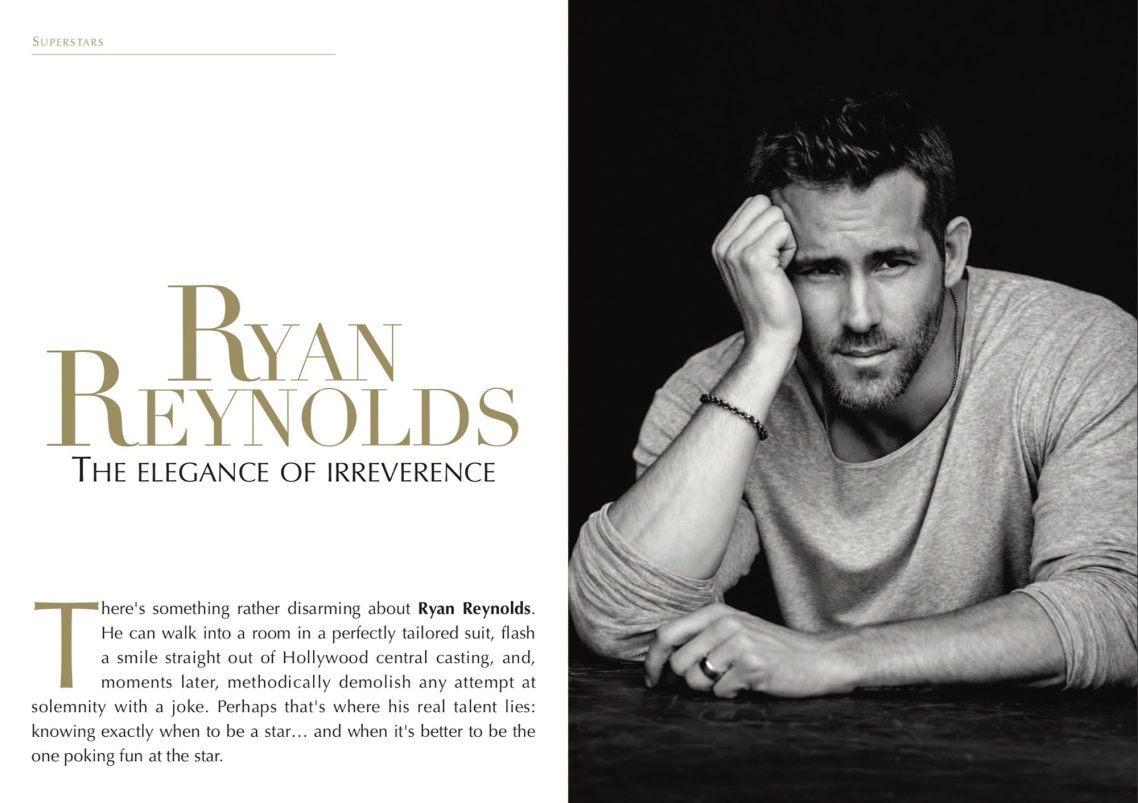
RYAN REYNOLDS
The Elegance of irreverence
There's something rather disarming about Ryan Reynolds. He can walk into a room in a perfectly tailored suit, flash a smile straight out of Hollywood central casting, and, moments later, methodically demolish any attempt at solemnity with a joke. Perhaps that's where his real talent lies: knowing exactly when to be a star… and when it's better to be the one poking fun at the star. Approaching fifty, the Canadian actor is no longer just one of the most recognizable faces in American cinema. He has become a persona in his own right, straddling film, advertising, sport, and entrepreneurship, territory few actors have ventured into with such effectiveness. His secret, though, isn't much of a mystery. Ryan Reynolds understood, before many others, that in a world saturated with images, personality has become an asset. And his is particularly profitable. Ryan Reynolds has never quite fit the mold of the classic Hollywood hero.
Handsome, certainly, but with a deliberately less chiseled elegance; athletic, but without the stiffness of an action-movie lead; funny, above all, with that almost British knack for slipping a touch of self-deprecation into an otherwise perfectly composed sentence. His style operates on the same principle. Impeccably cut suits, understated shirts, structured coats, discreet watches: Ryan Reynolds cultivates an elegant silhouette without ever looking like he spent three hours studying it in the mirror. That's precisely what makes it interesting. For him, luxury is rarely showy. There's also that particular smile of his, faintly ironic, as if he already knows the official photo could become a joke within five minutes. That self-deprecation isn't merely likeable. It's one of the foundations of his public image. From Comedy to Deadpool Before becoming a global star, Ryan Reynolds had a career path far less linear than his current image might suggest.
He started out on Canadian television before breaking through in the United States with the sitcom Two Guys, a Girl and a Pizza Place, then continued with comedies like Van Wilder and The Proposal. He also experimented with action, drama, and science fiction. Buried, in 2010, notably proved he could carry an entire film almost single-handedly, with a tone far darker than his romantic-comedy image. Then came Green Lantern, a relative critical and commercial failure, but one whose importance in Ryan Reynolds's trajectory is considerable. Ironically, one of his worst bets would help pave the way
for his best.
Ryan Reynolds Wants Deadpool: The character suits him almost too well: irreverent, chatty, self-aware about being in a movie, able to comment on Hollywood conventions while using them to his advantage. After years of troubled development, Deadpool finally arrived in 2016 with an unusually modest budget for a superhero film, around $58 million, and became a global phenomenon, grossing over $780 million at the box office. The machine was set in motion. The character was no longer simply played by Ryan Reynolds: it seemed to have been written for him. The first Deadpool didn't just change Ryan Reynolds's career. It proved that an R-rated superhero film, meant for adult audiences, could become a global phenomenon without adopting the traditional codes of the family blockbuster. Ryan Reynolds had finally found the role that brought together his two greatest strengths: the physique of a star and the instincts of a comedian. What followed confirmed the instinct. Then came Free Guy in 2021, another demonstration of his knack for blending action, comedy, and pop culture. In 2024, Deadpool & Wolverine crossed yet another threshold.
With Hugh Jackman, Ryan turned the character's return into a global event. The film grossed over $1.33 billion worldwide, becoming the second-biggest worldwide hit of 2024. Even Marvel itself seemed to grasp something at that point: Ryan Reynolds was no longer just a cast member. He had become one of the creative engines driving his own universe. When the Actor Becomes an Entrepreneur Many celebrities use their fame to sell a product. Ryan Reynolds chose a different approach: building brands whose messaging feels like one of his own films. With George Dewey, he founded Maximum Effort in 2018. The company became both a production house and a creative engine specializing in advertising campaigns and digital content. The principle is simple: instead of making advertising that feels like advertising, make advertising that feels like entertainment. The Ryan Reynolds tone, fast, absurd, self-deprecating, sometimes deliciously cheeky, became a genuine commercial method.
Maximum Effort has notably handled communications for numerous brands and projects tied to Ryan Reynolds, turning humor into a real strategic tool. Enter Aviation Gin Ryan Reynolds took a stake in the brand and, more importantly, became its creative face. His ad campaigns, often deliberately offbeat, drew as much attention as the product itself. In 2020, Diageo announced the acquisition of Aviation American Gin and Davos Brands for a value of up to $610 million, made up of an initial $335 million plus up to $275 million more tied to future performance. Ryan retained a stake in the brand. That figure tells us something important: Ryan Reynolds hadn't simply sold his image to a spirits company. He had understood that, in certain highly competitive sectors, how you tell a product's story can become just as important as the product itself. And he did it again. $300 Million More... or Almost Mint Mobile is probably the best example of his entrepreneurial instinct. The American low-cost mobile carrier brought Ryan Reynolds on as an investor and creative partner.
His messaging turned a rather austere industry into a comedic playground. The result was spectacular. In 2023, T-Mobile announced the acquisition of Ka'ena Corporation, Mint Mobile's parent company, in a deal worth up to $1.35 billion, with 39% of the consideration in cash and 61% in stock. Ryan Reynolds's exact stake, and the personal amount he actually walked away with from the deal, aren't public with enough precision to justify the figures sometimes floated in the press, but that's beside the point. A Hollywood actor had managed to become an investor capable of spotting a young company, contributing to its growth, and above all giving it an instantly recognizable personality. Ryan Reynolds in Numbers: $1.33 billion: worldwide gross of Deadpool & Wolverine. Up to $610 million: announced value of the Aviation Gin deal. Up to $1.35 billion: announced value of T-Mobile's acquisition of Mint Mobile. 2018: founding of Maximum Effort. 2016: Ryan Reynolds receives his star on the Hollywood Walk of Fame.
His Fortune: The Number and What It Says The most commonly cited estimates now place Ryan Reynolds's personal fortune at around $350 million. And ultimately, that figure is less interesting than what it's made of. Ryan Reynolds illustrates a profound transformation in Hollywood's economic model. In the past, a star's fortune rested mainly on their fees, endorsement deals, and box-office revenue. Today, the real leverage often lies in intellectual property. A brand. A production company. An equity stake. A football club. An ad campaign. A license. In other words, Ryan Reynolds is no longer just looking to get paid for his work. He's looking to own a piece of what he helps create. The Man Behind the Character There is, however, one line Ryan Reynolds seems intent on preserving: his family life. Married to actress Blake Lively since 2012, he is a father of four. The couple has chosen to protect their family privacy as much as possible and shares very few images of their children. That discretion stands in contrast to the sheer digital omnipresence of the "Ryan Reynolds" persona. He communicates constantly, jokes relentlessly, takes part in his companies' campaigns, and happily plays with his own image. Yet he doesn't turn his family into media content in the process. The distinction is subtle, and rather elegant.
It also helps explain why his humor works so well: behind the constant joking lies a very precise sense of control over what should stay private. And Now ? In 2026, Ryan Reynolds returns to the big screen with Mayday, alongside Kenneth Branagh. Directed by John Francis Daley and Jonathan Goldstein, the film casts him as a US Navy pilot trapped behind Soviet lines during the Cold War. After the phenomenon that was Deadpool & Wolverine, Ryan Reynolds could have simply repeated the formula. Instead, he chose a new variation on what he does best: action, comedy, self-deprecation, and an unlikely duo. But Ryan Reynolds's real next chapter may no longer lie solely in movie theaters. He is already a producer, entrepreneur, investor, communicator, and co-owner of a football club. His fortune has become a consequence of this diversification rather than its sole objective. That's probably what makes his trajectory more interesting than that of a mere Hollywood star. Ryan Reynolds understood something the great luxury houses have known for a long time: a strong brand doesn't just sell a product.
It creates a world people want to belong to. His is made of elegance without stiffness, humor without vulgarity, business without a three-piece suit, and a very Canadian way of looking at Hollywood with a slight smile.
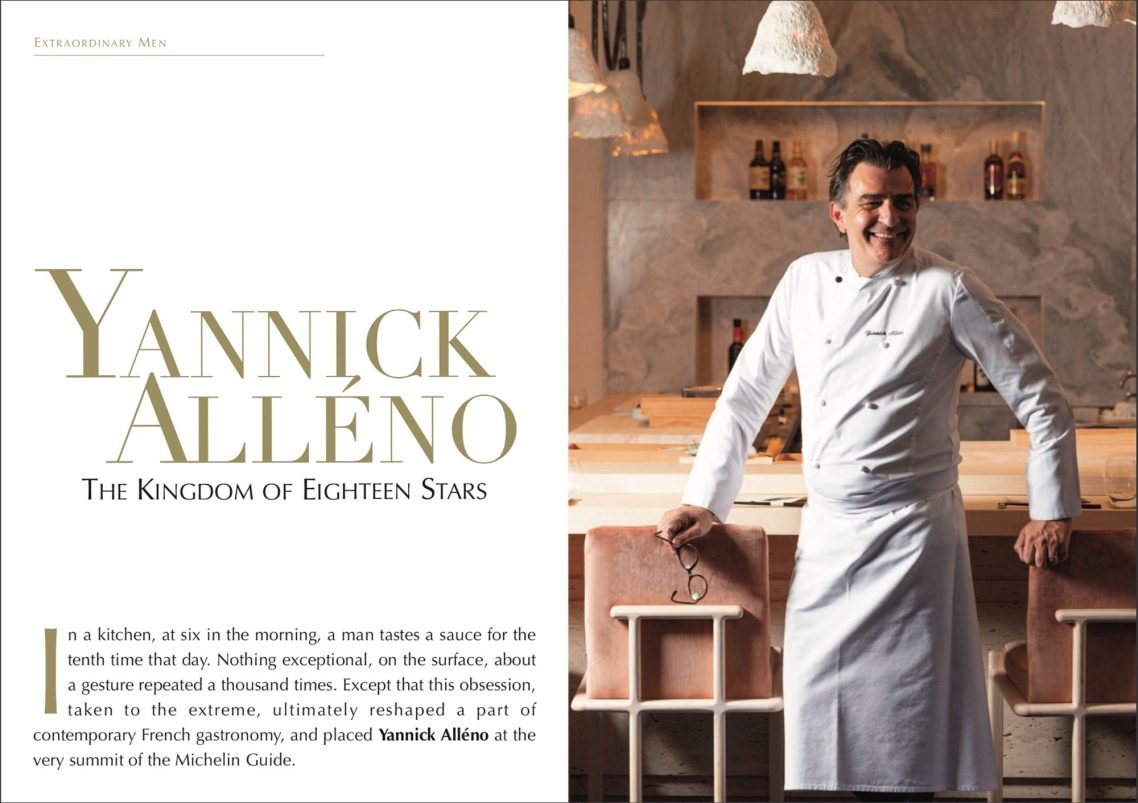
YANNICK ALLÉNO
The kingdom of eighteen Stars
In a kitchen, at six in the morning, a man tastes a sauce for the tenth time that day. Nothing exceptional, on the surface, about a gesture repeated a thousand times. Except that this obsession, taken to the extreme, ultimately reshaped a part of contemporary French gastronomy, and placed Yannick Alléno at the very summit of the Michelin Guide. Eighteen stars, as of March 2026, a figure that makes him one of the two most decorated chefs in the world. A reign built not in the spotlight, but in the goldsmith-like refinement of an element long thought exhausted: sauce, that nineteenth-century legacy he has turned into an almost scientific discipline, where extraction and fermentation have
replaced age-old recipes.
The Dior Gamble Seven months, that's how long it took the restaurant Monsieur Dior, on Avenue Montaigne in Paris, to earn its first star in the Michelin Guide 2026. An unprecedented union between a century-old couture house and a chef who, until now, had never set foot in the world of fashion in quite this way. The symbolism was lost on no one. Christian Dior, an astrology enthusiast and great lover of fine tables, would surely have appreciated the irony of the timing: eighty years after the house's founding on Avenue Montaigne in Paris, it is gastronomy that now crowns the myth. In entrusting the kitchens of its Parisian flagship to Alléno, LVMH was not simply looking for a chef. It was looking for a signature. Alléno also oversees Café Dior and the pâtisserie Le Jardin, within the same historic boutique, a gourmet triptych conceived as an extension of the house's wardrobe.
The Architect of Sauces The paradox is worth pausing on: here is a French chef who has turned sauce, that thing Anglo-Saxons readily suspect of masking a dish's mediocrity, into the very instrument of his precision. A way, almost, of proving them wrong with elegance. His group, founded in 2008 with Florence Cane, now traces a singular geography of global luxury: Courchevel, Seoul, Dubai, Marrakech, Beijing, and London, where he set up on the edge of Hyde Park in 2023. Twenty-one establishments, a thousand employees, ten starred tables in 2026 alone. Yannick Alléno: by the Numbers 18 Michelin stars (March 2026) 21 establishments worldwide 1,000 employees 10 starred restaurants in 2026 The Year Everything Accelerates 2026 sets an unprecedented pace for the chef. He takes over the gastronomic reins of COMO Le Beauvallon in Saint-Tropez, one of the season's most anticipated hotel openings, and becomes executive chef of the Orient Express Corinthian, billed as the largest sailing cruise ship ever built, a sign that a legendary yacht is now also judged by its table. Y
et those close to him describe a man who is surprisingly approachable, almost shy in the face of honors, more at ease behind a saucepan than in front of a camera. « Together, we form a true constellation of stars, endlessly pushing the boundaries of excellence. » Yannick Alléno What Remains to Be Written At fifty-seven, Yannick Alléno is tracing a path where the culinary gesture is no longer an end in itself, but a language for saying something else: transmission, memory, perhaps even a form of repair.
One question remains, one that even eighteen stars cannot settle: how far can a man push the boundaries of his art before the art itself becomes the only possible refuge? For Yannick Alléno, the answer seems to be written, season after season, in a kitchen.
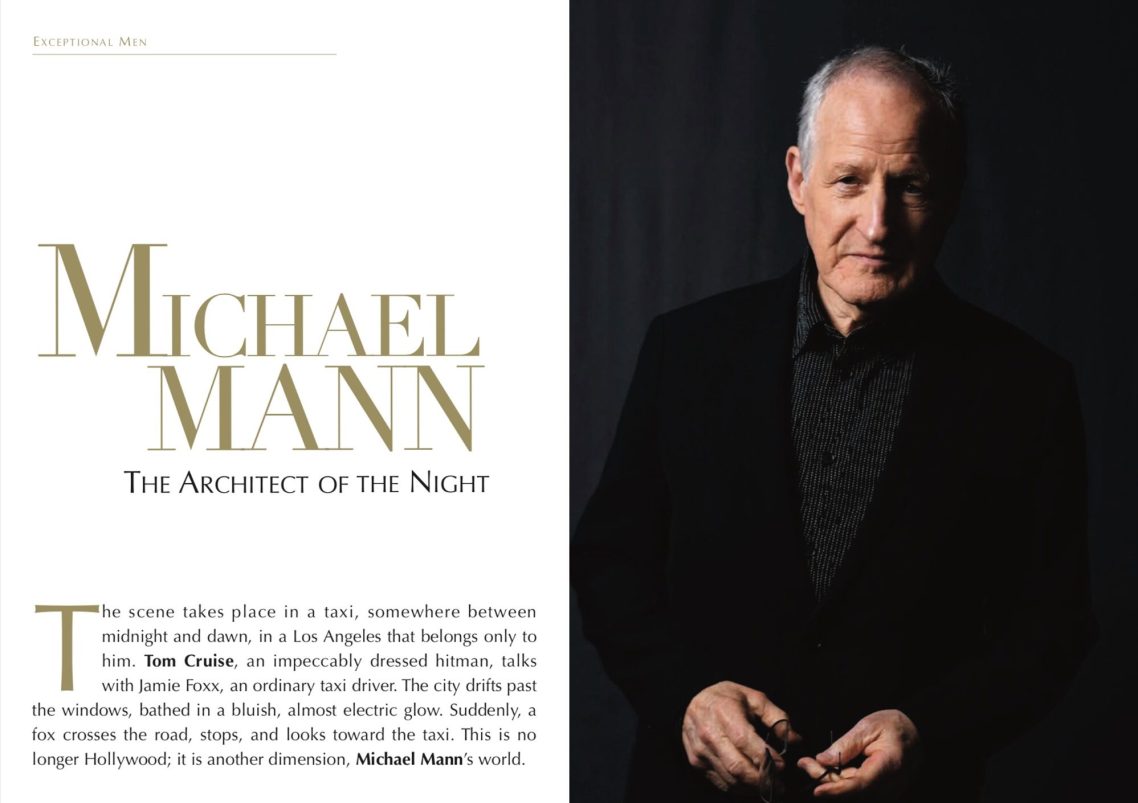
MICHAEL MANN
The Architect of the night
The scene takes place in a taxi, somewhere between midnight and dawn, in a Los Angeles that belongs only to him. Tom Cruise, an impeccably dressed hitman, talks with Jamie Foxx, an ordinary taxi driver. The city drifts past the windows, bathed in a bluish, almost electric glow. Suddenly, a fox crosses the road, stops, and looks toward the taxi. This is no longer Hollywood; it is another dimension, Michael Mann’s world. For more than forty years, this American filmmaker has transformed cinema into a moving art gallery. His films are not simply watched: they are contemplated. Heat, Collateral, The Insider, Ferrari… Each title is a promise fulfilled: an aesthetic so precise, so obsessive, that it becomes a character in its own right.
The Painter of Neon Michael Mann composes every frame as though it were a canvas, every light a brushstroke. In Heat, his 170-minute crime epic in which Al Pacino and Robert De Niro face each other in a silent duel, the director imposes a palette of cold blues and urban greys that gives Los Angeles an almost unreal atmosphere. The streets are not illuminated: they are sculpted. Mann has perfected this visual signature over the decades. He works with the same cinematographers, Dante Spinotti, Dion Beebe, much like a conductor returning to his musicians. “I’ve developed a family within the camera,” he once said. A family that understands that, for Mann, technique is never an end in itself. It serves a single ambition: to transport the audience. In the masterpiece Collateral, he pushes the experience even further. One of the first major feature films to be shot extensively in high-definition digital, the film captures the night like nothing that had come before it. “You can’t capture the night on film in the same way you can with digital video,” Mann explains. The proof lies in those scenes where faces are barely illuminated, where the city becomes an impressionist painting of neon and shadow.
“I don’t make much distinction between genius design, engineering, athletic performance and great works of art; it’s all the human nervous system seen from the inside out.” Michael Mann The Obsession with Detail What stands out about Mann is his ability to transform the ordinary into the sublime. A highway at 3 a.m., an empty Chinese restaurant, an underground parking garage, nothing is incidental, everything is intentional. Take the iconic shootout scene in Heat: Mann refused to rely on sound effects added in post-production. The gunshots? They were recorded live on set. The result: a raw, almost violent realism that hits like a slap in the face. Neighbors called the police during filming, convinced that a real shootout was taking place. Mann pushes this pursuit of authenticity to the extreme. For The Insider, he delves into the ruthless world of the tobacco industry. For Ali, he follows Muhammad Ali for months, capturing not the myth, but the man. For Public Enemies, he recreates 1930s Chicago with the precision of a historian. Michael Mann shot Collateral using Thomson Viper FilmStream cameras, a technology that was revolutionary at the time.
The film helped pave the way for a new era of digital cinema, proving that HD could rival 35mm film, and even surpass it in certain lighting conditions. The Mann Paradox Michael Mann makes action films, yet his most memorable sequences are often the quietest. In Heat, the diner scene between Pacino and De Niro, two mortal enemies sharing a cup of coffee, is more intense than any car chase. In Collateral, the conversations inside the taxi between two killings create an almost unbearable tension. Mann is not trying to impress. He is trying to penetrate. “My aspiration is to transport the audience,” he says. “If I fail, that’s acceptable. But I’m not interested in creating filmed theater or simple storytelling.” He sums up this philosophy through a surprising analogy: architecture.
To Mann, a film is a structure in which every element, color, object, sound, light, influences the whole. “Everything in a film is part of the whole and acts upon it,” he explains. An almost scientific approach, yet one placed entirely at the service of pure emotion.. The Legacy of a Visionary Born in 1943 in Chicago, Mann first worked in television before making his mark on the big screen with Thief (1981), his first feature film. Miami Vice, which he produced, became a cultural phenomenon in the 1980s. Since then, he has never stopped pushing the boundaries. His Influence? Immense. Filmmakers such as Christopher Nolan, Denis Villeneuve, and Nicolas Winding Refn have openly acknowledged their debt to Mann. That aesthetic of urban neo-noir, those cold colors, that light that seems to come from nowhere, all of it is part of his legacy. And yet Mann remains discreet. No bombastic statements, no obsessive presence on social media. He works, he prepares, he shoots, and then waits for the audience to come to him. Michael Mann in Numbers 4 Oscar nominations 12 feature films directed over more than 40 years of career 1 Emmy Award for The Jericho Mile (1979) More than $2 billion in cumulative worldwide box-office revenue Beyond the Image In Ferrari, his latest film to date, Mann returns to his recurring themes: excellence, obsession, and the pursuit of transcendence. “It is a universal human aspiration to surpass our current limits,” he observes when speaking about motor racing, a reflection that applies just as much
to his own work.
Because ultimately, Michael Mann does not film stories. He films states of being. Moments suspended between two breaths. Instants in which everything can change. And perhaps that is where his true genius lies: in his ability to transform cinema into a fully immersive sensory experience. Not in the technique, not in the lighting, but in his unwavering conviction that every image must matter, that every second must be felt. The next time you watch a Michael Mann film, don’t look only for the story.
Watch the light. Listen to the silence between the dialogue. Observe how the city becomes a character. You will never see Los Angeles, Chicago, or Miami in quite the same way again. And that, perhaps, is his greatest talent.
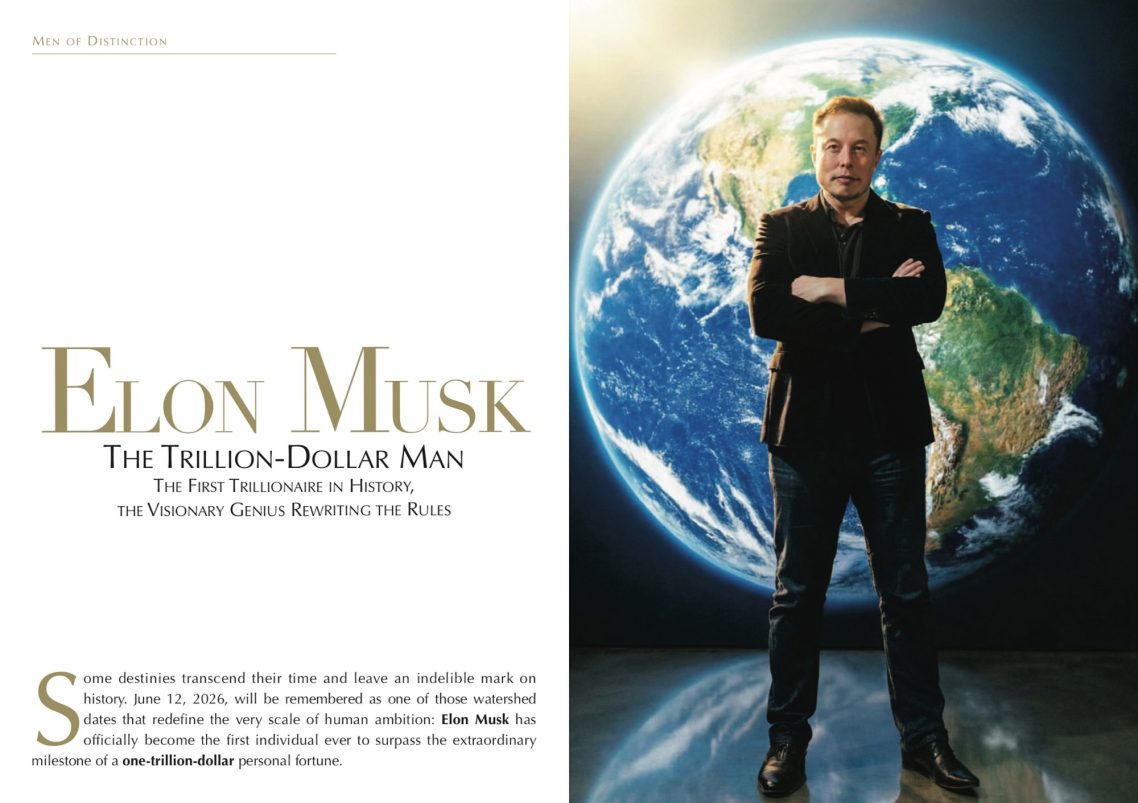
ELON MUSK
The Trillion Dollar Man
Some destinies transcend their time and leave an indelible mark on history. June 12, 2026, will be remembered as one of those watershed dates that redefine the very scale of human ambition: Elon Musk has officially become the first individual ever to surpass the extraordinary milestone of a one-trillion-dollar personal fortune. There are figures so staggering as to seem almost abstract , and yet this one is very real. The man who, as a child, dreamed of conquering Mars through the pages of science-fiction novels has now accomplished on Earth what no one else had even dared to imagine.
A Historic Day on Nasdaq Everything unfolded on June 12, 2026, with the long-awaited listing of SpaceX on the Nasdaq — the most eagerly anticipated financial event in years and, without question, the most spectacular in the history of the markets. Trading under the ticker symbol SPCX, with an initial offering price of $135 per share, SpaceX raised $75 billion in a single session, shattering the previous world record set in 2019 by Saudi Aramco and reaching an overall valuation of $1.75 trillion. To grasp the magnitude of this achievement, one need only observe that only three American corporations, Apple, Microsoft and Nvidia, currently boast market capitalizations exceeding $2 trillion. From its very first trading day, SpaceX entered the exclusive club of the world's corporate giants.
As markets opened on that historic Friday, Elon Musk's personal fortune, previously estimated by Forbes at $835 billion, crossed the symbolic trillion-dollar threshold, reaching $1.2 trillion according to the American magazine's estimates. For the first time in the history of modern capitalism, a single individual controls wealth comparable to the entire gross domestic product of Switzerland or Poland. More striking still, his fortune is worth three times the value of the gold reserves held by the Banque de France. The speed of this ascent is nothing short of astonishing. At the end of 2024, Musk's net worth stood at "only" $400 billion. In just eighteen months, he has nearly tripled his wealth — an achievement without precedent in the history of global capitalism. SpaceX: The Odyssey of a Visionary To understand Elon Musk, one must first understand SpaceX. Founded in 2002, at a time when many scoffed at the Silicon Valley billionaire's ambition to privatize space exploration, Space Exploration Technologies Corp. has become far more than an aerospace company.
It is, in itself, an industrial revolution. Where government agencies once required decades and hundreds of billions of public dollars to send humans into space, SpaceX reinvented the economics of the sector by pioneering reusable rockets, reducing the cost of access to orbit by a factor of ten. Its Falcon 9 launch vehicles, whose first stages return to Earth with almost choreographic precision, have transformed what was once considered a technological feat into an industrial routine. Starlink, the high-speed satellite constellation that now spans virtually the entire globe, generates enormous commercial revenues and has become the company's true financial engine. From the most remote regions of Africa to the battlefields of Ukraine, Starlink has redefined global connectivity, an ambition that is at once commercial, geopolitical and humanitarian. With the integration of xAI, its artificial intelligence division, SpaceX now stands at the crossroads of the defining revolutions of the twenty-first century: space, artificial intelligence, defense and planetary connectivity. The filing of its S-1 prospectus on May 20, 2026, officially marked the transformation of an aerospace enterprise into a genuine twenty-first-century technological conglomerate.
More than a company, SpaceX embodies Elon Musk's grand vision: to push back the frontiers of what humanity considers possible. What once appeared to be the dream of an eccentric entrepreneur has evolved into one of the most formidable engines of innovation and value creation the modern world has ever witnessed. An Empire of Many Faces Elon Musk’s greatness lies precisely in his relentless refusal to confine himself to a single field. Where others might have capitalized on a success and settled into it, he has consistently reinvested his gains into high-stakes bets on the future. Tesla, which he took over in 2004 when the company was still in its infancy, has become the global symbol of the automotive energy transition. Musk did not merely build electric cars: he made electric mobility desirable, and ultimately inevitable, forcing the entire global automotive industry to reposition itself. The Tesla Model S proved that a clean vehicle could be an object of absolute desire; the Supercharger network created the infrastructure that governments struggled to envision; and the development of autonomous driving is, before our eyes, shaping the mobility of tomorrow. Neuralink explores the outer limits of brain–computer interfaces, with the declared ambition of merging human and artificial intelligence in preparation for a future in which humanity coexists with advanced AI. The Boring Company is reimagining underground transportation in major American cities. xAI, created to compete with OpenAI and Google in the field of generative artificial intelligence, has rapidly emerged as one of the most influential players in an industry undergoing explosive transformation.
And then there is X, formerly Twitter, acquired by Musk in 2022 and reshaped into what he describes as the “digital public square” of our era, sitting at the crossroads of information, finance, and global political discourse. From a Childhood Bedroom in Pretoria to the Top of the World Elon Musk’s personal journey reads like a novel in itself. Born on June 28, 1971, in Pretoria, South Africa, into a household whose tensions he has never concealed, he found early refuge in books, science fiction, encyclopedias, and computer manuals. At the age of twelve, he sold his first video game, which he had coded himself. At seventeen, he left South Africa, spent time in Canada, and later enrolled at the University of Pennsylvania, where he earned dual degrees in economics and physics. It was during the first wave of the internet boom in the late 1990s that he made his initial fortunes. Zip2, his web software company co-founded with his brother Kimbal, was acquired by Compaq for $307 million in 1999. With his share of the proceeds, Musk went on to found X.com, an online banking venture that later merged with Confinity to form PayPal, which was sold to eBay in 2002 for $1.5 billion.
He could have stopped there, enjoyed a life of luxury, and joined the discreet pantheon of Silicon Valley entrepreneurs. But that was never in his nature. Instead, he immediately reinvested nearly all of his fortune into two seemingly impossible ideas: electrifying the automobile industry with Tesla, and privatizing space with SpaceX. Both nearly ruined him. And yet, both ultimately triumphed. The Genius of Risk and Long-Term Vision What fundamentally distinguishes Elon Musk from the entrepreneurs of his generation is his singular relationship with risk, not as a constraint to be minimized, but as the very fuel of innovation itself. Where established corporations optimize quarterly margins, Musk thinks in decades, even centuries. His deep conviction that humanity must become a multiplanetary species in order to ensure its long-term survival is not a marketing argument. It is a civilizational project that guides every one of his investment decisions, from the design of Starship, the most powerful rocket ever built, to SpaceX’s Martian ambitions, now newly empowered by its recent public listing. He is also one of the very few entrepreneurs capable of attracting world-class talent around him, instilling in them a culture of radical rigor, the so-called “first principles” approach, which consists in resetting assumptions entirely rather than merely improving what already exists, and sustaining a pace of innovation that both public and private competitors struggle to match.
A Symbol of a New Era Elon Musk embodies a new form of excellence, one that is no longer measured solely in watches, yachts, or palaces, but in ambitions of a truly cosmic scale. He is the man redefining what it means to “succeed” in the 21st century: not to accumulate, but to transform. His empire, valued at unprecedented levels in the history of capitalism, is not the product of chance, inheritance, or speculation. It is the result of relentless willpower, a long-term vision pursued to the point of obsession, and a rare ability to turn abstraction into industrial reality. On June 12, 2026, by crossing the symbolic threshold of one trillion dollars, Elon Musk not only set a financial record; he also drew the horizon line of what human ambition can achieve when it refuses to be constrained by the conventional limits of imagination.
History will remember this day as the moment when a man, starting from almost nothing, quite literally changed the scale of wealth, and with it, perhaps, the scale of our collective dreams.
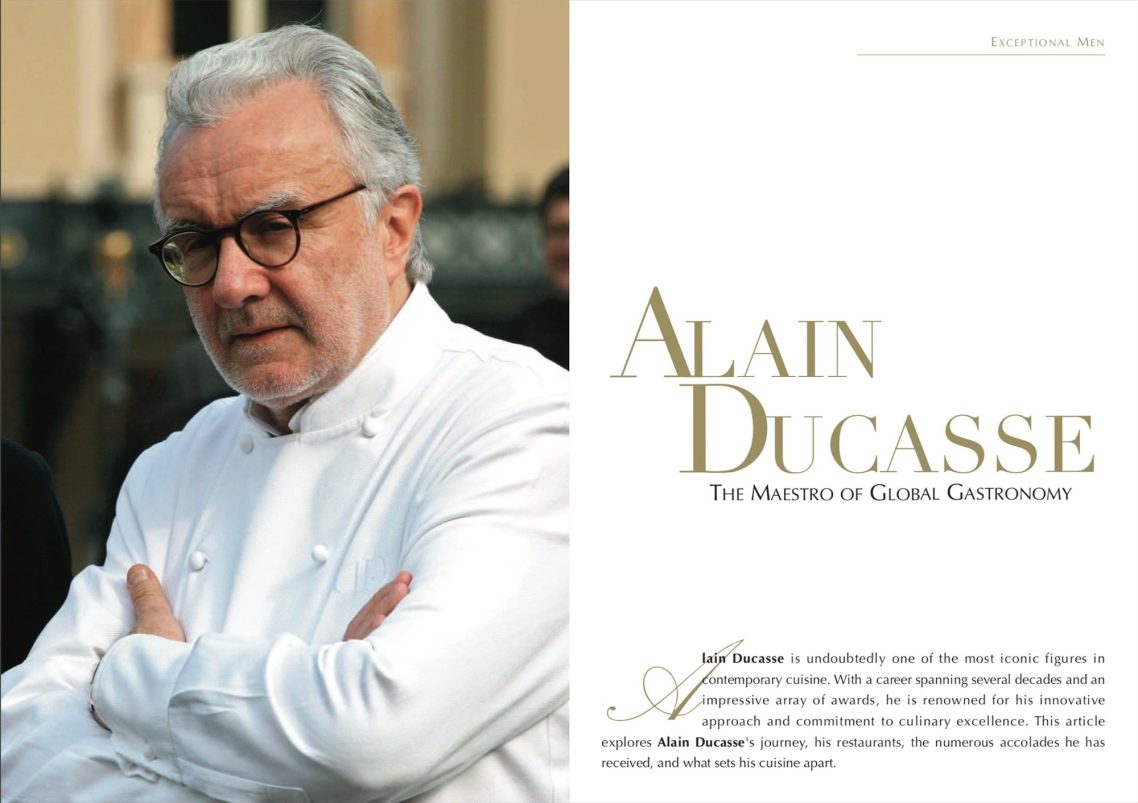
ALAIN DUCASSE
The Maestro of global Gastronomy
Alain Ducasse is undoubtedly one of the most iconic figures in contemporary cuisine. With a career spanning several decades and an impressive array of awards, he is renowned for his innovative approach and commitment to culinary excellence. This article explores Alain Ducasse's journey, his restaurants, the numerous accolades he has received, and what sets his cuisine apart.
A Dazzling Career.
Born on September 13, 1956, in La Palue, in the southwest of France, Alain Ducasse comes from a modest family. He began his culinary training in the kitchens of his hometown before studying at renowned establishments such as the École de Cuisine de Nice and the Lycée Hôtelier de Toulouse. His rise in the world of gastronomy truly began when he became the chef at Louis XV in Monaco in 1987. Under his leadership, the restaurant earned three Michelin stars, an achievement that catapulted Ducasse into the international stage. A Network of Must-Visit Restaurants The Alain Ducasse Group is now a culinary empire with restaurants located around the globe. Here are some of its most renowned creations: Louis XV – Alain Ducasse at the Hôtel de Paris (Monaco): This three-Michelin-star restaurant, founded in 1987, is where Alain Ducasse made his prestigious debut. It is renowned for its refined approach to classic French cuisine. Alain Ducasse at Plaza Athénée (Paris): Located in the heart of the French capital, this three-Michelin-star restaurant is famous for its modern and creative cuisine.
It reflects Ducasse’s philosophy with dishes crafted from the finest local ingredients. Le Meurice (Paris) : his Michelin-starred restaurant is another example of Ducasse’s culinary excellence, offering refined French cuisine in an elegant setting. Benoit (Paris): This traditional bistro, acquired by Ducasse, embodies classic French cuisine in a more casual atmosphere. Alain Ducasse at The Dorchester (London): This restaurant offers contemporary French cuisine and has been widely praised for its culinary innovation. Oteiza (Tokyo): A destination for fans of contemporary Basque cuisine, reflecting Ducasse’s international influence. A Collection of Awards Alain Ducasse has received numerous awards and honors that testify to his influence in the culinary world: Three Michelin Stars for several of his restaurants, including Louis XV and Alain Ducasse at Plaza Athénée. Best Chef in the World: His restaurant El Celler de Can Roca, ranked among the world's top restaurants, has frequently topped the World's 50 Best Restaurants list. Legion of Honor: In 2015, Alain Ducasse was awarded the Legion of Honor, one of France's most prestigious distinctions.
What Sets Him Apart What distinguishes Alain Ducasse in the world of gastronomy is his ability to blend innovation with tradition. His cuisine is characterized by a meticulous approach to ingredients and a constant quest for perfection. Here are some key aspects of his culinary style: Respect for Ingredients: Alain Ducasse takes great care to use the highest quality ingredients, often sourced from local producers or chosen with rigorous standards. Minimalist Cuisine: His culinary philosophy is often described as minimalist, favoring the purity of flavors and simplicity in presentation.
Creativity and Innovation: Alain Ducasse is known for his ability to reinvent classics and introduce innovative techniques into his dishes. Sustainable Commitment: He has also been a pioneer in adopting sustainable and ethical practices, emphasizing the importance of environmental responsibility in cuisine. Alain Ducasse is a central figure in the world of gastronomy, leaving his mark both through his technical expertise and his sense of innovation.
With an impressive network of restaurants and a remarkable collection of awards, he continues to set the standards for culinary excellence on a global scale.
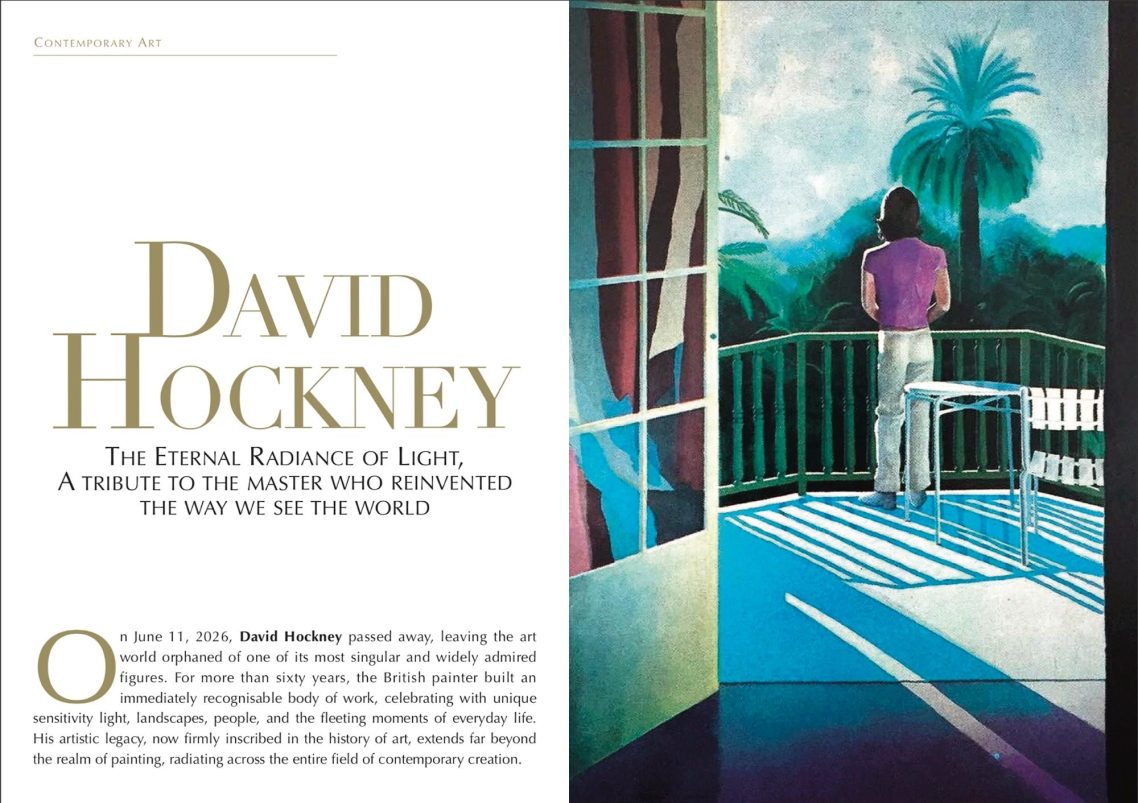
DAVID HOCKNEY
The eternal radiance of light
On June 11, 2026, David Hockney passed away, leaving the art world orphaned of one of its most singular and widely admired figures. For more than sixty years, the British painter built an immediately recognisable body of work, celebrating with unique sensitivity light, landscapes, people, and the fleeting moments of everyday life. His artistic legacy, now firmly inscribed in the history of art, extends far beyond the realm of painting, radiating across the entire field of contemporary creation. With his passing at the age of 88, a certain idea of colour, freedom, and the joy of painting now enters posterity.
For David Hockney never ceased to look at the world with the wonder of a man convinced that beauty can be found everywhere, within familiar landscapes as much as in the most ordinary scenes. Born in Bradford, Yorkshire, on July 9, 1937, Hockney emerged in the 1960s as one of the leading figures of British Pop Art. Yet very quickly, his universe extended beyond the boundaries of any movement to which he could ever truly be confined.
A virtuoso draftsman, printmaker, photographer, set designer, and passionate experimenter, he devoted his life to pushing the limits of representation. His move to California in the mid-1960s marked one of the major turning points of his career. Fascinated by the radiant light of Los Angeles, its modernist architecture, and the hedonistic lifestyle of the American West Coast, Hockney developed an immediately recognisable aesthetic.
Unreal blue swimming pools, clean-lined villas, lush vegetation, and immaculate skies compose a world bathed in an almost cinematic luminosity. Among the most emblematic works of this period is A Bigger Splash (1967), now considered one of the iconic images of the 20th century. With its turquoise pool pierced by the dramatic explosion of a diving splash, the painting became a symbol of an idealised California, immortalised through the artist’s singular gaze. Another major masterpiece, Portrait of an Artist (Pool with Two Figures) (1972), remains one of the most celebrated works in recent art-market history.
In November 2018, it was sold at Christie’s for more than 90 million dollars, setting a world record at the time for a work by a living artist. This spectacular sale cemented Hockney’s exceptional standing among the greatest creators of his era. His double portraits, notably Mr and Mrs Clark and Percy (1970–1971), his Yorkshire landscapes, his vast Norman panoramas, as well as his series devoted to the arrival of spring, bear witness to a creativity that remained intact until his final years.
Having settled in France, in Normandy, since the late 2010s, the painter found in the French landscape a renewed source of inspiration, producing works of extraordinary vitality that celebrate the metamorphoses of nature and the cycle of the seasons. What distinguishes David Hockney from many contemporary artists is also his ability to embrace technological innovation without ever renouncing the essence of his art. Far from confining himself to traditional techniques, he was one of the first major painters to explore the possibilities offered by photography, photo- collages, and later digital tools, going so far as to create works on the iPad that were subsequently exhibited in the world’s leading museums. His exceptional market value reflects the admiration he commands from collectors and institutions alike.
Sales organised by Christie’s, Sotheby’s, or Phillips regularly rank among the most significant on the international art market, while his works are included in the permanent collections of the world’s greatest museums, from the Tate Britain to the Centre Pompidou, from the Metropolitan Museum of Art in New York to the Guggenheim Museum. But beyond records and figures, David Hockney’s legacy lies above all in a profoundly humanist artistic philosophy. At a time when contemporary art has sometimes drifted away from the general public’s gaze, he never ceased to defend the joy of seeing, the emotional power of colour, and the importance of observing the real world. His paintings celebrate light, friendship, love, landscapes, and the beauty of everyday life. They remind us that a work of art can be both scholarly and accessible—deeply modern while remaining timeless.
His influence now extends far beyond painting. Photography, design, interior architecture, fashion, and even digital arts all bear the imprint of his luminous aesthetic and creative freedom. Few artists have exerted such a profound influence across multiple generations of creators. David Hockney leaves behind an immense body of work and a gaze that has changed the way we perceive the world. His iconic swimming pools, his deeply human portraits, his radiant landscapes, and his inexhaustible love of colour will continue to inhabit the collective imagination long after his time. For some artists mark their century. Others, more rarely, transcend time itself.
David Hockney unquestionably belongs to this second category: that of masters whose work, carried by light and joy, seems destined for eternity.
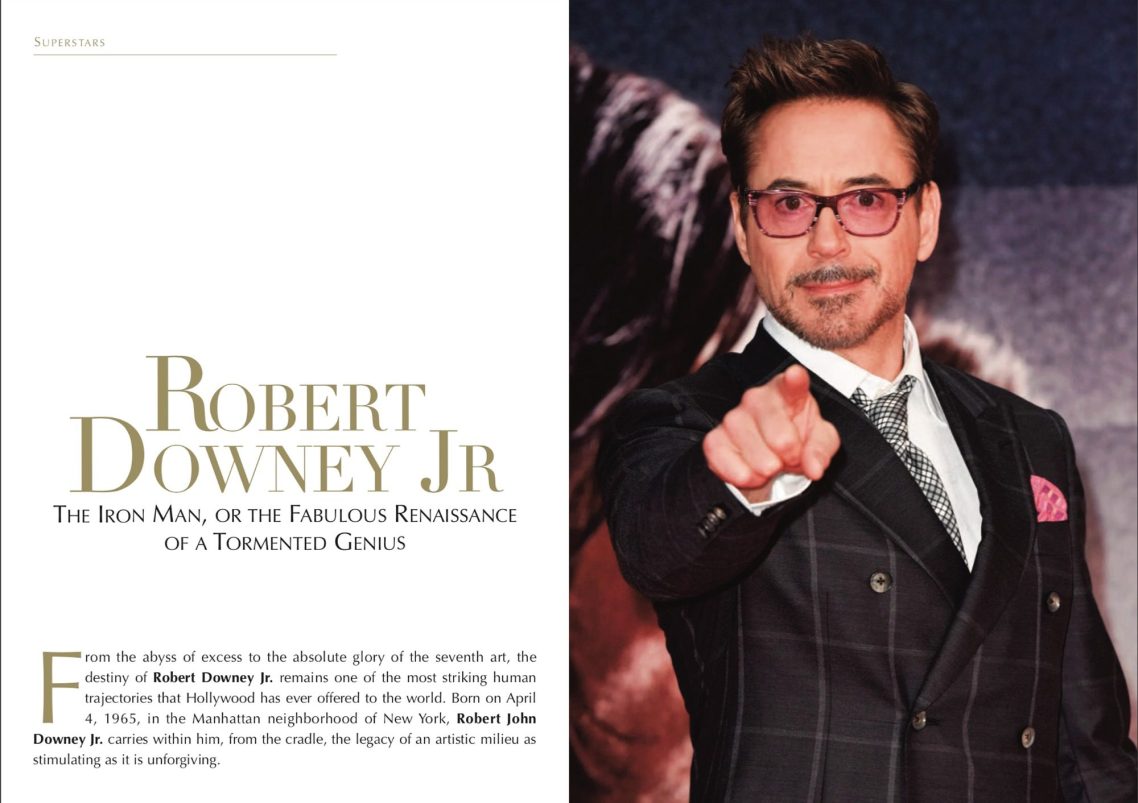
ROBERT DOWNEY JR
The Iron Man, or the fabulous renaissance
of a tormented genius
From the abyss of excess to the absolute glory of the seventh art, the destiny of Robert Downey Jr. remains one of the most striking human trajectories that Hollywood has ever offered to the world. Born on April 4, 1965, in the Manhattan neighborhood of New York, Robert John Downey Jr. carries within him, from the cradle, the legacy of an artistic milieu as stimulating as it is unforgiving. His father, Robert Downey Sr., an avant-garde filmmaker and figure of American independent cinema in the nineteen-sixties, introduced him to a film set at the age of five, casting him in his film Pound (1970).
His mother, Elsie Ann Ford, was herself an actress. The child thus grew up behind the scenes of a world where artistic creation intertwined with a sometimes disorderly bohemian lifestyle. It is in this particular soil that the young Robert's all-consuming passion for acting took root. A turbulent teenager, he dropped out of school at seventeen to follow his father to Los Angeles and devote himself fully to his calling. Auditions followed one after another, as did small roles, and one could very quickly perceive in this young man, with his singularly intense gaze, a flame that the silver screen could only amplify. Early Rise & First Brilliance An Undisciplined Talent Embracing Extremes Robert Downey Jr.'s career truly took off in the mid-nineteen-eighties, when his charismatic presence and subtly nuanced acting propelled him to the rank of a rising hope of American cinema. He joined the legendary cast of Saturday Night Live in 1985, a brief but revealing experience.
Then came the iconic films of the Brat Pack generation: Tuff Turf (1985), Weird Science (1985), and above all Less Than Zero (1987), in which he portrayed a character consumed by drug addiction — a role that foreshadowed, with troubling irony, the personal trajectory of its performer. The artistic apotheosis of this first period arrived in 1992, when Richard Attenborough entrusted him with the title role in Chaplin. Downey Jr. delivered a performance of rare precision and sensitivity, inhabiting with unsettling genius the body and soul of Charlie Chaplin across several decades.
he Academy of Motion Picture Arts and Sciences granted him his first Academy Award nomination for Best Actor — belated recognition of a talent that had, however, surprised no one in the industry. He also received the BAFTA Award for Best Actor for that same role, singled out by the discerning eye of the British Academy. The Wilderness Years, The Hell of the Dark Years, 1996–2003 But behind the professional glory, a fire smoldered that nothing seemed capable of extinguishing. From the mid-nineteen-nineties onward, Robert Downey Jr. plunged into an abyss of dependencies — alcohol, cocaine, heroin — that kept him away from film sets and thrust him into courthouse corridors, then behind bars. In 1996, he was arrested in possession of drugs and a firearm. In 1999, the California justice system sentenced him to three years in prison, a sentence ultimately commuted to forced internment in a rehabilitation center. These years constitute the darkest chapter of a life otherwise rich in contrasts. Hollywood gradually turned its back on him; producers hesitated to hire an actor deemed unmanageable, and insurance companies refused to cover his productions. The fame once so easily acquired turned against him with a cruelty that only the world of entertainment knows how to unleash. Yet, in these depths, the actor did not surrender.
He struggled, relapsed, and struggled again, until a defining encounter came along to change everything. Private Life — Susan, the Anchor Who Saved Everything At the heart of Robert Downey Jr.'s renaissance stands a woman: Susan Levin, whom he met on the set of Gothika in 2003, where she was serving as executive producer. She was young, ambitious, possessed of a practical intelligence and a serenity that the turbulent actor had never before encountered on his path.
Their marriage, celebrated on August 27, 2005, marked a turning point as much existential as professional. Susan would go on to become the co-founder of Team Downey, their joint production company, but above all the emotional cornerstone without which this resurrection might never have taken place. With Susan, he is the father of two children: Exton Elias and Avri Roel. The family lives between a property in Malibu, valued at several tens of millions of dollars, and a ranch in Georgia, where they have chosen to raise their children far from the glare of the Hollywood spotlight. A devotee of Tibetan Buddhism and martial arts — most notably Wing Chun Kung Fu — and a vegetarian for several years, Robert Downey Jr. has profoundly transformed his relationship with his body and with food.
The Resurrection — Iron Man and the Marvel Empire: A Four-Billion-Dollar Renaissance In 2008, Jon Favreau made the most audacious decision of the decade by entrusting the role of Tony Stark to Robert Downey Jr. for Iron Man. The studios were skeptical, the insurers reluctant, but Favreau was unyielding: no one else possessed the aristocratic nonchalance, the razor-sharp humor, and the melancholic depth required to embody this brilliant and tormented billionaire.
The gamble was absolute. It would be crowned with a resounding victory. Iron Man grossed 585 million dollars at the worldwide box office and gave birth to one of the most lucrative franchises in the history of cinema: the Marvel Cinematic Universe. Over eleven years, from 2008 to 2019, Robert Downey Jr. portrayed Tony Stark in no fewer than ten productions, becoming the tutelary face of an unprecedented cinematic empire. His remuneration reached dizzying heights: for Avengers: Endgame (2019), he reportedly earned, according to the most reliable estimates, between 75 and 100 million dollars, performance bonuses included — making him the highest-paid actor in the history of cinema over that period. Tony Stark's final scene — that whispered "I am Iron Man" before the fatal snap of the fingers — immediately entered the pantheon of the seventh art. It is rare for an actor to succeed in weaving such an emotional bond with an audience as vast and as diverse.
You no longer see the work — you just see a human being. » — Robert Downey Jr., Screen Actors Guild Awards, 2020 Awards & Recognition — A Belated, Yet Total Consecration If the Hollywood Academy long seemed to keep Robert Downey Jr. at arm's length from its highest honors, the 2020s came to correct this injustice with a generosity that borders on official rehabilitation. Academy Award for Best Supporting Actor — Christopher Nolan's Oppenheimer (2024): after decades of waiting, the statuette finally arrived, in the hands of a visibly moved man, who received it with the dignity of those who have learned to be worthy of their victories. BAFTA Award for Best Supporting Actor — Oppenheimer (2024): the British confirmed their long-standing admiration for this actor whom they had already honored for Chaplin back in 1993. Golden Globe Award for Best Supporting Actor — Oppenheimer (2024): the third Golden Globe of his career, following those received for the television series Ally McBeal (2001) and for Sherlock Holmes (2010). Screen Actors Guild Award for Best Supporting Actor — Oppenheimer (2024): the vote of his peers, always the most meaningful in the eyes of industry professionals.
Academy Award nomination for Best Supporting Actor — Ben Stiller's Tropic Thunder (2009): a comic performance of an absolutely staggering level of mastery, in which he portrayed an Australian actor passing himself off as an African-American — a high-wire act that few others could have pulled off. BAFTA Award for Best Actor — Chaplin (1993): the first major international consecration, earned at the age of just twenty-seven. Fortune & Assets — Approximately 400 Million Dollars: The Price of a Renaissance Robert Downey Jr.'s fortune is estimated by financial analysts specializing in entertainment industry wealth at approximately 400 million dollars.
This figure, as impressive as it may be, is above all the reflection of an extraordinary professional trajectory: the fees from the Marvel franchise — which alone constitute the most substantial portion of this wealth — to which are added the revenues generated by Team Downey, the production company he co-runs with his wife Susan, as well as shrewd real estate investments in California and other American states. The Downey family lives in luxury but with relative discretion, in contrast to certain Hollywood peers whose ostentatious spending feeds the gossip columns. Susan, whose business acumen is unanimously praised throughout the industry, plays a central role in the management and preservation of this considerable wealth. Upcoming Projects — The Return of the Lord of Shadows: Doctor Doom in the MCU
The announcement that electrified the film world in July 2024 at San Diego Comic-Con remains, to this day, one of the most spectacular plot twists that Marvel Studios has ever orchestrated. Robert Downey Jr., whom many believed had definitively stepped away from the Marvel universe following Tony Stark's sacrificial death in Endgame, makes his grand return in the guise of an entirely new character: Victor Von Doom, also known as Doctor Doom, the most formidable and complex antagonist in the pantheon of Marvel Comics supervillains. This Doctor Doom will appear in Avengers: Doomsday (slated for 2026) and in Avengers: Secret Wars, under the direction of brothers Anthony and Joe Russo, who had already helmed Infinity War and Endgame. This return is no mere commercial reprise: it speaks to the absolute confidence that Marvel and Disney place in Robert Downey Jr. to embody the soul of a new era of their franchise. Moving from beloved hero to arch-villain constitutes a dramatic pivot of remarkable audacity — one that he alone, in all likelihood, can carry off with the necessary credibility. Furthermore, Team Downey is developing several production projects outside the Marvel universe, including adaptations of ambitious novels and series destined for streaming platforms.
The company, now established as a respected entity within the Hollywood landscape, embodies Robert Downey Jr.'s determination to leave a lasting mark on the industry — no longer solely as an actor, but as a creative force in his own right. Sixty years of existence, six decades marked by fire and grace, by excess and hard-won wisdom — Robert Downey Jr. is, at heart, the most accomplished mirror of an America that believes, against all odds, in redemption. Hollywood has never produced a truer story.
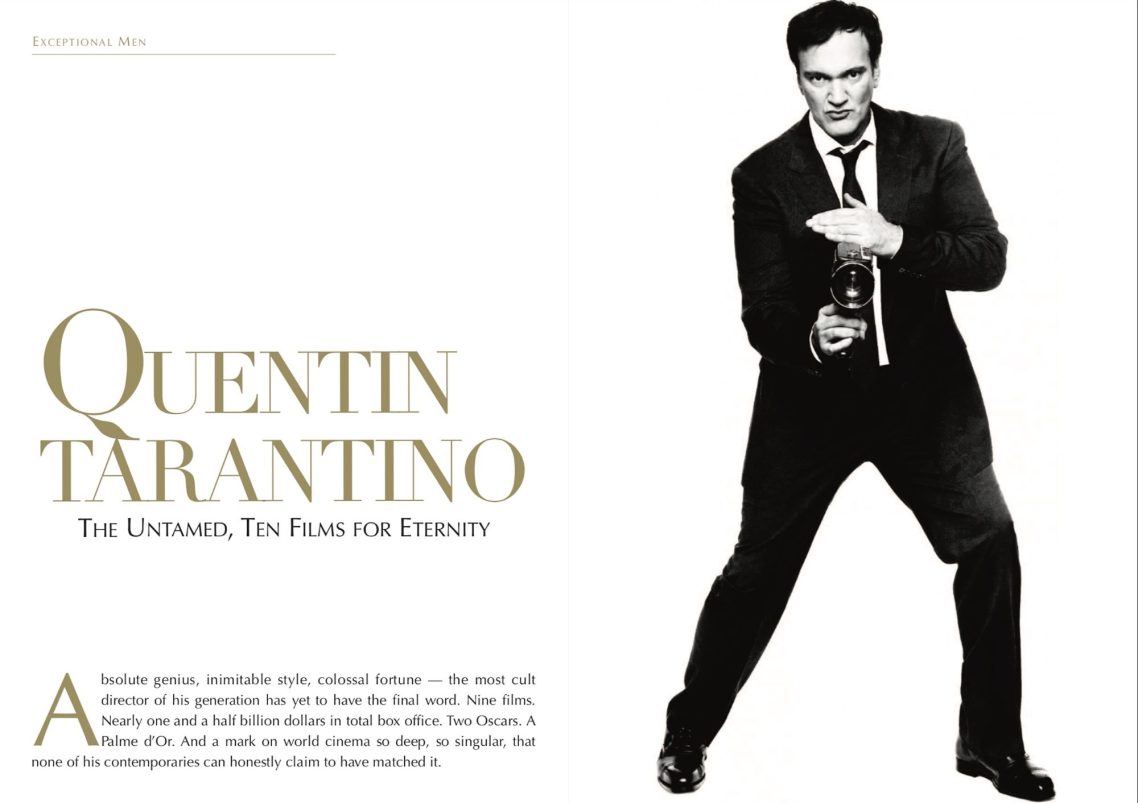
QUENTIN TARENTINO
The untamed, ten films for eternity
Absolute genius, inimitable style, colossal fortune — the most cult director of his generation has yet to have the final word. Nine films. Nearly one and a half billion dollars in total box office. Two Oscars. A Palme d’Or. And a mark on world cinema so deep, so singular, that none of his contemporaries can honestly claim to have matched it.
Quentin Tarantino is the cartographer of a parallel cinematic universe where violence becomes poetry, where dialogue carries the density of great literature, and where every frame reveals a visual culture of almost vertiginous erudition. In a Hollywood standardized by franchises, sanitized by reading committees, and lobotomized by market research, this enfant terrible from Knoxville, Tennessee, imposed his vision with the sovereign brutality of a cultural conquistador.
Thirty years after Reservoir Dogs, the world of cinema still belongs to him — and will for a long time to come. The Childhood of a Master: Birth of a Self-Taught Genius Born on March 27, 1963, in Knoxville, Tarantino grew up in the suburbs of Los Angeles, far from Hollywood’s gilded world, yet close enough to his dreams that he could almost touch them. His mother, Connie McHugh, raised him alone. His biological father, Tony Tarantino, a failed actor, would remain nothing more than an absence.
But where others might have fallen into resentment, the young Quentin built an inner cathedral: cinema. Hundreds, then thousands of films. Spaghetti westerns, Japanese B-movies, French crime films from the 1960s, Hong Kong kung fu classics—he consumed everything, digested everything, transformed everything into a unique raw material that the world would soon recognize as Tarantino-esque. At sixteen, he dropped out of high school. At twenty, he worked as a clerk at Video Archives in Manhattan Beach, a shadowy temple that would become legendary through him. No diploma, no connections, no film school internship.
Only a hunger for knowledge and an encyclopedic memory that would confound the greatest professors in the field. Jean-Luc Godard once said the best way to learn cinema is to watch it. Tarantino simply took that axiom literally and elevated it into an existential manifesto. The Work: A Parallel Galaxy at the Heart of Hollywood Reservoir Dogs (1992) — The Thunderclap Presented at the Sundance Film Festival on a modest $1.2 million budget, Reservoir Dogs shattered conventions like glass under impact.
No linear exposition, fractured time structure, surgically precise dialogue, and violence that is both stylized and visceral. Harvey Keitel, Tim Roth, Michael Madsen—men in black suits talking about Madonna and killing each other without warning. The film world immediately understood: something had just been born. Pulp Fiction (1994) — The Revolution Palme d’Or at Cannes. $213 million in global box office from an $8 million budget. Pulp Fiction is a cultural earthquake whose aftershocks are still felt three decades later. A resurrected John Travolta, a sublime Uma Thurman, a prophetic Samuel L. Jackson.
The non-chronological structure, long conversations about burgers and foot massages, heroin overdoses and Ezekiel quotations—scenes instantly etched into the collective memory of the Western imagination. Tarantino redefined what “cinema” can mean. Jackie Brown (1997) — The Subtle Tribute Often underestimated, this portrait of an African-American flight attendant caught between arms traffickers reveals the filmmaker’s emotional depth. Pam Grier, icon of Blaxploitation cinema, delivers the performance of her life.
Far from his usual explosive style, Tarantino signs his most human film, proving he is not only a showman of chaos but also a portraitist of the human soul. Kill Bill Vol. 1 & 2 (2003-2004) — The Bloody Opera Two films. One epic. Uma Thurman as a vengeful bride traverses continents to punish her executioners. Japanese influences, westerns, martial arts, anime—Tarantino conducts a ballet of destruction with the precision of a classical composer. Kill Bill grosses nearly $335 million worldwide and confirms that its creator is the only filmmaker capable of turning violence into pure visual poetry.
Inglourious Basterds (2009) — The Rewriting of History With an audacity bordering on insolence, Tarantino literally rewrites the Second World War. Adolf Hitler dies in a Paris cinema. The tension of the opening chapter—Christoph Waltz as Col. Hans Landa confronting a French farmer—is unanimously regarded as one of the greatest opening scenes in cinema history. Inglourious Basterds grosses $321 million worldwide. Christoph Waltz receives the Academy Award for Best Supporting Actor. Tarantino, for his part, receives the eternal gratitude of film lovers across the globe. Django Unchained (2012) — Revenge with a Capital R A freed slave, a German bounty hunter, and a Mississippi plantation.
Django Unchained is a fable about dignity, freedom, and vengeance, wrapped in the flamboyant attire of the spaghetti western. $425 million in worldwide box office—the highest commercial success of Tarantino’s career. Jamie Foxx and Christoph Waltz light up the screen, while Leonardo DiCaprio, as a sadistic slave owner, delivers a chilling counter-performance. Second Oscar for Tarantino—for Best Original Screenplay. The Hateful Eight (2015) — The Dark Room Eight strangers. A refuge. A blizzard. And unspeakable secrets. Shot in 70mm in a claustrophobic, locked-room atmosphere, The Hateful Eight is perhaps his most formally ambitious film—a reflection on trust, betrayal, and the foundational violence of America.
Once Upon a Time… in Hollywood (2019) —The Love Letter Winner of the César for Best Foreign Film and awarded the Best Screenplay Prize at Cannes, this melancholic portrait of Hollywood in 1969 stands as the most personal and nostalgic film of his career. Leonardo DiCaprio and Brad Pitt are absolutely commanding. Once again, Tarantino rewrites history. The Style: An Unmistakable Cinematic DNA What sets Tarantino apart is the radical impossibility of imitating him without being instantly exposed. His style is a genetic imprint. First, the dialogue. Endless, digressive, exuberant—people talk about everything except what they seem to be talking about.
Pop culture brushes up against moral philosophy, street slang flirts with classical literature. His characters have conversations real people wish they could have, delivered with disarming naturalism and jeweler-like precision. Then, the soundtrack. Tarantino never relies on a dedicated composer for original scores—he draws from the history of popular music with the nose of a perfumer and the audacity of a DJ. Chuck Berry, Ennio Morricone, David Bowie, Al Green—the songs in his films are full-fledged characters in their own right. Finally, violence. Stylized but never gratuitous, it acts as a revelation—it exposes what characters truly are beneath social decorum.
Tarantino treats it with the same calm as a Flemish painter handling still life. The Fortune: Figures of an Empire The most serious estimates place Quentin Tarantino’s personal fortune between $100 and $120 million. A sum that reflects not only the phenomenal commercial success of his films—whose global cumulative box office comfortably exceeds $1.5 billion—but also royalties, publishing deals, screenplay sales, and the cultural asset value of a living legend. His income as director, producer, and screenwriter has made him permanently independent from the studio system. He negotiates his films on his own terms—no imposed final cut, no creative constraints, no financial executives dictating the length of his credits.
This absolute freedom, rare in the industry, is perhaps the greatest wealth he has accumulated. Private Life: Love as a Late Revelation Long considered a confirmed bachelor—devoted to his films the way others are to their family—Tarantino experienced, late but decisively, the revelation of marital love. In 2018, at the age of 55, he married Daniella Pick, an acclaimed Israeli singer and the daughter of legendary musician Svika Pick, a towering figure in Israeli pop since the 1970s. The couple has two children: Leo, born in February 2020, and Juniper, born in May 2022.
Those who have known Tarantino since the 1990s unanimously describe a profound transformation. The once obsessive, nocturnal man, entirely consumed by his art, has become a father with a tenderness and seriousness he never previously displayed in public. “He became someone else, for the better,” confides a close acquaintance. Fatherhood, it seems, has made him even greater. Israel: A Life Choice, a Commitment of the Heart Since his marriage to Daniella Pick, Quentin Tarantino has divided his life between Los Angeles and Tel Aviv, where the couple owns a residence. But this is no mere luxury pied-à-terre—it is a genuine anchoring, fully embraced and openly acknowledged. Tarantino has learned Hebrew.
He engages with Israeli cultural circles with curiosity and respect. He has been received as a major figure of international culture in a country whose citizen he married, but also, as he puts it, “its soul.” His connection to Israel has extended beyond marriage into a public stance. Following the terrorist attacks of October 7, 2023—one of the darkest tragedies in the country’s recent history—Tarantino expressed his solidarity in explicit and unambiguous terms, at a time when many in the international sphere opted for cautious silence or calculated ambiguity. This act of moral clarity, in a film industry often prone to self-censorship, was strongly praised by Israeli and Jewish communities worldwide. For Tarantino, Israel is not a media posture—it is family, a home, and now a constitutive part of his identity.
His Projects The great question haunting the world of cinema for several years now is this: what will be Tarantino’s tenth—and possibly final—film? The director has repeatedly stated his intention to make only ten feature films before “hanging up his boots” to devote himself to writing. A self-imposed limit, like an artist refusing to dilute his work through excess. Several projects have circulated: a Kill Bill sequel starring Uma Thurman—never officially confirmed—a science-fiction film, and an adaptation of his own book Cinema Speculation (published in 2022 to critical acclaim). What is certain is that Tarantino’s next film, whatever it may be, will be a global event. Studios will compete to produce it.
Stars will fight for roles. Festivals will await it with feverish anticipation. And audiences, as loyal as ever, will fill theaters with the devotion of a grand pilgrimage. It is also certain—and confirmed by close sources of the filmmaker—that Israel will play a role in this final act. Whether through the filming locations, thematic choices, or simply the mindset in which the work is conceived, Tarantino’s Israeli life will inevitably permeate the conclusion of a majestic filmography. A Free Man in an Unfree World Quentin Tarantino turns sixty-three this year.
He is in love, a fulfilled father, and freer than he has ever been. In a Hollywood in crisis—paralyzed by ideological censorship and culture-war battles—he remains the last of a breed: a filmmaker of unapologetic, sovereign cinema, without excuses or concessions. His fortune guarantees his independence. His genius guarantees his legacy. And his love for Daniella and his children has given him something no Oscar can buy: inner peace.
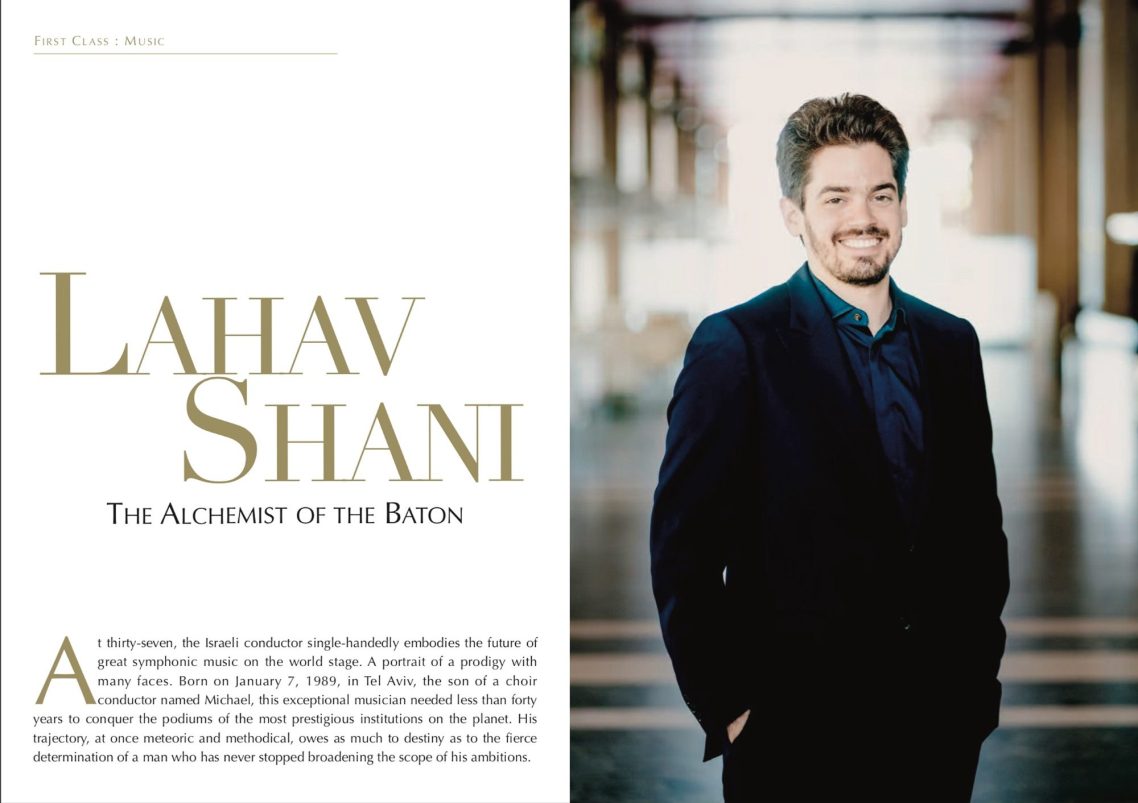
LAHAV SHANI
The Alchemist of the Baton
At thirty-seven, the Israeli conductor single-handedly embodies the future of great symphonic music on the world stage. A portrait of a prodigy with many faces. Born on January 7, 1989, in Tel Aviv, the son of a choir conductor named Michael, this exceptional musician needed less than forty years to conquer the podiums of the most prestigious institutions on the planet.
His trajectory, at once meteoric and methodical, owes as much to destiny as to the fierce determination of a man who has never stopped broadening the scope of his ambitions. From the streets of Tel Aviv to the concert halls of Berlin: the awakening of a genius When he is three years old, it is a neighbour — a renowned jazz musician — who hears him playing around on the keyboard through the wall of their Tel Aviv apartment building. The anecdote is charming, but it says it all: Lahav Shani did not simply learn music, he was seized by it. At the age of six, he formally begins studying the piano under Hannah Shalgi, before going on to study with Professor Arie Vardi at the Buchmann-Mehta School of Music in Tel Aviv. An insatiable teenager, he also takes up double bass at secondary school, an instrument he plays in his school orchestra and later within the Israel Philharmonic Orchestra under the baton of Zubin Mehta. At fourteen, out of sheer curiosity, he begins leafing through orchestral scores — the first being Stravinsky's The Rite of Spring.
This encounter with orchestral complexity would act as a silent revelation. His academic training continues in Germany, at the Hanns Eisler School of Music in Berlin, where he studies piano with Fabio Bidini and conducting with Christian Ehwald. It is there that he crosses paths with Daniel Barenboim, who becomes his mentor. This relationship, discreet yet decisive, instils in the young Shani a demanding conception of the Austro-German repertoire and a musical maturity well beyond his years. A triple career: the exception that proves the rule What fundamentally sets Lahav Shani apart from his peers is a quite staggering instrumental versatility. Where most great conductors have followed a single path — from singing or a solo instrument to the baton —, Shani combines three simultaneous careers: double bassist, concert pianist, and conductor. In 2007, at the age of eighteen, he performs Tchaikovsky's Piano Concerto with the Israel Philharmonic Orchestra, under the baton of Zubin Mehta.
As a pianist, he goes on to perform as a soloist alongside artists such as Martha Argerich — with whom he gives duo recitals — as well as Valery Gergiev. He has conducted and performed as soloist in piano concertos with ensembles as illustrious as the Vienna Philharmonic, the Philharmonia Orchestra, the Staatskapelle Berlin, and the Royal Concertgebouw Orchestra. This triple mastery is no mere stylistic exercise: it grants the Israeli conductor an understanding of sonic balance that few music directors can claim. From the stage, he perceives what his soloists feel; in the pit, he anticipates what his musicians are seeking.
This technical empathy is one of the keys to his magnetism. The Bamberg revelation and the irresistible ascent In 2013, at the age of twenty-four, Lahav Shani wins the prestigious Gustav Mahler International Conducting Competition in Bamberg. This triumph abruptly flings open the doors of the greatest concert halls. The Israel Philharmonic Orchestra, which has known him since he was sixteen, immediately invites him to conduct the opening concerts of its season. Invitations multiply at a breathtaking pace. The Staatskapelle Berlin, the Bavarian Radio Symphony Orchestra, the Staatskapelle Dresden, the Tonhalle Orchestra Zurich, the Philadelphia Orchestra, the Philharmonia Orchestra of London, and the Philharmonic Orchestras of Rotterdam, Stockholm, Seoul, and Radio France: all these institutions open their doors to him in turn. In 2016, he is appointed principal guest conductor of the Vienna Symphony Orchestra. The Rotterdam episode remains one of the most romantic chapters of his career. In June 2016, at the age of twenty-seven, he conducts the Rotterdam Philharmonic Orchestra for the first time. The chemical reaction is immediate.
The musicians are captivated, and Lahav Shani is enchanted by what he hears. On the strength of this single appearance, he becomes the youngest conductor ever to hold the position of music director in the orchestra's history, succeeding Yannick Nézet-Séguin, who had departed for the Metropolitan Opera in New York. This partnership includes an exclusive recording contract with Warner Classics, a label that consecrates exceptional artists. Several albums are released under this banner, including a fourth disc in 2024 devoted to a carefully chosen symphony, true to the Central European tradition that defines his artistic direction.
Tel Aviv at heart: loyalty to the Israel Philharmonic Orchestra Since the 2020–2021 season, Lahav Shani has also served as music director of the Israel Philharmonic Orchestra, succeeding Zubin Mehta, who had held the position for fifty years. A passing of the torch laden with symbolism — Mehta being one of the guiding figures of his own musical formation — and a responsibility that Shani assumes with a keen awareness of history. In 2025, his tenure at the helm of the Israel Philharmonic Orchestra was extended for a further five years, through to the end of the 2031–2032 season, a resounding testament to the confidence placed in him by both the musicians and the institution.
Munich: a rendez-vous with History: The crowning moment of this already extraordinary trajectory takes shape in a nomination of considerable significance: in February 2023, he is appointed chief conductor of the Munich Philharmonic, effective from the 2026–2027 season. An orchestra founded in 1893, whose history calls forth the names of Gustav Mahler, Bruno Walter, and Sergiu Celibidache. From September 2026, Lahav Shani will leave his artistic mark on the Munich ensemble through eight distinct subscription series. Even before officially taking up his post, he and the orchestra have already begun their collaboration: a European tour in autumn 2025 (Lucerne, Frankfurt, Paris, Luxembourg, Vienna), a first Asian tour in spring 2026, and the launch of a three-year residency at the Easter Festival in Aix-en-Provence.
The man of convictions, beyond music Lahav Shani is not merely a technician of sound. In September 2025, he finds himself at the centre of a controversy when the Flanders Music Festival cancels his concert on the grounds of unbearable and wholly unjust political pressure linked to the Israeli-Palestinian conflict. The conductor speaks out against demands he deems incompatible with his commitment to peace, declares his attachment to human values, and refuses any political instrumentalisation of his art. A rare and courageous public statement, which reveals an artist deeply committed to never separating ethics from aesthetics. A singular personality: greatness without arrogance Far from the myth of the remote, Olympian conductor, Lahav Shani is described as a thoroughly down-to-earth man in his thirties: he cooks, watches TV series, teaches his musicians backgammon between rehearsals, and openly professes his love of sleep as his favourite pastime. This disarming humanity is precisely what makes his relationship with orchestras so unique: wherever he goes, musicians vote for him unanimously or by an overwhelming majority. It goes beyond talent; it is alchemy. He performs regularly at the Verbier Festival, as well as at the Easter chamber music festivals in Aix-en-Provence and Jerusalem. Occasions where he reconnects with music in its most intimate essence, far from the grandeur of the great concert halls.
What the future holds for him Lahav Shani's schedule for the coming seasons is dizzying. Chief conductor of the Israel Philharmonic Orchestra until 2032, music director of the Munich Philharmonic from September 2026, permanent guest of the Berlin Philharmonic, the Vienna Philharmonic, the Concertgebouw in Amsterdam, the Chicago Symphony Orchestra, and so many other houses of excellence — he is charting a map of the symphonic world that has few equivalents in the current generation.
What Lahav Shani promises is a vision of great music that refuses embalming: alive, embodied, served by a musician who first received it in his very being before offering it to the world. In Munich, from next autumn, a new page in the history of conducting will be written under his baton. Music lovers the world over would be wrong not to be there.
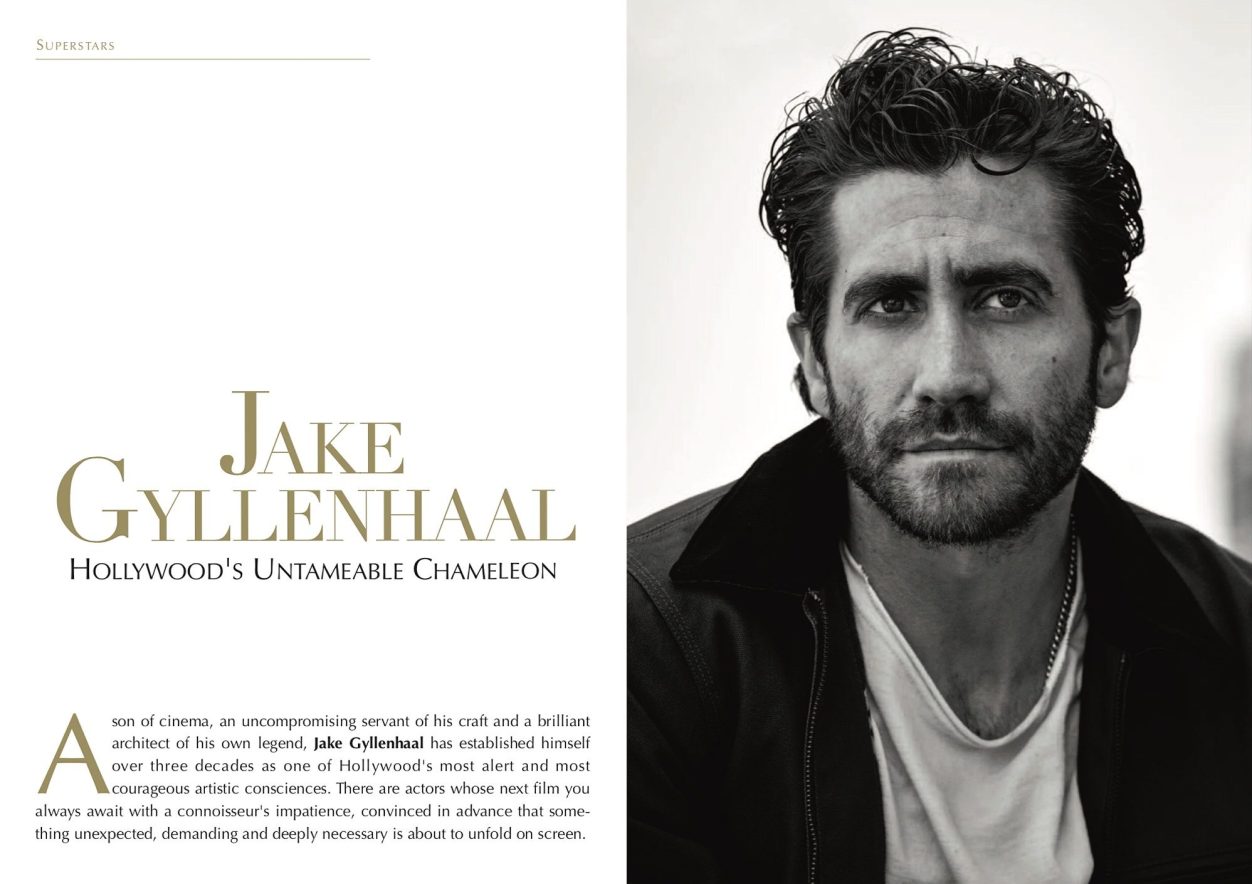
JAKE GYLLENHAAL
Hollywood's untameable chameleon
A son of cinema, an uncompromising servant of his craft and a brilliant architect of his own legend, Jake Gyllenhaal has established himself over three decades as one of Hollywood's most alert and most courageous artistic consciences. There are actors whose next film you always await with a connoisseur's impatience, convinced in advance that something unexpected, demanding and deeply necessary is about to unfold on screen. Jake Gyllenhaal is unquestionably one of them. Over more than thirty years of career, this son of Los Angeles, born into the light of cinema, has built — film after film — a body of work of rare coherence and demanding standards, moving across genres with a tightrope walker's agility while never sacrificing his credibility on the altar of commercial success.
A chameleonic actor, visionary producer, accomplished man of the theatre and an unavoidable figure in the world of international luxury, Gyllenhaal embodies today, at forty-four, the fully kept promise of a talent announced since childhood. Los Angeles, Cradle of a Dynastic Calling Born on December 19, 1980 in Los Angeles, Jacob Benjamin Gyllenhaal grew up in one of the households most intimately connected to the American film industry. His father, Stephen Gyllenhaal, is a director; his mother, Naomi Foner, an Oscar-nominated screenwriter; his older sister, Maggie Gyllenhaal, an actress and now a filmmaker of the first order. Here, vocation owes less to chance than to heredity. Raised according to principles of humility and social commitment — he celebrated his bar mitzvah at a homeless shelter, at his parents' decision — Jake Gyllenhaal carried from an early age the conviction that art must serve a truth greater than itself. His first on-screen role came at eleven, in City Slickers (1991), alongside Billy Crystal.
But it was in 1999, playing Homer Hickam in the biographical film October Sky, that the young actor revealed for the first time the full breadth of a dramatic sensibility that would, just a few years later, shake Hollywood to its very foundations. Donnie Darko and Brokeback Mountain: the Birth of a Myth In 2001, Richard Kelly's Donnie Darko revealed to the world an actor of disconcerting depth. In this unsettling and mesmerizing psychological thriller, Gyllenhaal portrayed a teenager tormented by apocalyptic visions with a disturbing intensity that made him, overnight, the object of every cinephile's fascination. The film, overlooked upon its theatrical release, quickly became a worldwide cult classic — and its lead, a promise that American cinema had been waiting for without knowing it. Four years later, Ang Lee's Brokeback Mountain (2005) struck like an earthquake. In this drama of impossible love between two cowboys in 1960s Wyoming, Gyllenhaal — partnering a Heath Ledger at the very height of his grace — delivered a performance of heartbreaking delicacy and sincerity that earned him an Academy Award nomination for Best Supporting Actor and a BAFTA Award. The film won three Oscars, including Best Director. Gyllenhaal was just twenty-five years old; his status as a leading actor was now irrevocably established.
A Filmography Carved in Granite What strikes you about Gyllenhaal's career is his stubborn insistence on choosing roles that force him to shed himself entirely. Every character is an act of exposure, every film a radical transformation. David Fincher's Zodiac (2007) revealed him as a press cartoonist consumed by an obsession with the elusive Zodiac Killer — a portrait of all-devouring fixation rendered with a clinical, cold subtlety that made him the beating heart of one of the finest American thrillers of the modern era. Denis Villeneuve's Prisoners (2013) — in which he played a solitary, haunted detective opposite a possessed Hugh Jackman — stands as one of the most magnetic performances of his decade, vindicating the bold gamble of an actor who chose a prestigious supporting role over the easy comfort of a conventional lead. Nightcrawler (2014) remains perhaps the pinnacle of his transformative work. To inhabit Lou Bloom — a nocturnal image-hunter, seductive sociopath and chilling mirror of the excesses of media capitalism — Gyllenhaal lost more than fifteen kilograms, adopting a cadaverous thinness and an unforgettable predator's gaze. The international critical consensus was unanimous: a performance of the highest order. Golden Globe and BAFTA nominations duly followed. Southpaw (2015) and Stronger (2017) — the latter produced by his own company, allowing him to portray Jeff Bauman, a survivor of the Boston Marathon bombing — confirmed his unique ability to inhabit broken bodies and wounded souls with a truthfulness that transcends mere technical craft.
Road House (2024), a remake of the 1989 cult film produced by Amazon MGM Studios, confirmed his power to captivate global audiences in an entirely different way: the film became the most-watched original production in Amazon Prime Video history, amassing nearly 80 million viewers within a matter of weeks. A sequel, already in production, was naturally commissioned in its wake. Theatre, Series and Television Recognition Unlike many of his peers, Gyllenhaal has never regarded the theatre as a concession or a stylistic exercise: he has thrown himself into it with the same intensity he brings before a camera. On Broadway as well as London's West End, he has triumphed in ambitious productions — Little Shop of Horrors, Sunday in the Park with George — demonstrating a stage versatility that leaves no doubt as to the breadth of his training. In 2025, his immersion in the series Presumed Innocent (Apple TV+), an adaptation of Scott Turow's bestselling novel in which he plays Rusty Sabich — a brilliant magistrate mired in a murder trial — earned him a 2025 Golden Globe nomination for Best Actor in a Drama Series, crowning a performance of remarkable psychological density that demonstrates, once again, his capacity to transcend formats.
The Elegance of Luxury: Prada, Cartier and the Art of Ambassadorship Beyond the world of cinema, Jake Gyllenhaal has established himself as one of the most sought-after male figures by the world's great luxury houses — partnerships that aptly reflect the image he projects: that of a man of understated elegance, assured intelligence and a natural distinction that never requires ostentation to assert itself. His long-standing partnership with Prada — whose men's fragrances he fronts — has placed him within the lineage of an intellectual and rigorous aesthetic that corresponds perfectly to the DNA of the Milanese house. His designation in 2023 as the first male face in the history of Cartier's iconic Santos watch marks a landmark event in the world of prestige watchmaking — a choice by the house of Place Vendôme that speaks volumes about the stature and symbolic influence the actor has built over the years. He is also an ambassador for Ginori 1735, the venerable Florentine porcelain house founded in 1735, with whom he shares a vision of artisanal excellence and timeless beauty.These alliances are never mere advertising contracts: they reflect genuine affinities with houses whose values — rigour, refinement, longevity — correspond in every respect to the career philosophy of an actor who has always chosen quality over quantity. A Fortune Built with Method and Discernment Jake Gyllenhaal's financial success mirrors his career: solidly constructed, prudently diversified and never put on display. His personal fortune is estimated by specialist firms at between 85 and 95 million dollars, fed by more than thirty years of steadily rising fees — culminating in the 10 to 15 million dollars he received for Road House — and by the full breadth of his ancillary income: seven-figure advertising contracts, prestige real estate (a Tribeca apartment in New York acquired for 8.63 million dollars, several properties in California) and, above all, his production company. Founded in 2015, Nine Stories Productions is the true instrument of his creative independence.
The company has produced films as varied as Stronger, Wildlife and Hondros, reflecting a pronounced taste for demanding human stories, far removed from formulaic blockbusters. The combined worldwide box-office gross of all his films surpasses the staggering sum of 3.8 billion dollars — a figure that illustrates, if any illustration were needed, that artistic integrity and popular success are by no means mutually exclusive. Projects Worthy of an Artist at His Peak Jake Gyllenhaal's schedule for the coming seasons is that of a man at the height of his powers and influence. He will appear alongside Henry Cavill, Eiza González and Rosamund Pike in In the Grey (2026), an action film directed by his longtime collaborator Guy Ritchie — the promise of a spectacle of formidable efficiency. In a radically different register, he will be the central figure of Remain (2027), a romantic supernatural thriller written and directed by M. Night Shyamalan from a story co-conceived with Nicholas Sparks and distributed by Warner Bros. — a collaboration heralded as one of the major cinematic events of the season. He will also appear in 2026 in The Bride! — directed by none other than his own sister, Maggie Gyllenhaal, alongside Christian Bale, Jessie Buckley and Penélope Cruz.
This project, at once a family and artistic endeavour, represents a form of symbolic culmination: two siblings, shaped in the same household, united on the same set for one of the most eagerly anticipated productions of the year. The Road House sequel is also in production, testament to the unfailing appetite of a man who has never confused ambition with haste. A Legacy in Perpetual Motion Within contemporary American cinema, there exist a handful of figures whose work and personal trajectory seem to achieve that rare alliance between art and life, between rigour and generosity, between the highest ambition and the deepest humility. Jake Gyllenhaal is the most compelling embodiment of that ideal in his generation. Whether inhabiting a haunted teenager, a cowboy in the grip of the wrong love, an unscrupulous journalist or a big-hearted brawler, he always carries the same flame: that of a man who believes every role is an opportunity to say something essential about the human condition. In a Hollywood too often in a hurry to forget why cinema exists, Jake Gyllenhaal has never forgotten. And it is precisely for this reason that his name is destined to endure through the ages.
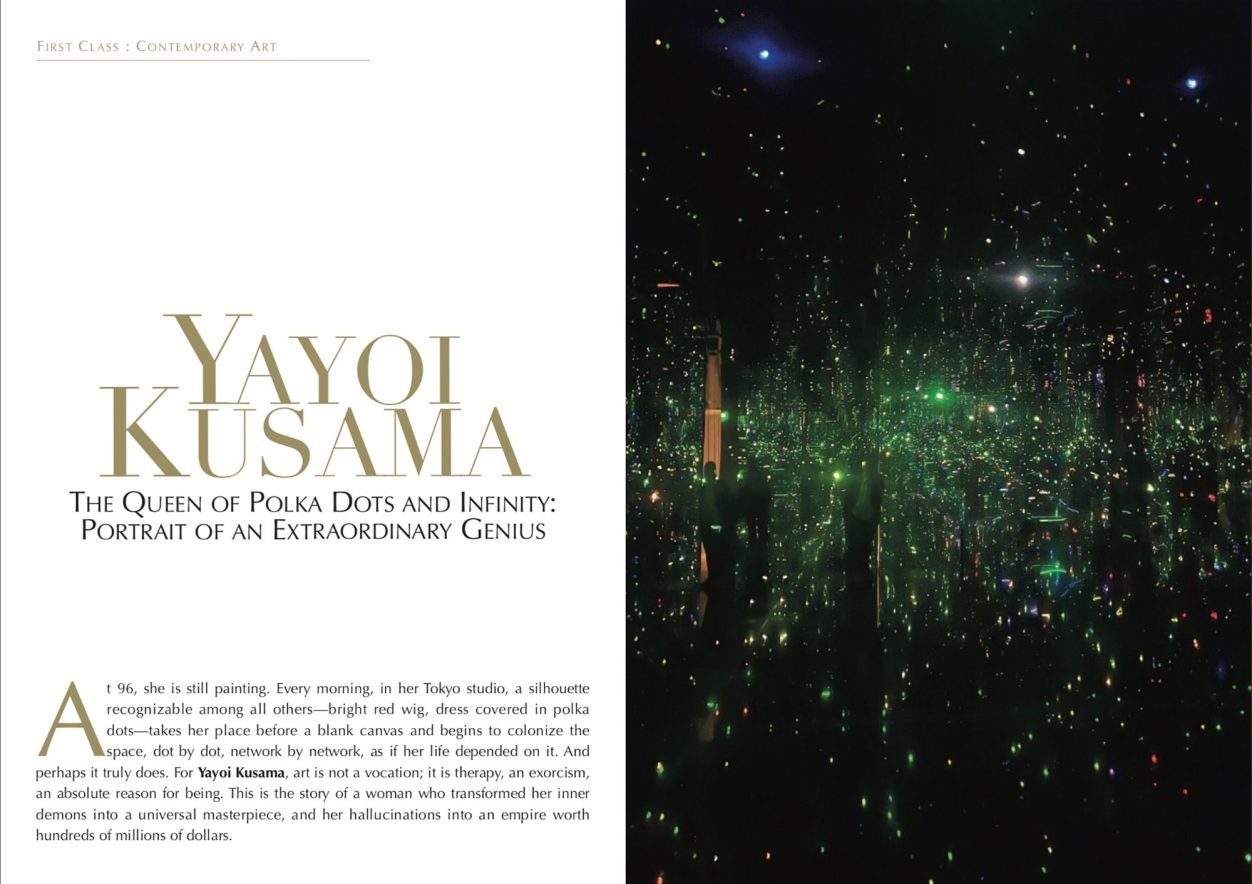
YASOI KUSAMA
The Queen of Polka dots and infinity
At 96, she is still painting. Every morning, in her Tokyo studio, a silhouette recognizable among all others—bright red wig, dress covered in polka dots—takes her place before a blank canvas and begins to colonize the space, dot by dot, network by network, as if her life depended on it. And perhaps it truly does. For Yayoi Kusama, art is not a vocation; it is therapy, an exorcism, an absolute reason for being. This is the story of a woman who transformed her inner demons into a universal masterpiece, and her hallucinations into an empire worth hundreds of millions of dollars.
The Roots of a Tormented Vocation Matsumoto, Nagano Prefecture, Japan, March 22, 1929. Yayoi Kusama is born into a provincial bourgeois family that owns plant nurseries. Her childhood is far from idyllic. Her mother, an authoritarian and distant woman, sends her to spy on her father’s infidelities, planting in the young girl the seeds of deep emotional instability. From the age of ten, Kusama begins to see luminous auras around objects, to hear flowers speak to her, to perceive patterns multiplying endlessly.
The real world seems to waver. To ward off this anxiety, she draws—compulsively, relentlessly. By the age of ten, she is already producing watercolors of unsettling maturity, filled with dots and obsessive nets. Her mother, disinclined to encourage what she considers an improper artistic vocation for a young girl of good family, sometimes destroys her works. Kusama persists. She enrolls at the Kyoto School of Arts and Crafts, where she studies traditional Japanese nihonga painting, before realizing that her destiny lies elsewhere—far, very far from Japan. New York, the Revelatory Metropolis In 1957, armed with a handful of works tucked under her coat and a letter of recommendation she had the audacity to request from Georgia O'Keeffe herself, Yayoi Kusama arrived in New York. She was 27, barely spoke English, and had meager financial resources. She would spend several years in genuine poverty, sometimes sleeping on the floor of a freezing Manhattan studio and surviving on the bare minimum.
Yet it was in this harsh environment that her most fundamental works were born. The Infinity Nets series—immense canvases covered with networks of meticulously hand-painted dots, sometimes exceeding ten meters in size—exploded onto the New York art scene. Donald Judd, then a young critic, praised their radicalism. Frank Stella was captivated. These works, which Kusama sometimes produced during eighteen-hour workdays, anticipated hard-edge painting and minimalist abstraction, but transcended them through their visceral and psychological intensity. They were not the result of formal calculation; they emerged from an inner necessity the artist herself described as a struggle against the dissolution of her identity. During the 1960s, Kusama established herself as a key figure of the avant-garde. She mingled with Andy Warhol, Georgia O'Keeffe, and Joseph Cornell—with whom she maintained a platonic romantic relationship for several years. She developed her first Accumulation Sculptures—everyday furniture and objects covered with soft fabric phalluses—sharply questioning sexuality, obsession, and consumer society with ironic wit.
These works, which could be loosely associated with Pop Art or Nouveau Réalisme, are nonetheless entirely unclassifiable: they form a genre of their own, wholly Kusama-esque. In 1965, she created her first Infinity Mirror Room, titled Phalli’s Field, an immersive installation in which visitors are plunged into a space where mirrors multiply forms to infinity. The work was prophetic, anticipating by several decades the immersive art that would dominate museums in the 21st century. Withdrawal, Then Rebirth In 1972, mentally exhausted and overtaken by her demons, Yayoi Kusama left New York and returned to Japan. She voluntarily entered a psychiatric clinic in Tokyo, where she still resides today—of her own accord, just a few hundred meters from her studio. This withdrawal from the Western world temporarily cast her work into obscurity. While the art market celebrated other names, Kusama painted, wrote novels, composed poems, and continued creating against all odds. This purgatory would last until the 1990s. The major retrospective organized by the Centre Pompidou in Paris, the Museum of Modern Art in New York, and the Tate Modern in London, which toured between 1998 and 2000, definitively restored Kusama to the center of the global art world.
A new generation of collectors, curators, and critics discovered with astonishment the breadth and coherence of a body of work produced over sixty years, never straying from its founding themes. An inimitable style: the poetics of obsession It would be reductive to reduce Kusama's universe to her polka dots, even though they are indeed her most immediately recognizable signature. Her work is in reality a coherent cosmological system, sustained by four major formal obsessions. The Infinity Nets, first: these hypnotic surfaces, covered in loops and networks painted with a fine brush, represent the aspiration to dissolve the self into the infinity of the universe. Each dot is a cell, each network is a life, and the whole is a meditation on the dissolution of the individual into the cosmos. The dots, next, which for Kusama symbolize the fundamental energy of existence. In her writings, she asserts that each dot represents a particle of the universe, and that the infinite repetition of dots expresses the fundamental equality of all things.
This motif, which she applies to canvases, sculptures, clothing, architecture, and even human bodies during her performances, is at once a philosophy and a personal form of therapy. The Infinity Mirror Rooms, her immersive installations made up of mirrors, LED lights, and suspended elements — glowing dots, pumpkins, flowers — are without doubt her best-known creations among the general public. These spaces, in which visitors find themselves projected into a vertiginous infinity of reflections, generate queues of several hours in museums around the world, making Kusama the most popular living artist on social media. The pumpkins, finally: since the 1980s, this plump vegetable form, covered in black and yellow dots, has become one of the most recognizable symbols of contemporary art. Kusama sees in the pumpkin a humanist and comforting shape, halfway between abstraction and figuration. Her monumental pumpkin sculptures, installed on Benesse Island in Japan, have become places of pilgrimage for art lovers the world over. Kusama holds the auction price record for any living female artist, a distinction she has retained with disconcerting consistency for over a decade. In 2024, according to the 30th Annual Artprice Art Market Report, Yayoi Kusama climbed to 6th place in the global ranking of top-performing artists at auction with $158 million — standing out as the first female artist and the first living artist to appear in this elite ranking. For the second consecutive year, Kusama retained first place in the ranking of living contemporary artists, generating $59 million in auction sales in 2024.
At the level of individual works, the figures are dizzying. The absolute record for a Kusama painting is Untitled (Nets) from 1959, sold for €8.39 million at Phillips in New York in 2022. This oil on canvas had far exceeded its pre-sale estimate, set at between £4 and £5.7 million. Yayoi Kusama's work is not only one of the most admired in the contemporary world: it is also one of the most lucrative. Kusama holds the auction price record for any living female artist, a distinction she has retained with disconcerting consistency for over a decade. The artist's sculptures sell for up to €6 million for large bronzes. Her Pumpkin (L) from 2014, a monumental bronze, was sold for €6 million at Sotheby's in 2023, setting a record for her sculptural practice. Yayoi Kusama's market value has seen remarkable growth over the past decade: the average price of her pictorial works has quadrupled since 2010. Paintings account for 76% of her sales, while sculptures make up 14%. Her works are particularly sought after in Hong Kong, Japan, the United States, Korea, and France. For collectors wishing to enter the Kusama universe without spending millions, her prints and silkscreens represent a more accessible entry point: the record for a print stands at €317,976 for Amour pour Toujours (2000), a numbered silkscreen, while multiples start from as little as €50.
Over the period from October 2024 to September 2025, Kusama unrivalled dominates the ranking of Asian artists at auction with a sales volume reaching $104.5 million, and a remarkable sell-through rate of 620 lots sold out of 783 offered. A global influence: from Louis Vuitton to the Instagram era Kusama's influence extends far beyond the walls of museums. In 2012, and again in 2023, her collaboration with Louis Vuitton — a house belonging to the LVMH group — was one of the most significant events in the meeting between art and the luxury industry. The facades of Louis Vuitton boutiques around the world were covered in giant polka dots, bags and accessories adopted her iconic motifs, and robots in her likeness were installed in the shop windows of the world's great avenues. The result: millions of pieces sold, and a tenfold increase in recognition among audiences who had never set foot in a museum. Kusama has also become, without having sought it, the queen of the Instagram era. Her Infinity Mirror Rooms generate millions of photographs shared on social media every year, making her exhibitions the longest queues in recent museum history. At the Hirshhorn Museum in Washington, the Tate Modern in London, and the Yayoi Kusama Museum in Tokyo — opened in 2017 and entirely dedicated to her — demand never wanes. This viral popularity has in no way diminished the esteem in which she is held by the most demanding institutions: the academic world and the general public share, in a rare convergence, the same admiration.
The eternal painter: an undiminished lucidity What strikes us, beyond the records and the fame, is Kusama's absolute constancy. At 96, she continues to go to her studio every day, painting by hand, dot by dot, network by network. She does not delegate. She does not stop. In recent interviews, she confides that art keeps her alive, that each painting is a victory over the madness that has haunted her since childhood. Her output remains impressive: hundreds of new works each year, exploring her founding themes with inexhaustible inventiveness. Her autobiography, Infinity Net, published in 2002 and translated into numerous languages, offers one of the most deeply moving accounts ever written about the relationship between artistic creation and psychological suffering. In it we discover a woman of rare lucidity and courage, who was able to make her own wounds the very material of her genius. A legacy that transcends art Yayoi Kusama's work is more than a sum of paintings, sculptures, and installations: it is a philosophy of existence. It invites us to consider our infinitesimal singularity within the immensity of the cosmos, to find in repetition not tedium but meditation, to see in the humblest dot a particle of the entire universe.
In a contemporary art world sometimes perceived as hermetic or elitist, Kusama achieves a remarkable feat: she is simultaneously the most highly valued artist on the market, the most widely exhibited in prestigious museum institutions, and the most beloved by the general public. This trilogy is the rare and precious mark of authentic genius. Kusama's dots have conquered the planet. And if one thinks about it carefully, perhaps this was inevitable — for is not the universe itself, at the subatomic scale, an immense canvas of vibrating points, connected to one another by invisible threads? Yayoi Kusama has always known this. She saw it before anyone else.
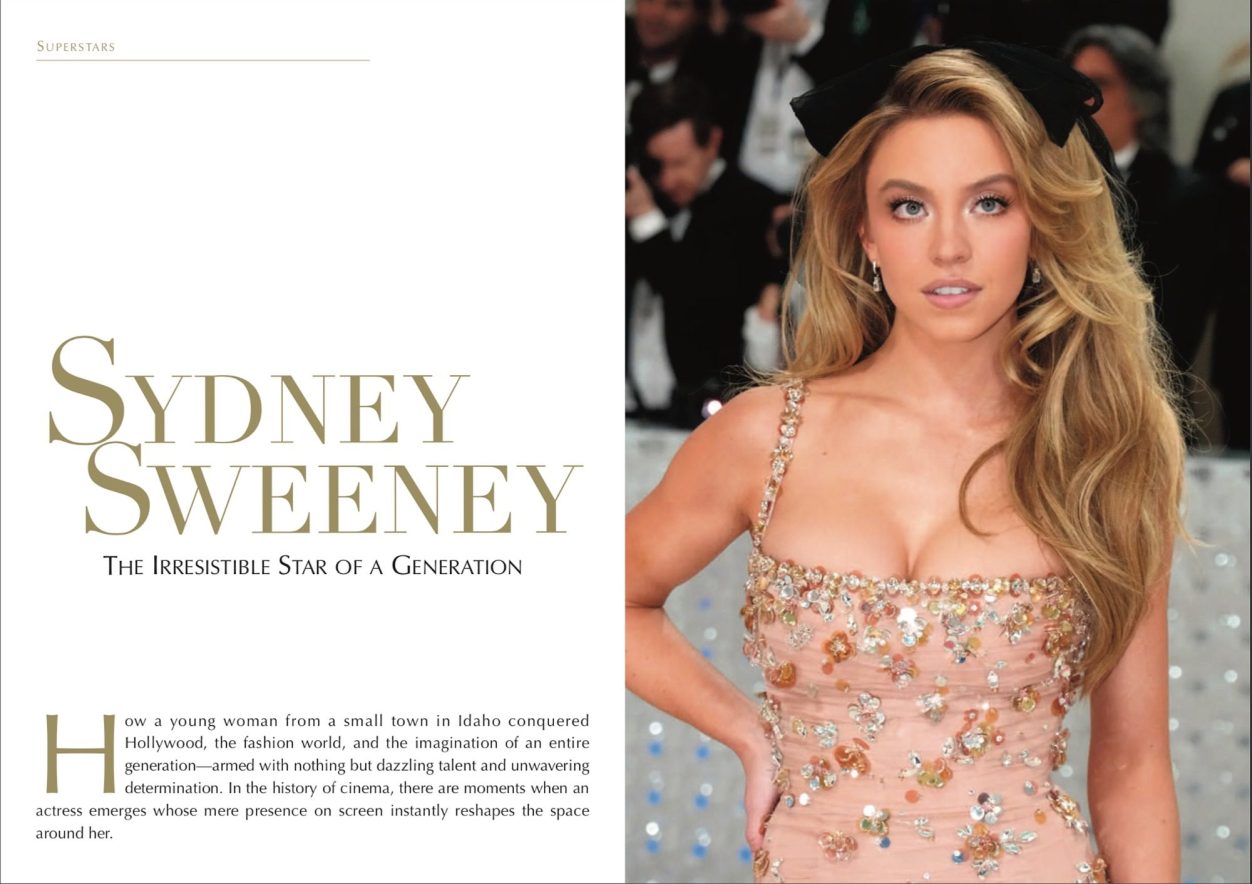
SYDNEY SWEENEY
The Irresistible Star of a Generation
How a young woman from a small town in Idaho conquered Hollywood, the fashion world, and the imagination of an entire generation—armed with nothing but dazzling talent and unwavering determination. In the history of cinema, there are moments when an actress emerges whose mere presence on screen instantly reshapes the space around her.
An actress whose gaze, bearing, and the way she breathes between words captivate the viewer with an intensity that is at once mysterious and unmistakable. Sydney Sweeney is one of those rare beings. At just twenty-seven, this child of Spokane, Idaho—a town not widely known for producing legends—has become one of the most sought-after, most photographed, and most bankable personalities in the global entertainment industry. Her rise has been meteoric, her trajectory impeccably managed, and her future dizzying. From Idaho to the Lights of Hollywood Born on September 12, 1997, in Spokane, Washington, Sydney Bernice Sweeney grew up in a modest middle-class household in Spokane Valley, Idaho.
Her calling revealed itself with striking precocity: by the age of twelve, she was pleading with her parents to let her try her luck in Hollywood. Faced with their legendary skepticism, she devised—at that improbable age—a fully detailed business plan to convince her family to move to California. This episode foreshadows everything her career would become: fierce ambition, rare strategic intelligence, and an ability to turn obstacles into springboards. Her first steps in the industry were modest but telling. Appearances in second-tier series—90210, Grey's Anatomy, Criminal Minds—allowed her to gain experience while pursuing studies that reflect an uncommon intellectual curiosity for her background: she is now a film graduate from the University of Southern California and has taken courses in airplane piloting, automotive mechanics, and Brazilian jiu-jitsu. Sydney Sweeney never confines herself to just one dimension. Euphoria and The White Lotus: Two Stunning Breakthroughs It was in 2019, with the phenomenon series Euphoria (HBO), that Sydney Sweeney firmly established herself in the public consciousness. In the role of Cassie Howard—a young woman torn between the pursuit of love and self-destruction—she delivered a performance of striking emotional complexity, masterfully alternating between profound vulnerability and cathartic outbursts. The bathtub scene in season 2, with its silent, convulsive tears, has already become iconic in contemporary television.
At the same time, she shone in The White Lotus (HBO, 2021), Mike White’s sharp satire of ultra-privilege, portraying Olivia Mossbacher with disarming naturalness and subtle irony. This simultaneous double performance—two major HBO projects, two radically different roles—earned her two Emmy Award nominations in 2022, a remarkably rare feat in the history of the prestigious American ceremony, and firmly cemented her status as a first-rate chameleon actress. A Filmography on the Rise In cinema, Sydney Sweeney has made a deliberate and courageous choice for diversity. In Reality (2023), she carried the weight of a film entirely based on a real FBI interrogation transcript for ninety minutes—a staggering technical and emotional challenge that she met with breathtaking presence and precision, earning unanimous praise from international critics. With Anyone But You (2023), a romantic comedy alongside Glen Powell, she proved she also possesses impeccable comic timing and the sparkling charm of classic screwball comedy stars—recalling, for the most discerning cinephiles, the great heroines of Hollywood’s Golden Age.
The modestly budgeted film grossed nearly $220 million at the global box office, dramatically demonstrating her pull with international audiences. Her portrayal of Madame Web (2024) and her role in Immaculate (2024)—a psychological horror film she produced herself under her own banner—reflect a taste for ambitious, risky projects, far from the well-trodden paths of a more conventional career. Her major breakthrough arrived with her masterful performance in The Housemaid, the cinematic adaptation of Freida McFadden’s bestseller, released in December 2025 and directed by Paul Feig. The role of Millie marked a true turning point in Sydney Sweeney’s career: The Housemaid became one of the biggest commercial successes of her career, significantly surpassing the box office of other films in which she starred as the lead. Thanks to this box office success, the studio has already greenlit a sequel, with Sweeney confirmed both as lead actress and executive producer, strengthening her influence behind the camera as much as in front of it. After gaining renown through series like Euphoria and The White Lotus, this film further solidifies her credibility in cinema and firmly establishes her as one of Hollywood’s rising stars, capable of drawing wide audiences even beyond television platforms. The Housemaid stands as one of her greatest successes to date, providing her with increased visibility, a producer role, and significant momentum for the future of her career.
Fashion Icon and Luxury Empires Sydney Sweeney captivates far beyond the film industry because she embodies, with astonishing ease, the aesthetic ideal of an era: a beauty that is both classic and modern, approachable yet mysterious, one that the world’s top fashion houses and luxury brands have vied for with a fervor rarely seen for an actress of her generation. Her partnership with Miu Miu—a brand within the Prada Group, for which she has become one of the most photographed faces—propelled her onto the covers of Vogue, Harper’s Bazaar, and Elle across four continents. Her collaboration with Laneige in beauty, her ambassadorship for Armani Beauty, as well as her standout appearances for Ray-Ban and American Eagle, have generated viral campaigns whose social media impact—where she alone has over 25 million Instagram followers—defies conventional measurement. She has also collaborated with the skincare brand Dr. Dennis Gross and, in 2024, launched her own haircare line, Lemon Soul, in partnership with Ford Models—a further testament to her extraordinary entrepreneurial instinct, which makes her far more than an actress: a brand in her own right. A Fortune Built on Talent and Strategy Sydney Sweeney’s market value at this stage of her career is truly remarkable.
Her personal fortune is estimated by industry observers to be between $15 and $20 million, fueled by steadily increasing acting fees, multimillion-dollar endorsement deals, and the revenues from her production company, Fifty-Fifty Films, which she founded to maintain control over the development of her projects and maximize both her creative freedom and her share of the profits. This business model, deliberately inspired by pioneers like Reese Witherspoon and Nicole Kidman, reflects a rare maturity and long-term vision for an actress of her generation. Sydney Sweeney does not endure Hollywood; she negotiates it, step by step, with a clarity and determination that command the admiration of even the most seasoned industry professionals. Projects Matching Boundless Ambition Sydney Sweeney’s schedule demonstrates a constant appetite for demanding roles and risky ventures. In 2025, she portrayed Christy Martin, the legendary American boxer, in a biopic produced by Todd Phillips—director of Joker—for which she underwent a radical physical transformation.
While the film did not achieve the anticipated box office success, it nonetheless confirmed the actress’s ability to reinvent herself without calculation or timidity—a hallmark quality of the greatest stars. Her highly anticipated return in the third and final season of Euphoria on HBO promises to bring one of the decade’s most closely followed dramatic arcs to a stunning conclusion. She is also set to appear in Scandalous! by Colman Domingo, portraying Hollywood icon Kim Novak, as well as in the adaptation of the cult video game OutRun, directed by Michael Bay for Universal—two projects that cement her status as a leading star in an industry that has now opened all its doors to her.
A Star for Eternity There is something extraordinary about Sydney Sweeney, something that goes beyond talent and beauty—two qualities Hollywood has never lacked. This something lies in the uniqueness of her presence, the depth visible behind every smile, and the quiet intelligence evident in every career decision she makes. She is one of those artists who carry the promise of a body of work still largely ahead of them, and you sense, deep down, that her best is yet to come. In a perpetually evolving Hollywood, searching for new icons who can combine dramatic power, timeless allure, and business acumen, Sydney Sweeney stands out with an ease that reconciles the most contradictory demands of our era. She is both the heir to a certain Golden Age and the undeniable embodiment of conquering modernity. A star, in every sense of the word.
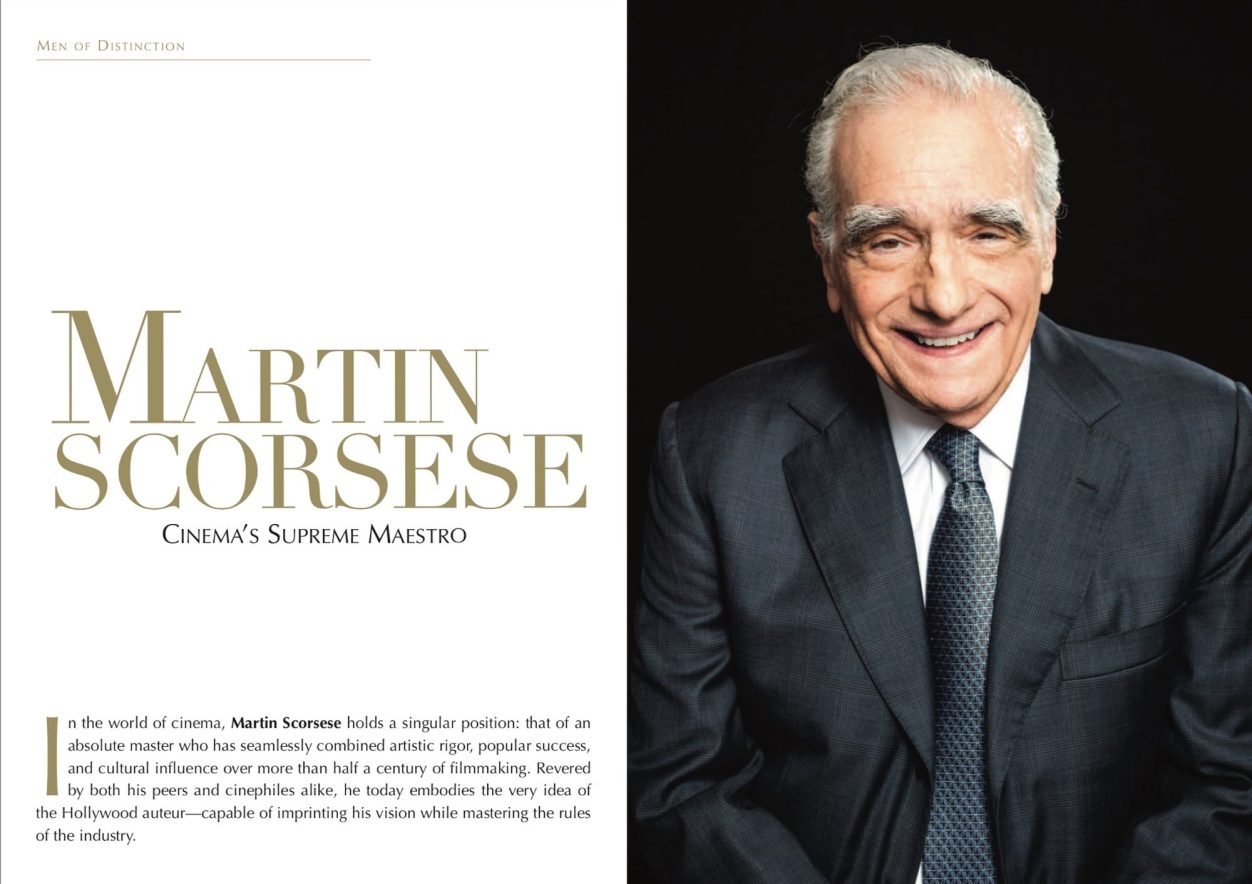
MARTIN SCORSESE
Cinema's Supreme Maestro
In the world of cinema, Martin Scorsese holds a singular position: that of an absolute master who has seamlessly combined artistic rigor, popular success, and cultural influence over more than half a century of filmmaking. Revered by both his peers and cinephiles alike, he today embodies the very idea of the Hollywood auteur—capable of imprinting his vision while mastering the rules of the industry. Born in 1942 in the Queens and raised in Little Italy at the heart of New York, Scorsese drew early inspiration from the bustling streets, Catholic fervor, and the trials of a tight-knit yet often violent Italian-American community.
Weakened by asthma, he sought refuge in movie theaters, developing a voracious passion for film, before studying cinema at New York University, where he earned a degree in film communication and later taught. After notable beginnings with the documentary Woodstock and a few lesser-known works, he made his mark with Mean Streets (1973), a raw, almost autobiographical dive into New York’s small-time underworld, which also launched his legendary collaboration with Robert De Niro. From that point on, each decade would see Scorsese deliver at least one major film, building a body of work that is coherent, instantly recognizable, yet continually evolving. The Iconic Films of a Visionary Scorsese has contributed some of the cornerstone works of contemporary cinema, films that have become absolute reference points for filmmakers around the world.
Among his most emblematic works are: Taxi Driver (1976), a hallucinatory portrait of a lonely veteran navigating a nocturnal, decadent New York—winner of the Palme d’Or at Cannes and a lasting aesthetic and moral shock. Raging Bull (1980), the electrifying biography of boxer Jake LaMotta, which earned De Niro an Oscar and established Scorsese as a master of both physical and psychological direction. Goodfellas (1990), a virtuoso plunge into the mafia world, often cited as one of the greatest gangster films in history, whose modernity remains undiminished. Casino (1995), a baroque fresco of Las Vegas, power, money, and downfall—a flamboyant extension of his exploration of organized crime. Gangs of New York (2002), The Aviator (2004), and The Departed (2006), an implicit trilogy in which he revisits American history, the myth of aviation, and contemporary corruption. Shutter Island (2010) explores the unsettling boundary between reality and illusion through the investigation of a marshal in a psychiatric asylum.
The film establishes an oppressive atmosphere, driven by masterful direction and sustained psychological tension. Gradually, the hero’s certainties begin to crack, revealing the mechanisms of denial and trauma. The final revelation transforms the story into a profound reflection on identity, guilt, and madness. The Wolf of Wall Street (2013), an unbridled satire of unchecked capitalism, reunites him with Leonardo DiCaprio, who becomes his new alter ego during a blazing second phase of his career. The Irishman (2019), a twilight meditation on time, loyalty, and mortality, produced with Netflix, allows him to revisit the mafia film through the lens of regret and reckoning. Killers of the Flower Moon (2023), a cinematic adaptation of David Grann’s book of the same name, marks his sixth collaboration with Leonardo DiCaprio and his tenth with Robert De Niro. Over the years, Martin Scorsese has surrounded himself with numerous actors with whom he has been able to collaborate repeatedly. Robert De Niro has appeared in ten of Scorsese’s films, as well as in Mad Dog and Glory, produced by the director. Their collaboration earned De Niro the Academy Award for Best Actor for his portrayal of boxer Jake LaMotta in Raging Bull.
Harvey Keitel is considered the director’s first “muse,” having worked with him six times, including on their respective debut feature Who’s That Knocking at My Door (1969). Leonardo DiCaprio has also played the lead in six of Scorsese’s films: Gangs of New York, The Aviator, The Departed, Shutter Island, The Wolf of Wall Street, and Killers of the Flower Moon. A Unique Style and a Moral Signature What sets Scorsese apart from most of his contemporaries lies as much in his vision as in his cinematic language. His camera work is instantly recognizable: swift tracking shots, hypnotic long takes, and fluid movements that mirror the inner fever of his characters. The editing, often sharp and syncopated, converses with a soundtrack blending rock, pop, and American standards, creating a musical dramaturgy that runs parallel to the visuals. But Scorsese’s singularity is also moral and spiritual. His films relentlessly explore guilt, redemption, temptation, and violence—a direct inheritance of his Catholic upbringing and his keen observation of the margins of American society.
Where many settle for spectacle, Scorsese interrogates the corruption of the soul, the shifting boundary between good and evil, and individual responsibility in the face of chaos. Finally, his work is founded on rare loyalty: to actors (Robert De Niro, Leonardo DiCaprio), screenwriters (Paul Schrader, Nicholas Pileggi), and editors (Thelma Schoonmaker), creating a genuine workshop of cinematic craftsmanship within Hollywood itself. Oscars, Accolades, and the Fortune of a Master The Academy long hesitated to honor this giant, but time ultimately confirmed the obvious. After numerous nominations, Scorsese finally received the Academy Award for Best Director for The Departed in 2007, which also won Best Picture. Beyond this belated statuette, his career is studded with distinctions: Golden Globes, BAFTAs, Directors Guild of America Awards, the AFI Life Achievement Award, a BAFTA Fellowship, not to mention a star on the Hollywood Walk of Fame and prestigious institutional tributes, from the Kennedy Center to various international cultural institutions. His films have generated over two billion dollars at the global box office, not counting the colossal revenues from distribution, television rights, and streaming platforms.
For a creator whose ambitions have always been more artistic than financial, Martin Scorsese is nonetheless an extremely wealthy man. In 2025, multiple estimates place his fortune at around $200 million, the result of his directing fees, producing activities, and particularly lucrative deals with streaming platforms, notably for The Irishman. Yet this prosperity has not diverted him from his primary obsession: making cinema a living, transmissible art—a mission he also champions through his efforts to preserve film heritage. A Living Legend Martin Scorsese represents a rare model: that of a creator who has transformed an intimate universe—Little Italy, faith, doubt, violence—into a body of work that is universally admired across the world’s cultural capitals. His name has become a guarantee of excellence, synonymous with both cinephilic refinement and narrative power, making him a natural companion to the world of high-end living, where rigor, depth, and coherence define true prestige.
At over eighty years old, far from slowing down, Scorsese continues to direct, to teach, and to engage with new generations of filmmakers and audiences. Like the finest vintners whose vintages are followed year after year, each new film bearing his signature is awaited as a rare vintage—the gesture of a master whose time only refines complexity and value.
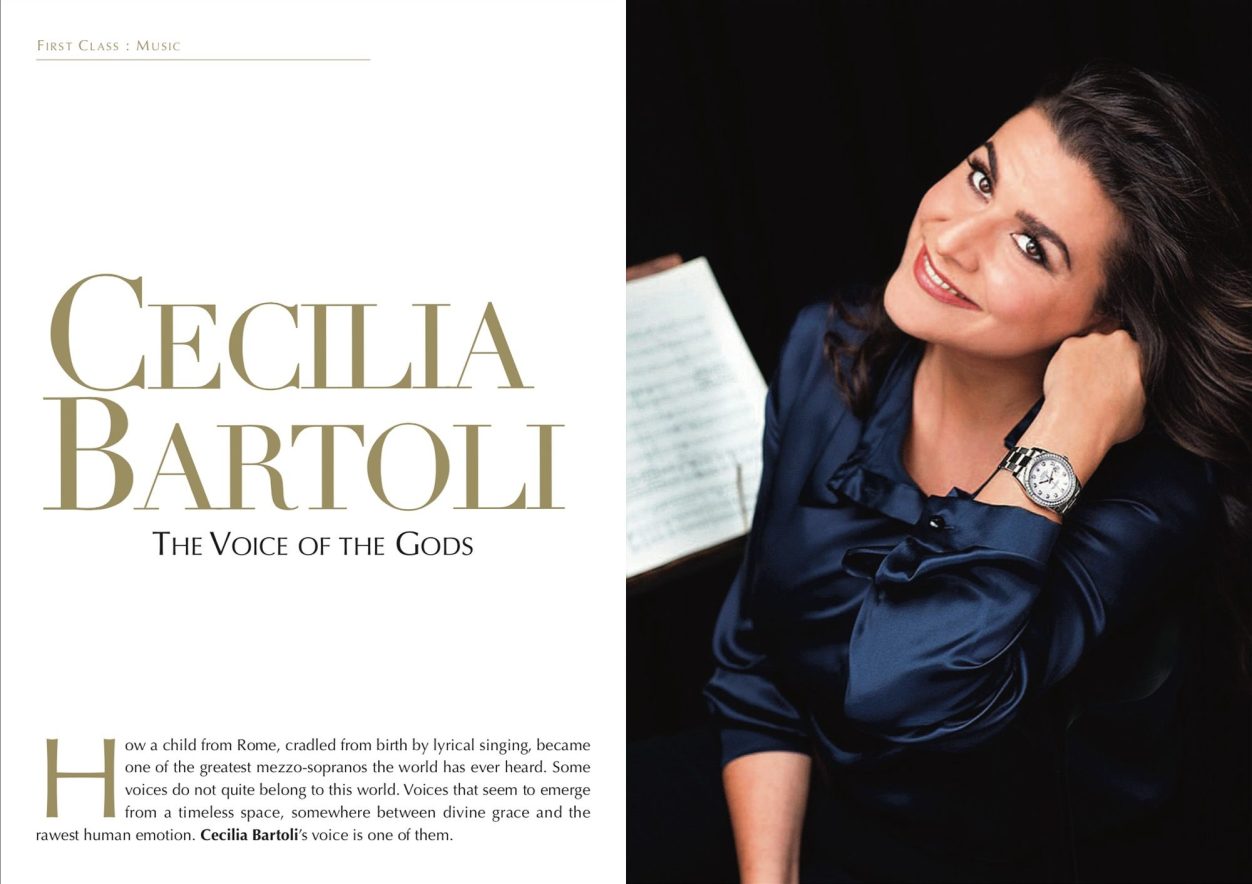
CÉCILIA BARTOLI
The Voice of Gods
How a child from Rome, cradled from birth by lyrical singing, became one of the greatest mezzo-sopranos the world has ever heard. Some voices do not quite belong to this world. Voices that seem to emerge from a timeless space, somewhere between divine grace and the rawest human emotion. Cecilia Bartoli’s voice is one of them. An extraordinary mezzo-soprano, an incomparable performer, a passionate musicologist, and an artistic director of rare audacity, the Roman has, for over three decades, established herself as one of the most dazzling and influential figures on the global operatic stage.
Where others sing, she embodies. Where others interpret, she resurrects. Where others bow to tradition, she reinvents it. Rome, Cradle of a Prodigy Born on June 4, 1966, in Rome, Cecilia Bartoli grew up in a household where music was not a pastime but a family vocation, passed down like precious blood. Her father, Pietro Angelo Bartoli, was a tenor; her mother, Silvana Bazzoni, a soprano. By the age of nine, little Cecilia was already taking the stage at the Rome Opera in minor roles, absorbing with insatiable appetite the secrets of an art she would soon elevate to unprecedented heights. Trained at the Santa Cecilia Conservatory in Rome and further refined under her mother, who remained her sole voice teacher, she revealed early on a voice of astonishing harmonic richness: a warm, velvety middle, crystal-clear high notes, unusually dark low notes for a mezzo, all governed by coloratura technique of near-supernatural precision. In 1987, barely twenty-one, she made her television debut on Pippo Baudo’s show—an appearance that stunned all of Italy and opened the doors to an international career.
A Career at the Pinnacle of World Opera Her debut on the great international stages was not long in coming. In 1989, she sang at the Metropolitan Opera in New York. In 1992, her debut at London’s Royal Opera House, Covent Garden, caused a sensation. The Wiener Staatsoper, Milan’s Teatro alla Scala, the Paris Opera: all the world’s major houses clamored for a voice that seemed to answer a demand embedded in the operatic repertoire for centuries, yet never fully satisfied—until now. Yet it was through her passionate relationship with two composers—Rossini and Vivaldi—that Cecilia Bartoli would forge her most enduring legend. For Rossini, she delivered interpretations that redefined bel canto style: prodigious vocal agility, phrasing of sovereign elegance, and a textural intelligence that transformed every recitative into a dramatic revelation. Her recordings of Rossini’s operas—The Barber of Seville, L’Italiana in Algeri, Cenerentola—remain absolute benchmarks, unmatched to this day. With Vivaldi, it was another, no less striking, adventure: that of true musical archaeology. By meticulously exploring the archives of Dresden and Turin, Bartoli unearthed works by the Red Priest long thought lost, recording them with astonishing devotion and virtuosity, and in doing so, opened a new territory for the Baroque repertoire. Her album Vivaldi (2000) caused a veritable explosion in the classical music world.
The Art of Constant Reinvention What fundamentally sets Cecilia Bartoli apart from her peers is her absolute refusal of easy choices and her extraordinary ability to reinvent herself without ever betraying her artistic convictions. Where a comfortable career might have invited her to settle into a well-trodden repertoire, she always preferred risky exploration, ambitious rediscovery, and the gesture of intellectual defiance. Her recording projects are as much musicological investigations as they are acts of passion, carried out with the rigor of a scholar and the ardor of a devotee. Salieri (1999), in which she masterfully rehabilitated the composer against the injustices of history; Opera Proibita (2005), a sumptuous journey through 17th-century Roman sacred repertoire; Maria (2007), a moving tribute to Callas; Mission (2012), devoted to the castrato Agostino Steffani—each album is an artistic statement, a musical act of faith, an invitation to explore previously uncharted sonic territories. Artistic Director and Guardian of a Living Heritage In 2012, Cecilia Bartoli reached a new milestone by accepting the artistic directorship of the Monte-Carlo Opera Festival, later taking the helm of the Monte-Carlo Opera in 2023. There, she developed a programming approach of exemplary rigor and originality, combining the rediscovery of forgotten scores, bold new stage productions, and invitations to exceptional artists.
Under her leadership, the Principality of Monaco has established itself as one of the world capitals of the most ambitious operatic expression. She is also one of the most active ambassadors for the cause of the castrati—those lost voices whose legacy she strives to preserve through roles written for them—and tirelessly works to make classical music accessible to younger generations, convinced that opera is not a museum art but a profoundly living form of expression, capable of speaking to all ages and cultures. A Record of Achievements Befitting the Greatest Cecilia Bartoli’s international recognition matches her extraordinary talent. Holder of more than ten Gramophone Awards—the classical music equivalent of the Grammy, and the highest number ever awarded to a single artist in the history of this distinction—she has also won multiple Grammy Awards and Echo Klassik, the most prestigious honors in the global classical recording world.
Her albums, primarily released on Decca Classics, have sold over 10 million copies worldwide—a truly remarkable figure for a career devoted entirely to the classical and Baroque repertoire. In 2021, Gramophone magazine solemnly named her one of the fifty most important voices in the history of recorded music. A Living Legend In an era when the world of performance too often succumbs to the demands of the instantaneous and the superficial, Cecilia Bartoli represents a form of elegant, steadfast resistance: that of an artist who has always chosen depth over ease, truth over effect, and enduring beauty over fleeting success. She is one of those rare personalities whose mere presence on stage can transform an evening into an event—and an event into an unforgettable memory. When Cecilia Bartoli’s voice rises in the silence of a concert hall—so singular, so corporeal, yet so celestial—something happens that words cannot capture. Centuries seem to bend, the boundaries between past and present vanish, and one suddenly understands why the Ancients spoke of the Muses. For, in the end, this is what Cecilia Bartoli is: one of them—embodied, miraculous, and offered to our time as a gift no one could have dared to hope for.
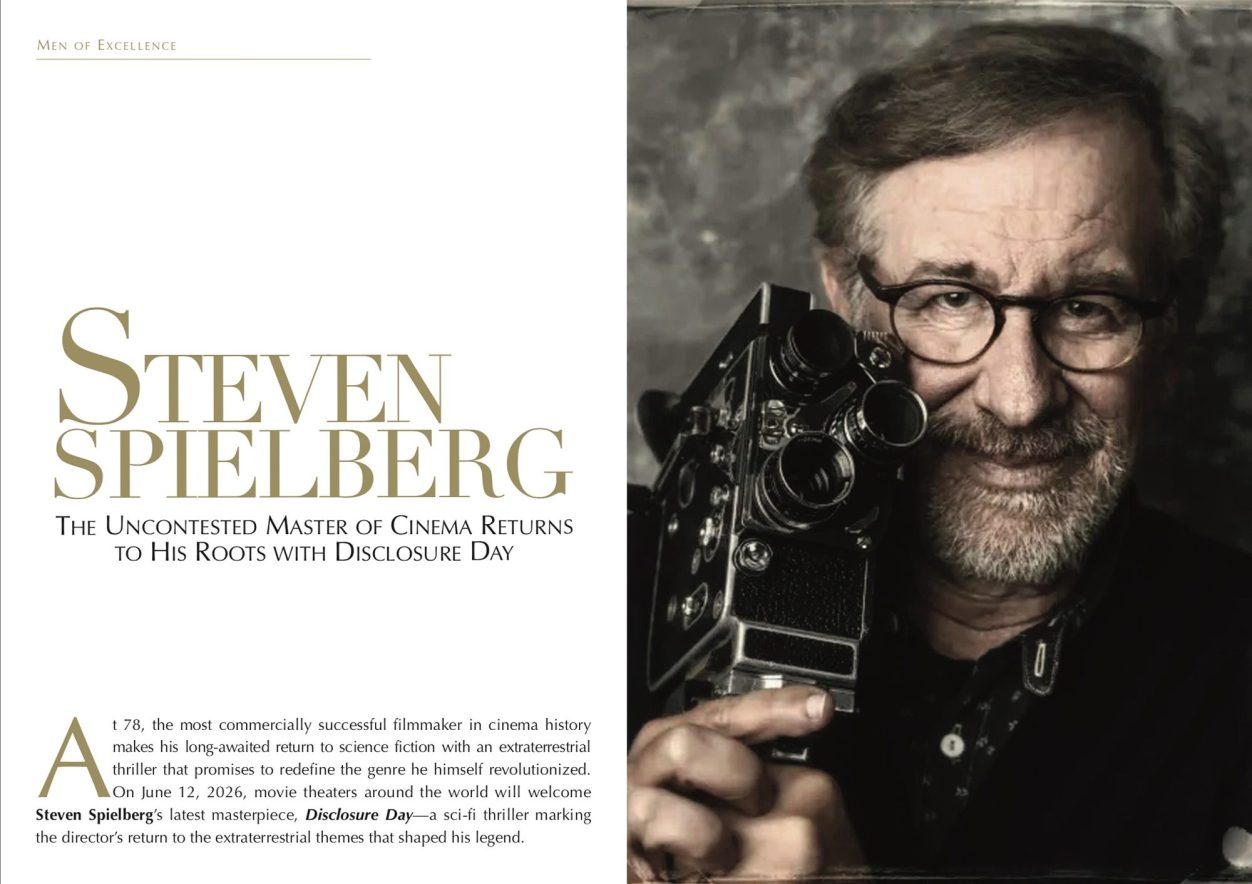
STEVEN SPIELBERG
THE UNCONTESTED MASTER OF CINEMA RETURNS TO HIS ROOTS WITH DISCLOSURE DAY
At 78, the most commercially successful filmmaker in cinema history makes his long-awaited return to science fiction with an extraterrestrial thriller that promises to redefine the genre he himself revolutionized...
Disclosure Day: Hollywood’s Best-Kept Secret
Rarely has a Steven Spielberg project been surrounded by such secrecy. Filmed throughout 2025, Disclosure Day remained remarkably protected from major leaks, preserving the veil of confidentiality carefully maintained by the director.
On December 16, 2025, Universal Pictures finally lifted part of the curtain by unveiling a teaser trailer alongside the release of James Cameron’s Avatar: Fire and Ash. The footage reveals Emily Blunt as a Kansas City weather presenter who, live on air, suddenly begins emitting inexplicable clicking sounds, as if possessed by a non-human intelligence. “What if you discovered that we are not alone? If someone showed you, proved it to you—would it frighten you?” asks the film’s logline.
“This summer, the truth belongs to seven billion people.”
The cast brings together some of the most talented actors of their generation: Emily Blunt (Oppenheimer), Josh O’Connor (Challengers), Colman Domingo (Rustin), Colin Firth (The King’s Speech), Wyatt Russell, and Eve Hewson.
This prestigious lineup, combined with David Koepp’s involvement—screenwriter of Jurassic Park, The Lost World: Jurassic Park, War of the Worlds, and Indiana Jones and the Kingdom of the Crystal Skull—as well as the thirtieth musical collaboration between Spielberg and the legendary John Williams, gives
Disclosure Day all the hallmarks of a major cinematic event. At a time when American audiences have been witnessing Congressional hearings on Unidentified Aerial Phenomena (UAP) since 2023—during which current and former government officials have testified to repeated violations of airspace by craft maneuvering in inexplicable ways—Spielberg’s film arrives at a culturally opportune moment.
The director himself has stated on multiple occasions:
“I don’t believe we are alone in the universe. I think it is mathematically impossible for us to be the only intelligent species in the cosmos.”
A Legendary Career: Forty-Nine Years of Cinematic Domination
Steven Allan Spielberg was born on December 18, 1946, in Cincinnati, Ohio, into an Ashkenazi Jewish family. His father, Arnold Spielberg, was a pioneering computer engineer who contributed to the development of the first computers, while his mother, Leah Adler, was a classical concert pianist and restaurateur. This duality—technical rigor from his father and artistic sensitivity from his
mother—would deeply shape the future filmmaker’s work.
As a teenager, Spielberg began making Super 8 short films, displaying an early talent for visual storytelling. At 13, he won an award for Escape to Nowhere, a forty-minute war film. By 16, he had completed Firelight, a 140-minute science fiction feature about an alien invasion—a remarkable early precursor to his future career.
In 1968, his short film Amblin' caught the attention of executives at Universal Pictures. At just 21, Spielberg became the youngest director ever signed to a long-term contract by a major Hollywood studio—an achievement that remains unmatched to this day.
His early television work for Universal (Night Gallery, Marcus Welby, M.D., The Name of the Game) already showcased exceptional technical mastery. In 1971, Duel, a made-for-TV thriller in which a motorist is menaced by a tanker truck, confirmed his genius. The film’s success was such that it was released theatrically in Europe, effectively launching Spielberg’s cinematic career.
1975 marked a historic turning point with Jaws. Despite a nightmarish production—massive budget overruns, a malfunctioning mechanical shark, and conflicts with the studios—the film became the first modern blockbuster in cinematic history, grossing over $470 million worldwide and establishing the concept of the summer event movie. At 28, Spielberg emerged as Hollywood’s rising star.
Two years later, Close Encounters of the Third Kind (1977) revolutionized the science fiction genre by portraying extraterrestrials as benevolent and wondrous for the first time, responding to human curiosity rather than fear. The film earned $338 million and cemented Spielberg’s reputation as a visionary capable of blending spectacle with emotion.
The Pinnacle of Glory: A Prodigious Decade (1981–1993)
The 1980s saw Spielberg reach commercial and artistic heights few filmmakers have ever matched. In 1981, Raiders of the Lost Ark, a collaboration with George Lucas, reinvented the adventure film and launched the Indiana Jones franchise. The film grossed $389 million and earned Spielberg his first Academy Award nomination for Best Director.
1982 remains one of the defining peaks of his career: E.T. the Extra-Terrestrial became the highest-grossing film of all time (until Jurassic Park eleven years
later), accumulating $792 million worldwide. This heartfelt tale of friendship between a lonely child and a lost alien transcended entertainment to become a global cultural phenomenon. Spielberg transformed the image of the extraterrestrial into a universal icon of innocence and benevolence.
Success followed in rapid succession: Indiana Jones and the Temple of Doom (1984, $333 million), The Color Purple (1985, $142 million and 11 Oscar nominations—an infamous snub), Indiana Jones and the Last Crusade (1989, $474 million), and Hook (1991, $300 million).
But 1993 undeniably marked the pinnacle of Spielberg’s career. That year, he achieved the impossible: releasing two masterpieces that were completely opposite in tone. Jurassic Park, released in June,
revolutionized visual effects by combining animatronics and CGI, bringing dinosaurs to life with astonishing realism. The film shattered all records, grossing $1.029 billion and becoming the highest-grossing movie in history until Titanic (1997).
Six months later, in December 1993, Spielberg unveiled Schindler’s List, a black-and-white historical drama about the Holocaust that profoundly moved audiences worldwide. A deeply personal project for the son of Ashkenazi Jewish survivors, the film won seven Academy Awards, including Best Picture and Best Director—a long-awaited recognition after five previous unsuccessful nominations.
That same year, Spielberg co-founded DreamWorks SKG with Jeffrey Katzenberg (formerly of Disney) and David Geffen (music mogul)—one of the last major independent studios ever launched in Hollywood.
The Era of Artistic Maturity (1997–2005)
The following years saw Spielberg consolidate his stature as a fully realized artist, alternating between blockbusters and historical dramas. The Lost World: Jurassic Park (1997) grossed $618 million. Amistad (1997) tackled the transatlantic slave trade with remarkable historical gravitas. Saving Private Ryan (1998) redefined the war film with its harrowing 27-minute opening sequence of the Normandy landing—traumatizing an entire generation of viewers—and won five Academy Awards, including Best Director.
Artificial Intelligence: A.I. (2001), a project initially developed by Stanley Kubrick before his death and entrusted to Spielberg, explored consciousness and humanity with rare philosophical depth. Minority Report (2002), a futuristic thriller starring Tom Cruise, eerily anticipated biometric surveillance technologies. Catch Me If You Can (2002), a captivating biopic about con artist Frank Abagnale Jr., showcased Spielberg’s narrative virtuosity.
The Terminal (2004), a dramedy featuring Tom Hanks stranded in an airport, and War of the Worlds (2005), a post-9/11 reinterpretation of H.G. Wells’ classic that grossed $603 million, further demonstrated his range.
The Filmmaker of the 2010s–2020s
The last decade and a half has seen Spielberg masterfully alternate between ambitious historical films and high-flying entertainment. Munich (2005) addressed Palestinian terrorism. Indiana Jones and the Kingdom of the Crystal Skull (2008) earned $786 million. The Adventures of Tintin: The Secret of the Unicorn (2011), a motion-capture experiment, grossed $374 million. Lincoln (2012), which earned Daniel Day-Lewis his third Best Actor Oscar, confirmed Spielberg’s status as a major chronicler of American history.
Bridge of Spies (2015), a Cold War espionage thriller; The Post (2017), on press freedom; and especially Ready Player One (2018), a futuristic virtual odyssey that grossed $607 million, proved that at 71, Spielberg remains at the pinnacle of his craft.
The Fabelmans (2022), a deeply moving autobiographical film about his
childhood and his budding passion for cinema, earned him his ninth Academy Award nomination for Best Director—a record he now shares with William Wyler.
A Phenomenal Record: The Staggering Numbers of an Exceptional Career
Spielberg’s career statistics are staggering. With over $10.5 billion in cumulative global box office receipts for the films he has directed, he remains the highest-grossing filmmaker in cinematic history. Adding the films he produced but did not direct—including the Transformers, Jurassic World, and Men in Black franchises—the total surpasses $18 billion.
His awards and honors reflect universal recognition: three Academy Awards (two for Best Director for Schindler’s List and Saving Private Ryan, and one for Best Picture for Schindler’s List), nine nominations for Best Director (a historic record), two Emmy Awards, seven BAFTAs, and four Golden Globes. In 2015, he was awarded the Presidential Medal of Freedom, the highest civilian honor in the United States.
Spielberg transformed the film industry in countless ways: he invented the modern summer blockbuster with Jaws, democratized digital visual effects with Jurassic Park, elevated science fiction and fantasy to the status of respected art, and created the model of the director-producer-entrepreneur through Amblin Entertainment and DreamWorks.
The Strength of Resilience: Bouncing Back After Adversity
After suffering devastating financial losses in the Madoff scandal, Spielberg’s response perfectly illustrates the resilience that has defined his career. Rather than collapsing publicly or seeking scapegoats, the filmmaker displayed remarkable dignity and fortitude.
In the weeks following the revelation of the scandal, as Hollywood buzzed with rumors about the scale of losses suffered by its biggest stars, Spielberg remained silent—eschewing interviews and focusing his energy on his family and his work. This period coincided with the production of several major projects, including The Adventures of Tintin and War Horse.
Despite the blow dealt by Madoff, the Spielberg Wunderkinder Foundation continued its charitable activities. According to ProPublica data, the foundation continued to receive tens of millions of dollars annually in the following years, demonstrating Spielberg’s ability to quickly rebuild his philanthropic legacy.
The Life Philosophy of a Survivor
This ordeal, painful as it was, never diminished Spielberg’s legendary creativity or productivity. On the contrary, it seems to have strengthened his determination to create meaningful works. In the years following the Madoff scandal, he produced some of his most personal and ambitious films: Lincoln, Bridge of Spies, The Post, Ready Player One, West Side Story, and above all The Fabelmans—an autobiographical meditation on the sacrifices and joys of an artistic vocation.
Spielberg’s resilience is not innate but cultivated. He has always cited his mother, Leah, as a model of strength in the face of adversity. An eccentric and creative woman in a conservative era, she divorced Arnold Spielberg in 1964—an event the young Steven experienced painfully, yet one that taught him the capacity to rebuild.
Decades later, he would pay tribute to his parents in The Fabelmans, tenderly and honestly exploring the complexities of family relationships.
Legacy and Wealth: An Artistic and Financial Empire
Today, at 78, Steven Spielberg remains by far one of the most influential and wealthiest filmmakers in the world. His personal fortune is estimated at $8 billion, making him the richest director on the planet, ahead of George Lucas ($5.5 billion) and Tyler Perry ($1.4 billion).
Beyond the figures, Spielberg’s legacy lies in his immeasurable cultural impact. He has shaped the collective imagination of multiple
generations: who can forget the silhouette of E.T. and Elliott flying across the moon on a bicycle? Who wasn’t terrified by the razor-sharp teeth of the shark in Jaws? Who didn’t dream of becoming an adventurous archaeologist after watching Indiana Jones? Or who wasn’t moved by the little girl in the red coat in Schindler’s List?
Disclosure Day: Coming Full Circle
With Disclosure Day, Spielberg returns to the origins of his genius: exploring our relationship with the cosmos, the unknown, and radical otherness. The first images suggest a darker and more unsettling tone than his previous extraterrestrial excursions. The title, Disclosure Day, evokes the “day of revelation” when humanity would officially discover the existence of cosmic visitors—a theme at the heart of contemporary theories on UAPs and alleged secret government programs.
The Eternal Artist
Steven Spielberg continues to create with the enthusiasm of a beginner. When recently asked about his future projects, he revealed that he is working on several concepts, including a possible film adaptation of Neil Gaiman’s graphic novel The Graveyard Book, as well as developing new series for Apple TV+ through Amblin.
Spielberg’s odyssey offers invaluable lessons in excellence, resilience, and the meaning of vocation. Here is a man who, born in a modest Ohio suburb, revolutionized the global film industry, amassed colossal wealth, survived financial setbacks that would have broken many, and continues, at 78, to push the boundaries of his art.

ELENA STIKHINA
THE RUSSIAN STAR LIGHTING UP THE WORLD'S GREATEST OPERATIC STAGES
At 38, this dramatic soprano, with her silky timbre and volcanic power, has established herself as the rightful heir to the great divas of the 20th century. In today’s operatic pantheon, where truly exceptional voices can be counted on one hand, one name now resonates with the
brilliance of the greatest: Elena Stikhina. This 38-year-old Russian soprano, endowed with a vocal instrument of rare richness and power, has, in less than a decade, emerged as one of the definitive interpreters of the most demanding roles in the repertoire.
From the Mariinsky Theatre in Saint Petersburg to the Metropolitan Opera in New York, from La Scala in Milan to the Salzburg Festival, Elena Stikhina captivates the most discerning music lovers with a unique combination of technical virtuosity, dramatic intensity, and musical
intelligence. For the readers of First Class Magazine International, this meteoric rise deserves to be told as it truly is: the emergence of an artist destined to leave her mark on her era.
Humble Beginnings in the Urals to the Moscow Conservatory
Elena Stikhina was born on December 25, 1986, in Lesnoy, a small industrial town in the Sverdlovsk region of the Urals, about 1,800 kilometers east of Moscow. This closed city, established during the Soviet era to house secret nuclear facilities, offered little in the way of artistic opportunities. Yet it was precisely in this austere environment that young Elena discovered music.
From the age of five, she studied piano at the municipal music school for children under the guidance of T. P. Mochalova. After completing her studies there, Elena continued her education at the town’s House of Culture. It was there that she met Olga Sergeyevna Khruleva, a vocal teacher who immediately recognized the young girl’s extraordinary potential. Under her attentive mentorship, Elena developed her voice and discovered the classical opera repertoire.
Aware that she needed to refine her skills at one of Russia’s major conservatories, Elena joined the prestigious Tchaikovsky Conservatory in Moscow in 2007. There, she studied under the renowned pedagogue Larisa Rudakova, who honed her technique and significantly expanded her repertoire.
During her years of study (2007–2012), Elena became the originator of several contemporary Russian works, including My Love, Musical Offering to A. Tarkovsky, Cycle of Works on Verses by A. Voznesensky by composer K. Shiryayev, and Cycle on Verses by Persian Poets by F. Khaidarova.
Graduating from the Moscow Conservatory in 2012 at the age of 25, Elena realized that she still needed specialized training to tackle the great roles of the operatic repertoire. She then joined the Opera Centre led by the legendary Galina Vishnevskaya — an iconic 20th-century soprano, wife of cellist Mstislav Rostropovich, and a guiding figure of Russian opera. From 2012 to 2014, Elena studied under the direction of Makvala Kasrashvili, the renowned Georgian pedagogue celebrated for shaping powerful and expressive dramatic voices.
First Accolades: International Competitions and European Recognition
The year 2013 marked a decisive turning point. Elena Stikhina won first prize at the prestigious 2nd Rachmaninov International Vocal Competition, a highly competitive contest dedicated to Russian vocal music. That same year, she received a special award from the Rostov State Musical Theatre. These distinctions drew the attention of the Russian operatic world to the young soprano, whose voice combines dramatic power with expressive subtlety — a rare combination in a dramatic soprano.
In 2014, Elena crossed Russia’s borders to conquer Europe. In Austria, she won first prize at the prestigious Competizione dell’Opera in Linz, as well as the Audience Prize — a double recognition that attested to her ability to captivate both professional juries and the general public. This victory opened the doors of Europe’s major opera houses.
In 2016, Elena participated in the legendary Operalia competition, founded in 1993 by Spanish tenor Plácido Domingo to discover and promote young operatic talents. She won both the Audience Prize and the Culturarte Prize, distinctions that definitively propelled her career onto the international stage.
Conquering the World’s Opera Temples (2017–2025)
Between 2017 and 2025, Elena Stikhina performed on virtually every major stage in the operatic world. During the 2016–2017 season, she made her debuts at Theater Basel in Switzerland (Leonora in Verdi’s La Forza del destino), the Finnish National Opera, and the Paris Opera (Tatiana in Eugene Onegin).
In February 2021, Elena made her debut at Milan’s Teatro alla Scala — the
ultimate temple of Italian opera — in the role of Salome. Singing at La Scala
represents the pinnacle of an operatic career, and Elena was only 34 at the time. At the Grand Théâtre de Genève, she triumphed in the title role of Aida, and she returned to the role with resounding success at the Dutch National Opera in Amsterdam.
In July 2025, she made her debut at London’s Royal Opera House, Covent
Garden, as Leonora in Il Trovatore, once again asserting herself in one of the most formidable Verdi roles in the dramatic soprano repertoire.
At the same time, she continued to perform regularly at La Scala in Milan (Tosca in 2025), at the Metropolitan Opera in New York — where she is set to debut as Cio-Cio-San (Madame Butterfly) in March 2026 — at the Bavarian State Opera in Munich (Aida, Norma), at the Vienna State Opera, at the Semperoper in Dresden (La Forza del destino), and at the Zurich Opera House (Manon Lescaut and Salome).
A Repertoire of Exceptional Scope
What sets Elena Stikhina apart from many contemporary dramatic sopranos is the remarkable breadth of her repertoire. While some singers specialize in a single composer or period, Elena moves effortlessly between Italian repertoire (Verdi, Puccini, Leoncavallo, Giordano), German (Wagner, Strauss), French (Bizet, Cherubini), Slavic (Tchaikovsky, Mussorgsky, Prokofiev, Rachmaninoff), and even contemporary works.
This exceptional versatility reflects not only an extraordinarily solid vocal technique but also rare musical intelligence and intellectual curiosity. As one critic notes, “her astonishing voice filled the auditorium effortlessly even on piano notes, and it pierced the orchestral texture in forte passages like a ray of light, all while remaining tender and pulsating.”
The Vocal Instrument: Power, Beauty, and Intelligence
Beyond her accolades and the breadth of her repertoire, what strikes about Elena Stikhina is the intrinsic quality of her vocal instrument. Critics consistently highlight several distinctive characteristics:
Power: Her dramatic soprano voice possesses a remarkable natural volume, capable of cutting through the most massive orchestrations of Wagner, Strauss, or Verdi without ever straining. This power is never harsh or metallic; it retains a harmonic richness that makes it appealing even in the most dazzling fortissimo passages.
Timbre: Commentators frequently describe her voice as “silky,” “tender,” and “pulsating” — qualities usually associated with lyric sopranos but rarely found in dramatic voices. This rare combination of strength and softness gives her singing an immediate emotional resonance.
Range: Elena has an extensive vocal range that allows her to perform both lyric soprano roles (Mimì, Micaëla, Tatiana) and Wagnerian dramatic soprano roles (Sieglinde, Brünnhilde, Senta) — an exceptional versatility in today’s operatic landscape.
Stamina: Roles such as Salome, Isolde, Brünnhilde, or Norma demand
extraordinary vocal stability over extended durations. Elena consistently
demonstrates the ability to maintain vocal quality from the first to the last act.
Musical Intelligence: Beyond pure technique, Elena exhibits a profound understanding of phrasing, nuance, and textual expressivity. Her interpretations are never mere vocal displays; they are dramatically coherent and musically sophisticated readings.
The Future: Towards the Ultimate Heights of the Repertoire
At 38, Elena Stikhina stands at a pivotal moment in her career. She has already conquered the world’s greatest stages, triumphed in the most demanding roles, and earned unanimous critical acclaim. The question now is: what new heights can she still reach?
Several paths suggest themselves. Having already performed Sieglinde and Brünnhilde (Siegfried), Elena could consider completing the Wagnerian cycle by tackling Brünnhilde in Die Walküre and Götterdämmerung — the ultimate pinnacle for any dramatic soprano. She might also further explore the Strauss repertoire beyond Salome: Elektra, the Marschallin in Der Rosenkavalier, and the Dyer’s Wife in Die Frau ohne Schatten.
The Italian repertoire also offers additional challenges: Puccini’s Turandot, Lady Macbeth in Verdi’s Macbeth, and Abigaille in Verdi’s Nabucco — formidable roles that few sopranos dare to undertake. In the French repertoire, she could take on Cassandre in Berlioz’s Les Troyens.
Finally, contemporary Russian opera could offer a privileged field of exploration for an artist so deeply rooted in her national musical culture. Creating new Russian operas by contemporary composers would give Elena the opportunity to make history as a creator of roles, much as she did during her student years at the Moscow Conservatory.
The Contemporary Embodiment of a Great Tradition
On a winter evening at the Vienna State Opera, as Elena Stikhina sings the
opening phrases of Tosca — “Mario! Mario! Mario!” — and her voice instantly fills the historic 3,000-seat auditorium, one intuitively understands why this artist is recognized as one of the great voices of our time.
Elena Stikhina embodies the continuity of a centuries-old operatic tradition, that of the great Russian divas who shaped the 20th century: her mentor Galina Vishnevskaya, before her Irina Arkhipova and Elena Obraztsova, tracing back to Feodor Chaliapin. She carries forward the Russian school of singing, characterized by technical solidity, emotional intensity, and absolute artistic seriousness.
Yet beyond this historical lineage, Elena also represents modernity: an artist
capable of navigating multiple repertoires, adapting to the boldest visions of
contemporary directors, and maintaining a dizzying international schedule
without ever compromising artistic quality.
For the readers of First Class Magazine International in search of authentic artistic excellence, Elena Stikhina offers a rare example of pure talent combined with an uncompromising work ethic. In a world where fame often stems more from marketing than merit, where image frequently outweighs substance, Elena reminds us that true artistic greatness cannot be proclaimed — it is earned, note by note, performance by performance, through sheer talent and determination.
When she takes on Cio-Cio-San at the Metropolitan Opera in March 2026, when she sings Salome in Vienna in May, and when she performs Norma in Munich, opera lovers around the world will know they are witnessing not merely a performance, but a moment of operatic history in the making.
Elena Stikhina is already an established star. She is not a promise — she is a reality. And for anyone privileged enough to hear her, this reality is among the finest that contemporary operatic art has to offer.
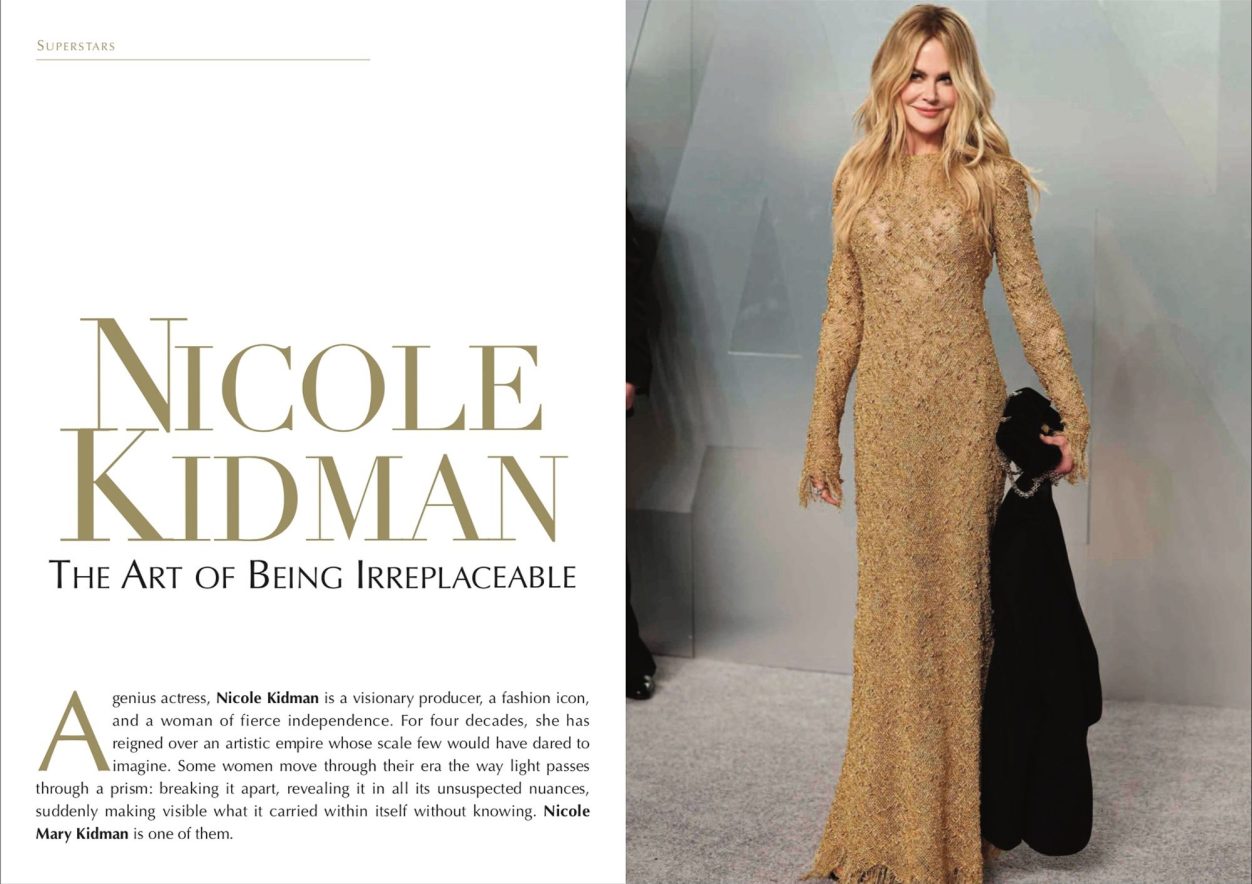
NICOLE KIDMAN
THE ART OF BEING IRREPLACEABLE
A genius actress, Nicole Kidman is a visionary producer, a fashion icon, and a woman of fierce independence. For four decades, she has reigned over an artistic empire whose scale few would have dared to imagine. Some women move through their era the way light passes through a prism: breaking it apart, revealing it in all its unsuspected nuances, suddenly making visible what it carried within itself without knowing. Nicole Mary Kidman is one of them. Born on June 20, 1967, in Honolulu, Hawaii, to Australian parents, raised in the lush suburbs of Sydney, and thrust early onto the stage of an extraordinary destiny, she is today, at fifty-eight, the most prolific, decorated, and fascinating actress of her generation. A woman whose supernatural beauty is merely the most accessible surface of a talent whose depth, film after film, decade after decade, continues to astonish even the most discerning.
Sydney, Honolulu, Hollywood: the path of a predestined star Little Nicole grew up in a cultured and loving family—her father, Antony Kidman, was a biochemist and clinical psychologist; her mother, Janelle, a nurse and editor—who instilled in her a strong work ethic, a love of words, and an insatiable intellectual curiosity. From her teenage years, the young woman with auburn curls abandoned ballet—her first passion—to devote herself to theater, attending the Philip Street Theatre in Sydney, where she quickly established herself as a formidable dramatic force. At sixteen, she landed her first role in an Australian film, Bush Christmas (1983). The following year, BMX Bandits brought her to the attention of the Australian public. But it was in 1989, with the seafaring thriller Dead Calm—in which she held her own against Billy Zane with a mastery and presence truly astonishing for a twenty-two-year-old—that the world realized a star of rare magnitude had been born. Hollywood soon came knocking at her door. From Role to Embodiment: The Genius of a Complete Actress What sets Nicole Kidman apart from nearly all of her contemporaries is a prodigious ability to disappear into her characters while infusing them with an inimitable presence. She doesn’t act—she inhabits. She doesn’t perform—she becomes.
And this mysterious alchemy of technique and grace, discipline and surrender, has produced a filmography of such richness and diversity that few actresses over four decades can claim anything comparable. To Die For (1995) by Gus Van Sant revealed her as an ambitious, icy manipulator whose hunger for fame is matched only by her complete lack of empathy—a biting, ironic performance that earned her a Golden Globe and the enduring admiration of international critics. Eyes Wide Shut (1999) by Stanley Kubrick—her final film with the director—remains one of the most intense and memorable collaborations in cinema history. Kidman embodied Alice Harford with a haunting sensuality and moral ambiguity of dizzying depth, proving she could meet the gaze of the most exacting eye ever behind a camera. Moulin Rouge! (2001) by Baz Luhrmann allowed her to reveal a previously unseen dimension: a voice, musical grace, and a tragic lightness that made Satine one of the most beloved heroines of 2000s cinema. The Hours (2002) by Stephen Daldry won her the Academy Award for Best Actress—an honor fully deserved for her portrayal of Virginia Woolf, marked by intelligence, profound humanity, the iconic nasal prosthetic, and, above all, an understanding of inner suffering that transcended any conventional acting technique. Lion (2016), The Killing of a Sacred Deer (2017) by Yorgos Lanthimos, Being the Ricardos (2021) by Aaron Sorkin—where she transformed herself down to her eyebrows to become Lucille Ball—and Babygirl (2024), Halina Reijn’s erotic thriller for which she won the Volpi Cup for Best Actress at the Venice Film Festival: these milestones chart a career that stubbornly rejects repetition and easy choices.
The Queen of Prestige Television Where other film stars might see television as a step down, Nicole Kidman embraced it as a new territory of freedom and rigor. With Big Little Lies (HBO, 2017)—which she co-produced with Reese Witherspoon through her company Blossom Films—she won both the Emmy and the Golden Globe for Best Actress in a Limited Series, setting a standard of production and performance on the small screen that redefined the boundaries between cinema and television. The Undoing (HBO, 2020), Nine Perfect Strangers (Hulu, 2021), and Expats (Prime Video, 2024) confirmed her unchallenged dominance on television. In 2024, Forbes named her Hollywood’s highest-paid actress—a distinction that speaks volumes about both the commercial and symbolic value of a career without equal. Blossom Films: Creative Power in Her Own Hands Founded in 2010 in partnership with Per Saari, Blossom Films is the instrument of Nicole Kidman’s creative and financial independence. The company has produced works as diverse as Rabbit Hole, The Undoing, Nine Perfect Strangers, and the first two seasons of Big Little Lies. By retaining control over the development of her projects, Kidman not only earns her acting fees—estimated at $10–20 million per film, and up to $1 million per episode for her TV series—but also benefits from the downstream profits of the successes she has shaped. A Hollywood mogul’s machinery that few actresses manage with such elegance.
Chanel, Omega, Jimmy Choo: The Mark of Absolute Luxury Few actresses possess a presence in an advertising campaign that can instantly elevate the prestige of a brand. Nicole Kidman is one of them. Since 2003, she has been the ambassador for Chanel—most notably the iconic N°5—a collaboration whose famous 2004 advertisement directed by Baz Luhrmann remains one of the most sumptuous and expensive in the history of global perfumery. In October 2025, under the artistic direction of new creative director Matthieu Blazy, the Rue Cambon house welcomed her to the Spring–Summer 2026 runway, officially naming her its new muse—a moment doubly symbolic, coming just a week after the announcement of her separation, making her radiant appearance alongside her two daughters a silent declaration of sovereignty. Her long-standing association with Omega Watches—through which she embodies timeless elegance—and her partnerships with Jimmy Choo, Neutrogena, and Etihad Airways form a portfolio of brands that reflects with near-geometric precision the image she projects worldwide: a woman who is at once accessible and unattainable, sophisticated without ostentation, luminous without artifice. A Fortune Fit for an Empress Nicole Kidman’s fortune is consistently estimated by industry observers at around $250 million—an empire patiently built over four decades of record-breaking salaries, production profits, multimillion-dollar endorsement deals, and strategic real estate investments. She owns an extensive portfolio of prestigious properties across several continents: a Manhattan penthouse, a Beverly Hills home, a primary residence in Nashville, an apartment overlooking Sydney Harbour, and a rural estate in Australia’s Southern Highlands—each a jewel in a collection whose total value exceeds $40 million. Her single contract for the famous 2004 Chanel N°5 campaign earned her $12 million, making it at the time one of the highest-paid celebrity endorsement deals in the history of the perfume industry. Between September 2019 and September 2020 alone, her acting earnings were estimated at $22 million.
Nicole Kidman is not content to be a star; she runs an empire. Private Life: The Woman Behind the Icon Nicole Kidman’s private life, like her filmography, has fueled the public imagination. Her marriage to Tom Cruise (1990–2001), which made them one of Hollywood’s most glamorous and scrutinized couples, left her with two adopted children—Isabella and Connor—and, upon the divorce, a freedom she immediately put to its most creative use. Her union with Australian country music star Keith Urban—celebrated in June 2006 at an Irish castle under the world’s gaze—long seemed to embody the ideal of enduring, companionable love.
The couple has two daughters: Sunday Rose, born in 2008, and Faith Margaret, born in 2010. After nineteen years of marriage, their separation was announced in September 2025. The divorce, finalized in January 2026, left each party in full control of their respective fortunes—without alimony or any obligation of support. This clarity in the resolution of a long union says much about the woman Kidman has become: sovereign over herself, dignified in adversity, and resolutely focused on the future. A few weeks later, she appeared at the Chanel runway show in Paris, radiant and liberated, accompanied by her two daughters—a portrait of grace the world remembered as a lesson in elegant resurrection. Her primary custody of the two teenage girls, whom she now raises alone for most of the year, is a testament to a deeply invested and fiercely protected motherhood. 2026 and Beyond: A Queen in Full Conquest While many actresses of her generation slow down, Nicole Kidman accelerates. In March 2026, she launched the Prime Video series Scarpetta—an adaptation of Patricia Cornwell’s novel in which she plays forensic pathologist Kay Scarpetta, hunting a serial killer alongside Jamie Lee Curtis. On May 4, she co-chaired the 2026 Met Gala alongside Beyoncé, Venus Williams, and Anna Wintour—her third time presiding over the most glamorous event on the global cultural calendar. On September 18, 2026, she will reunite with Sandra Bullock for Practical Magic 2 (Warner Bros.), the highly anticipated sequel to Practical Magic (1998), directed by Susanne Bier. She will also appear in the third and final season of Big Little Lies—whose return announcement electrified streaming platforms worldwide—and stars in Osgood Perkins’ upcoming horror film The Young People, scheduled for 2026.
Adding to this already dizzying schedule are Margo's Got Money Troubles (A24/Apple TV+, with Elle Fanning and Michelle Pfeiffer), the series Discretion (Paramount+) alongside Elle Fanning, season 3 of Lioness, and the Amazon series Girls and Their Horses. A lineup that would leave any Hollywood agent stunned—and that, for Kidman, seems simply natural. A Reign Without Dusk Ultimately, what makes Nicole Kidman a unique presence in the world of cinema is not her beauty—fleeting by nature—nor even her talent, which, to varying degrees, is shared by many others. What makes her irreplaceable is this singular combination of courage and grace: the courage to take risks in every role, the grace to turn them into something beautiful; the courage to reveal her life, the grace to elevate it; the courage to age in the spotlight, the grace to do so with a dignity that makes time feel like triumph. At fifty-eight, Nicole Kidman is not at the twilight of her legend. In truth, she is at its beating heart. And for those who have watched her since the beginning of this extraordinary career, only one certainty shines bright and whole: the best of Nicole Kidman—actress, woman, force of nature—may well still be ahead.
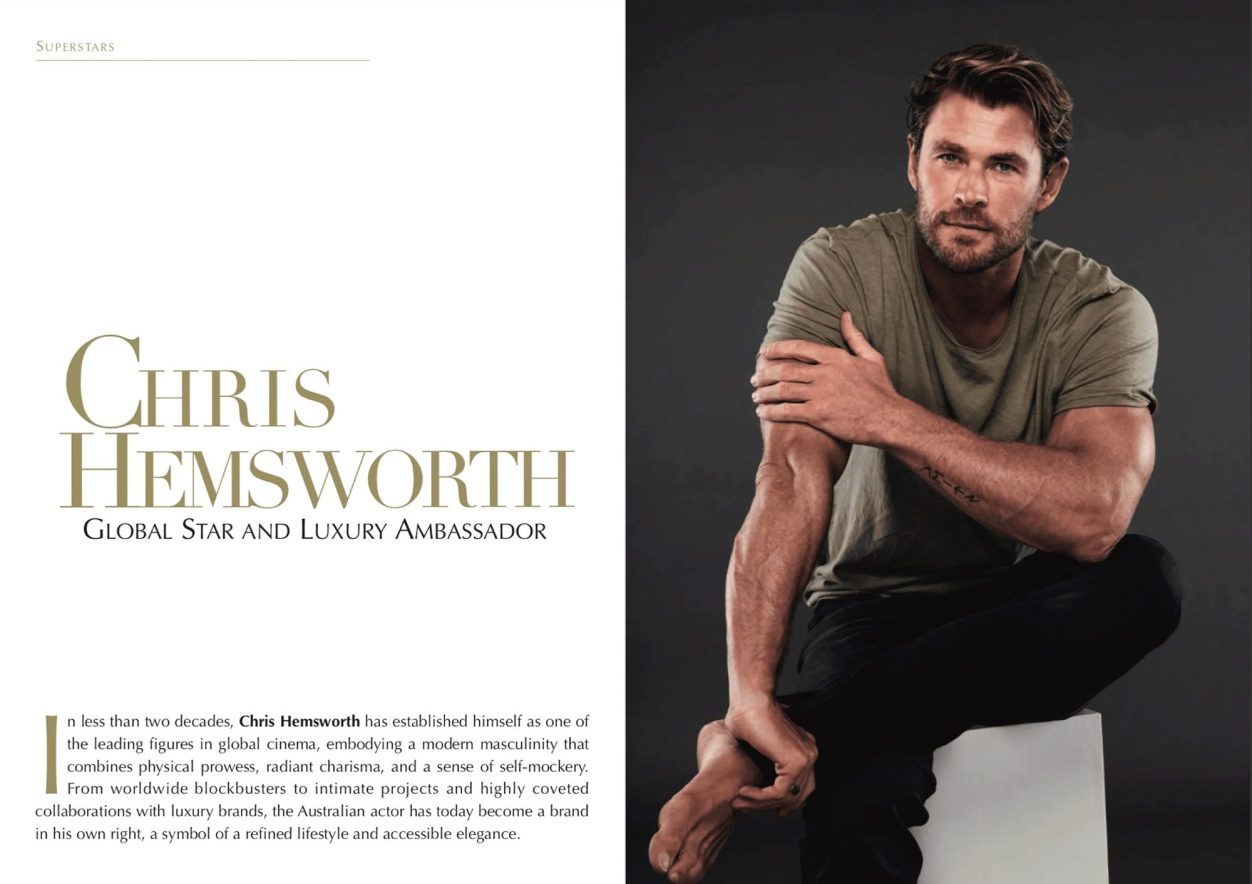
CHRIS HEMSWORTH
GLOBAL STAR AND LUXURY AMBASSADOR
In less than two decades, Chris Hemsworth has established himself as one of the leading figures in global cinema, embodying a modern masculinity that combines physical prowess, radiant charisma, and a sense of self-mockery. From worldwide blockbusters to intimate projects and highly coveted collaborations with luxury brands, the Australian actor has today become a brand in his own right, a symbol of a refined lifestyle and accessible elegance.
An Australian Who Became a Global Icon Born in Melbourne in 1983, Chris Hemsworth first captured the public’s attention through the Australian series Home and Away. He soon left the comfort of the small screen to try his luck in Hollywood, landing a notable early role in Star Trek (2009). But it was in 2011, with his portrayal of Thor in the Marvel universe, that he became an essential face of contemporary cinema. His interpretation of the modernized Norse god—combining raw strength with humor—catapulted him to global icon status. His filmography reflects a sharp intelligence in choosing roles. Alternating between major franchises and auteur-driven projects—from Ron Howard’s Rush, a sophisticated biopic of pilot James Hunt, to Bad Times at the El Royale and the thriller Spiderhead—Chris Hemsworth refuses to be confined to the superhero archetype.
He cultivates a nuanced range, able to move seamlessly from drama to comedy, all while maintaining the distinctive physical presence that has become his signature. On the Road of Memories In 2025, Chris Hemsworth revealed a deeply personal side of himself by co-directing the documentary Chris Hemsworth: On the Road of Memories, a poignant work dedicated to Alzheimer’s disease. Today, more than 57 million people worldwide live with dementia, and nearly 10 million new cases are diagnosed each year. Confronted with this sobering reality, Chris chose to address a universal question: what can we do to support those affected? In this moving project, he embarks on a motorcycle journey across Australia alongside his father, Craig, who was recently diagnosed. Together, they strive to rekindle their memories and strengthen their bond, exploring the power of connection, community, and nostalgia—treasures that are sometimes forgotten but essential for maintaining brain health. More than a documentary, it is a tribute to familial love and the strength of memories, an invitation to embrace what makes us profoundly human.
A Career in Constant Motion Riding the colossal success of the Avengers saga, in which he is one of the cornerstones, Chris Hemsworth has leveraged his fame to establish franchises under his own name, such as Extraction, for which he also serves as producer. This dual role as actor and producer allows him to influence artistic choices—from writing to directing—and to shape darker, more contemporary action narratives. His schedule remains incredibly full. After Furiosa: A Mad Max Saga, where he explores a more ambiguous range, he is set to appear in new Marvel installments as well as in productions currently in post-production, such as Crime 101 and Avengers: Doomsday. He is also expanding into documentaries and hybrid formats, exploring nature, physical performance, and the limits of the human body, continuing the trajectory he began with the series Limitless. Private Life, Lifestyle, and Wealth Away from the Hollywood frenzy, Chris Hemsworth has settled in Byron Bay, Australia, with his wife Elsa Pataky and their three children, in a home that embodies understated contemporary luxury: endless ocean views, minimalist design, and harmony with nature. Surfing, sports, and family life contribute to an authenticity rarely seen at this level of fame. Financially, Chris Hemsworth ranks among the highest-paid actors of his generation, with an estimated fortune exceeding $100 million, thanks to his Hollywood salaries, ambassadorial contracts, and investments.
He has also developed his own wellness ecosystem through the app Centr, which offers a comprehensive program combining training, nutrition, and mindfulness—a reflection of his philosophy of a balanced, high-performing lifestyle. A Natural Face of Contemporary Luxury Beyond the film sets, Chris Hemsworth has become a sought-after partner for luxury houses, embodying a new-generation masculine elegance that is both sporty and radiant. TAG Heuer has welcomed him into its family of international ambassadors, extending a connection first forged through the film Rush, perfectly aligned with the brand’s DNA and its heritage in motorsports. The actor also lends his image to premium fashion houses, including Hugo Boss, in campaigns where his charisma and athletic physique harmonize with urban wardrobes and sophisticated tailoring. The result is a modern embodiment of luxury masculinity: disciplined without ostentation, sophisticated without affectation, somewhere between cinematic superhero and Australian beach man. Upcoming Projects Chris Hemsworth has a particularly busy schedule in the coming years, continuing his status as an action star while exploring more nuanced roles. Feature films already shot or completed: Crime 101: a heist thriller directed by Bart Layton, in which he plays a jewel thief on Highway 101. Avengers: Doomsday: a new installment in the Marvel universe, currently in post-production, scheduled for 2026.
Ongoing shoots and announced films: Subversion: an action thriller described as a “Die Hard on a submarine,” for Amazon MGM. Stuntnuts: The Movie: the first installment of a series centered on a group of stunt performers, in which Chris Hemsworth plays himself alongside Sam Rockwell. Crossover Transformers / G.I. Joe (working title): a project in pre-production that would further solidify his presence in major global franchises.
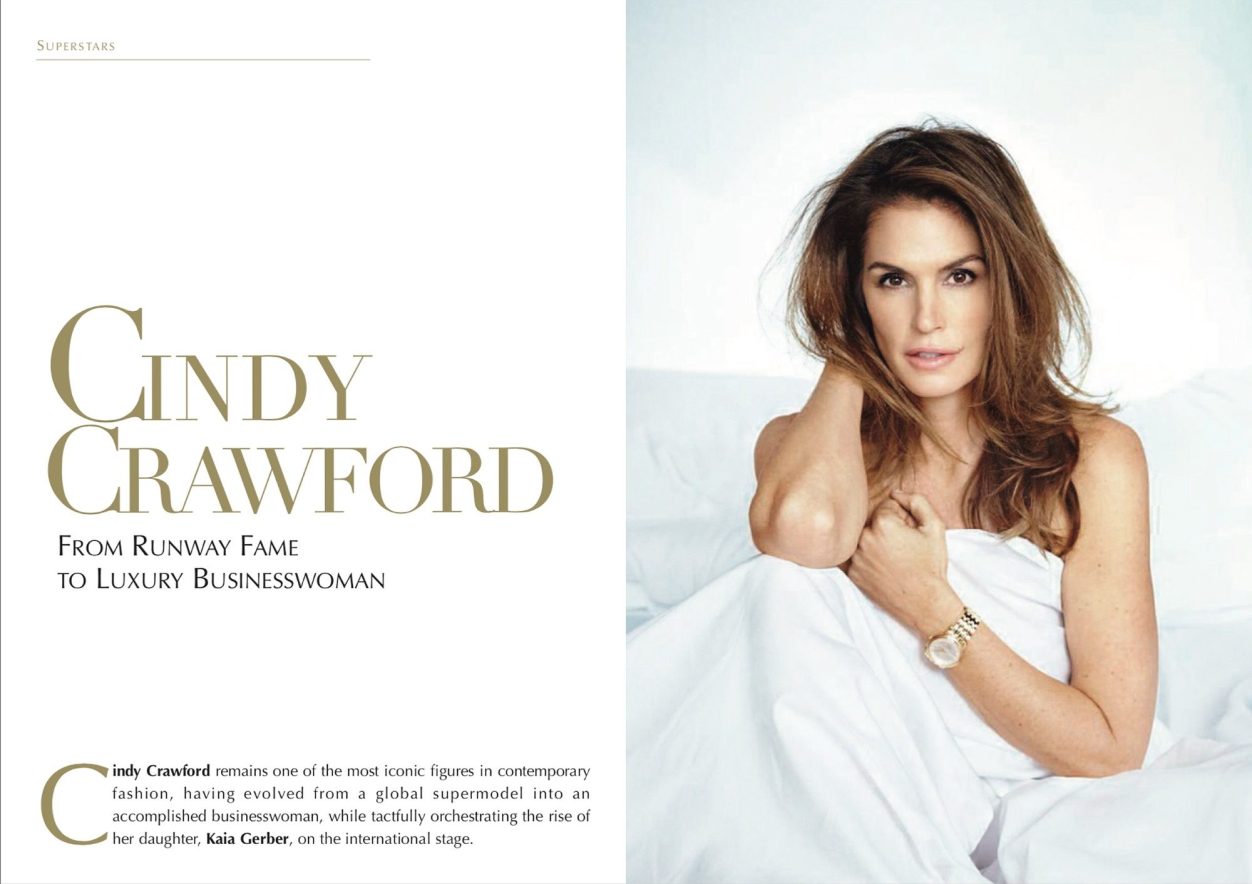
CINDY CRAWFORD
FROM RUNWAY FAME TO LUXURY BUSINESSWOMAN
Cindy Crawford remains one of the most iconic figures in contemporary fashion, having evolved from a global supermodel into an accomplished businesswoman, while tactfully orchestrating the rise of her daughter, Kaia Gerber, on the international stage. Her influence now spans luxury watchmaking, beauty, high-end furniture, and the entertainment industry, forming a remarkably well-managed career continuum.
A Pioneering Supermodel Career Born in 1966 in Illinois, Cindy Crawford rose to prominence in the late 1980s and throughout the 1990s as one of the leading faces of the “supermodel” wave, alongside Naomi Campbell, Claudia Schiffer, and Linda Evangelista. She was quickly sought after by the top fashion houses and became one of the symbols of a decade in which models achieved true celebrity status. She stood out with an image that was both radiant and approachable, appealing to mainstream advertising as well as the luxury world, appearing on countless magazine covers, runways, and international campaigns. Her role in an iconic Pepsi commercial aired during the Super Bowl, notably featuring her famous denim shorts, helped establish her as a pop icon far beyond the fashion circle.
Luxury Brand Ambassador Among her most defining collaborations is her partnership with the Swiss watchmaker OMEGA. Beginning in 1995, she became the face of the “My Choice” campaign, associated with the launch of a new Constellation model that quickly became known as “Cindy’s watch.” She didn’t limit herself to serving as the brand’s image; she contributed to the design of the Constellation collection, aiming for a more feminine and practical aesthetic. Nearly 30 years later, she remains an official ambassador of the brand, bringing her children Kaia and Presley into the OMEGA “family” in 2017.
Over the course of her career, Cindy Crawford has appeared in campaigns for major fashion houses—most notably Versace—as well as numerous beauty brands such as Revlon, cementing her image as a timeless muse for the luxury industry. She is still regularly invited to embody the “90s revival,” as seen in a recent collaboration with Zara for the brand’s 50th anniversary, where she reinterpreted her youthful image in an ultra-glamorous seaside setting. Businesswoman and Entrepreneurial Ventures Far from limiting herself to the role of muse, Cindy Crawford built a genuine entrepreneurial portfolio early on. She is co-founder of the skincare brand Meaningful Beauty, created in collaboration with French cosmetic surgeon Jean-Louis Sebagh. The line leverages antioxidants derived from a melon with exceptional longevity to offer a range of anti-aging products. This direct-to-consumer brand, launched long before the current wave of “celebrity beauty brands,” has established itself as a lasting success, with estimated annual revenues exceeding $100 million and a valuation approaching $400 million, of which she owns roughly 50%.
At the same time, she developed Cindy Crawford Home, a furniture collection positioned in the accessible-chic segment, distributed through over 500 showrooms across the United States, leveraging her image as an elegant, family-oriented woman. Her marriage in 1998 to entrepreneur Rande Gerber also placed her at the heart of another resounding success: Casamigos, the tequila brand co-founded by Gerber, George Clooney, and Mike Meldman. She has supported its growth through her influence and public image, helping establish it as a major player in the premium segment. Her New Entrepreneurial Momentum and Projects Cindy Crawford is now entering a phase of professional maturity, carefully selecting each project to nurture and expand her brand ecosystem. Meaningful Beauty, celebrating its 20th anniversary, remains her most visible initiative: she continues to serve as its spokesperson, embodying aging with confidence, based on prevention, rigorous skincare routines, and careful image management—including personal discipline regarding sleep, diet, and alcohol in preparation for shoots.
At the same time, she leverages her fashion collaborations—whether occasional appearances in fashion campaigns or partnerships with mainstream brands—as visibility tools designed to support her own ventures, particularly her furniture and skincare lines.
The couple has also made numerous high-end real estate investments, particularly in Malibu and Mexico, buying, renovating, and reselling coastal properties with significant added value—sometimes for amounts exceeding tens of millions of dollars. This wealth-building strategy, combined with the value of her brands and the partial sale of certain assets, has positioned Cindy Crawford within the exclusive circle of fashion entrepreneurs whose fortunes are built on a true empire of licenses and joint ventures. Kaia Gerber, the Heiress of Style Daughter of Cindy Crawford and Rande Gerber, Kaia Gerber has emerged as one of the leading faces of Generation Z in the luxury world, carrying forward and reinventing her mother’s legacy. At the age of 10, she modeled for Young Versace and signed with IMG Models in 2015, going on to campaign for Alexander Wang, Chrome Hearts, Miu Miu, Chanel, Prada, and Celine, while walking for the biggest fashion houses.
Kaia quickly became the face of Marc Jacobs Beauty and YSL Beauté, cemented her status with magazine covers, and stood out on the runway—walking 26 shows and opening and closing several during the Fall-Winter 2019 season. She has since expanded into film and television, with roles in Babylon, Bottoms, the series American Horror Story, and, in 2024, a recurring role in Palm Royale on Apple TV+, along with appearances in RuPaul’s Drag Race and Hacks, gradually establishing herself as a fully-fledged actress. Current Activities and Media Presence In the media sphere, Cindy Crawford remains omnipresent in fashion and lifestyle conversations, whether through her embrace of trends—such as the return of boho chic—or the ways younger generations reinterpret her 1990s looks. In 2025, her private life also made headlines when she and Kaia Gerber obtained a long-term protective order against an alleged stalker, revealing the darker side of celebrity life in the age of social media.
She also continues to appear in campaigns celebrating the heritage of major brands, such as the anniversary collaboration with Zara, while maintaining her longstanding ties with OMEGA through commercial and charitable events, notably supporting Orbis International, the flying eye hospital backed by the brand. In this interplay of glamour, charitable engagement, and brand strategy, Cindy Crawford positions herself as a bridge figure—embracing her role both as an icon of her generation and as a public mentor to a new guard embodied by her daughter. Cindy Crawford thus presents the portrait of a legend who has transformed beauty capital into brand capital, an economic empire, and a family narrative, firmly embedding the Gerber-Crawford dynasty at the heart of contemporary luxury imagination.
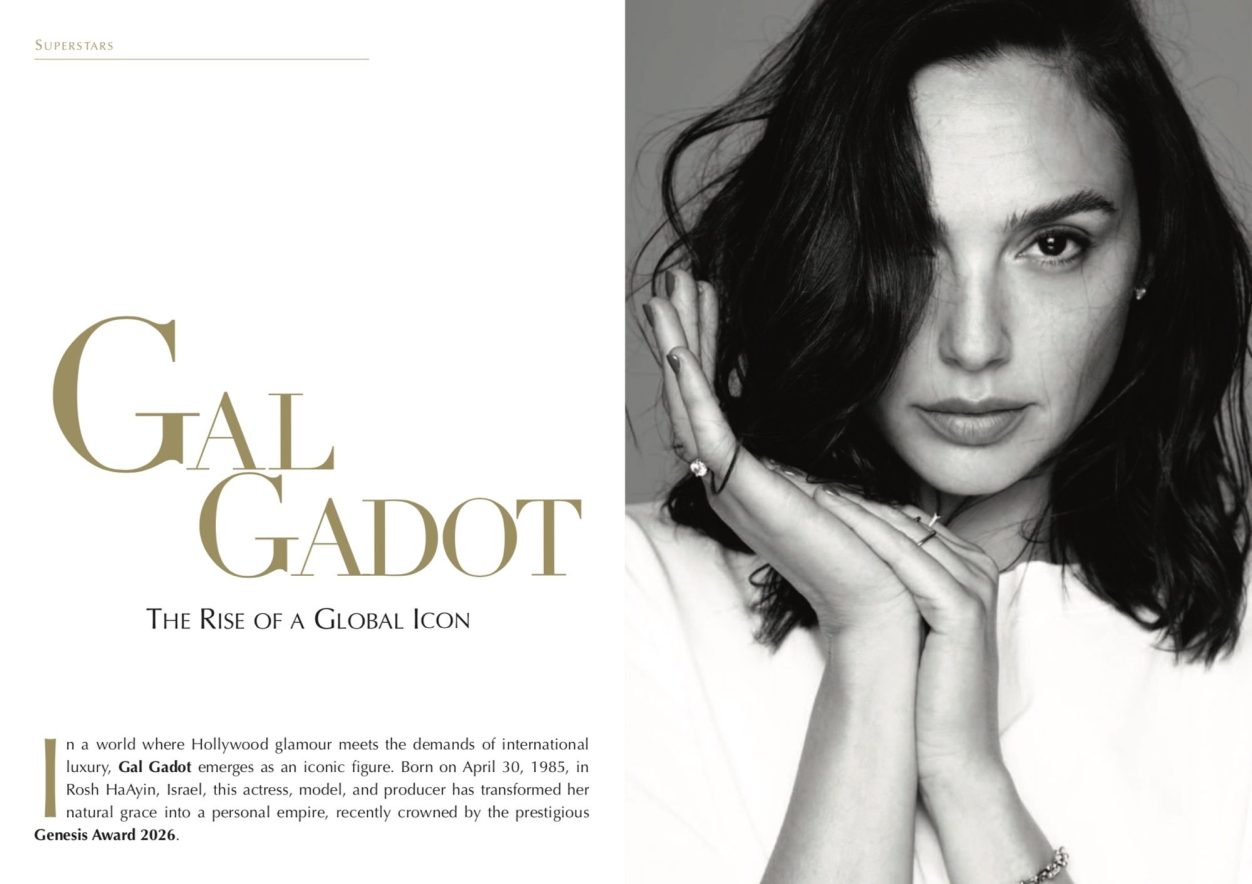
GAL GADOT
THE RISE OF A GLOBAL ICON
In a world where Hollywood glamour meets the demands of international luxury, Gal Gadot emerges as an iconic figure. Born on April 30, 1985, in Rosh HaAyin, Israel, this actress, model, and producer has transformed her natural grace into a personal empire, recently crowned by the prestigious Genesis Award 2026.
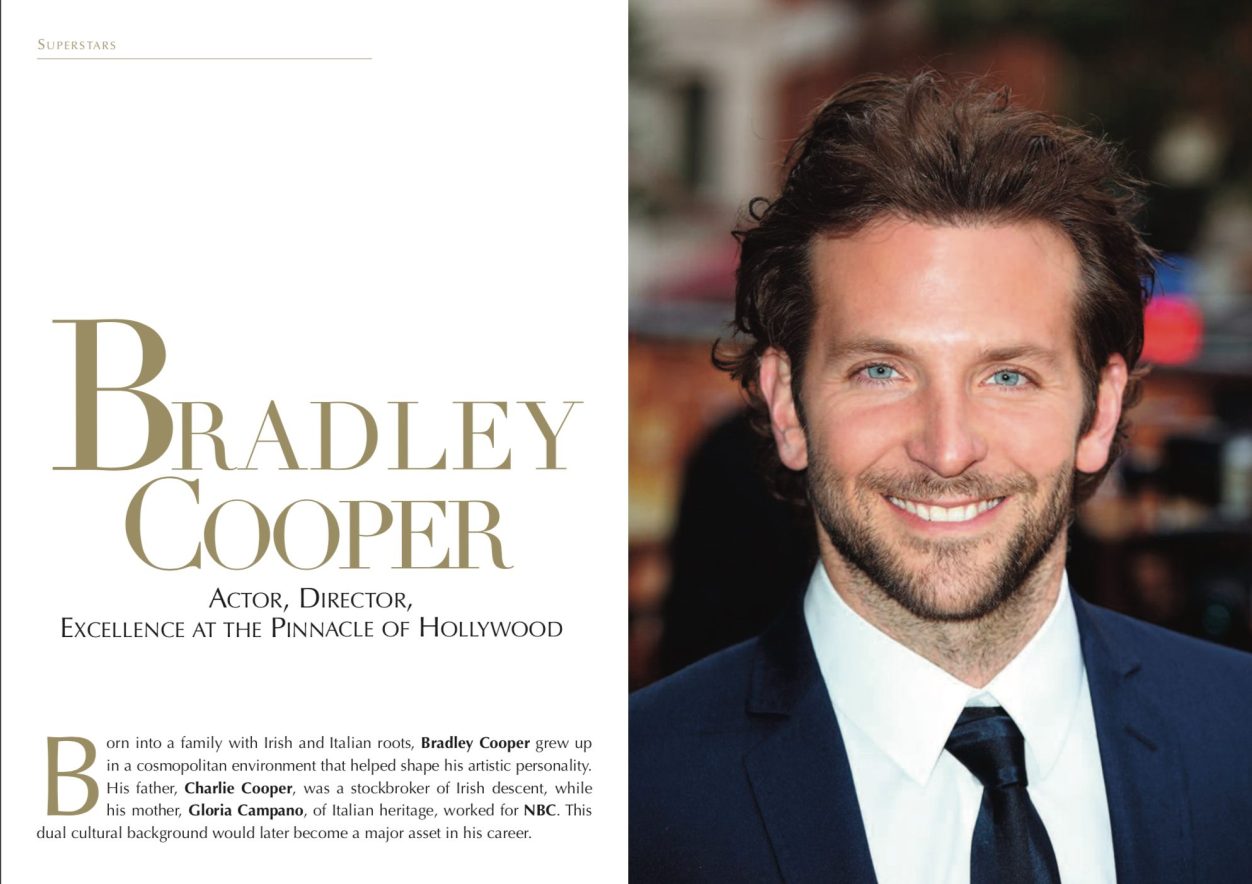
BRADLEY COOPER
ACTOR, DIRECTOR,
EXCELLENCE AT THE PINNACLE OF HOLLYWOOD
Born into a family with Irish and Italian roots, Bradley Cooper grew up in a cosmopolitan environment that helped shape his artistic personality. His father, Charlie Cooper, was a stockbroker of Irish descent, while his mother, Gloria Campano, of Italian heritage, worked for NBC. This dual cultural background would later become a major asset in his career...
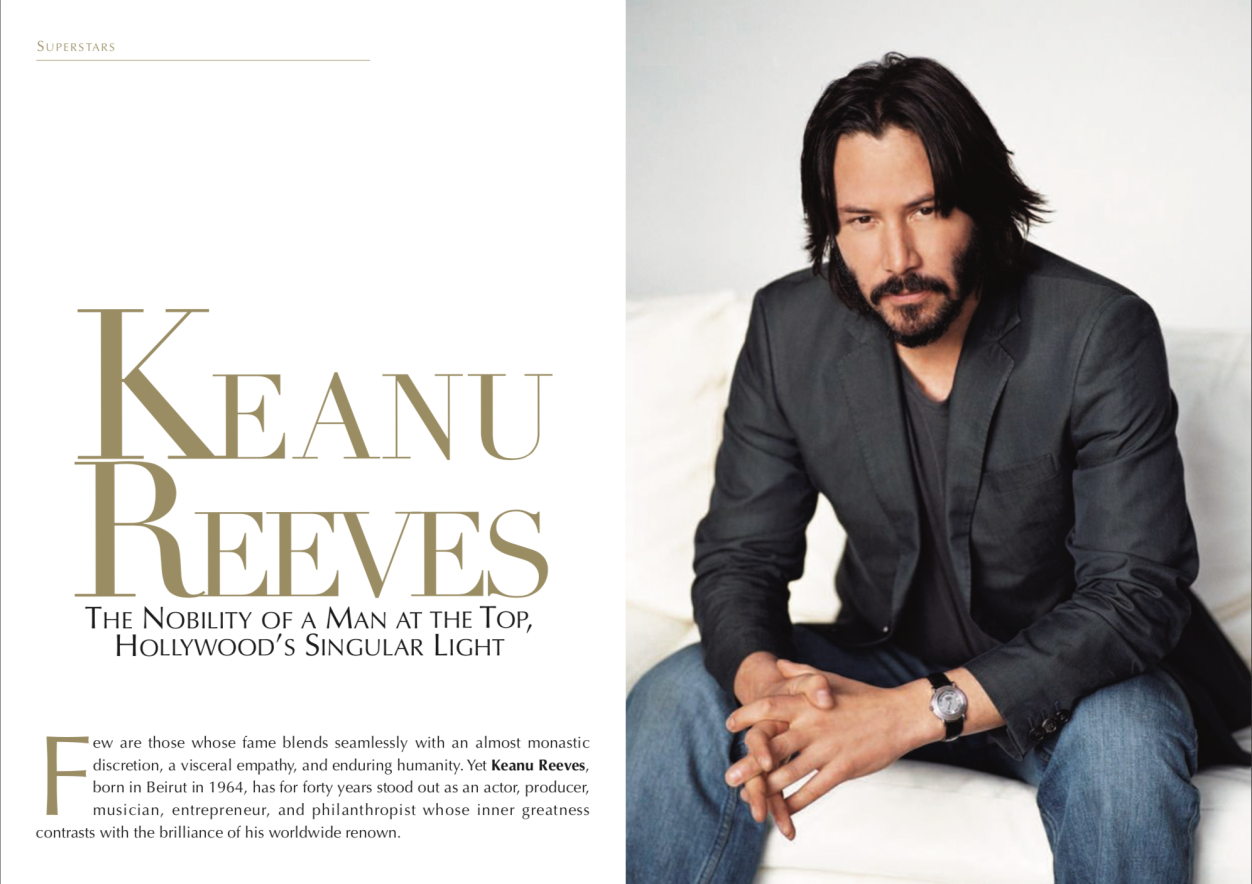
KEANU REEVES
THE NOBILITY OF A MAN AT THE TOP
Few are those whose fame blends seamlessly with an almost monastic discretion, a visceral empathy, and enduring humanity.
Yet Keanu Reeves, born in Beirut in 1964, has for forty years stood out as an actor, producer, musician, entrepreneur, and philanthropist whose inner greatness contrasts with the brilliance
of his worldwide renown...
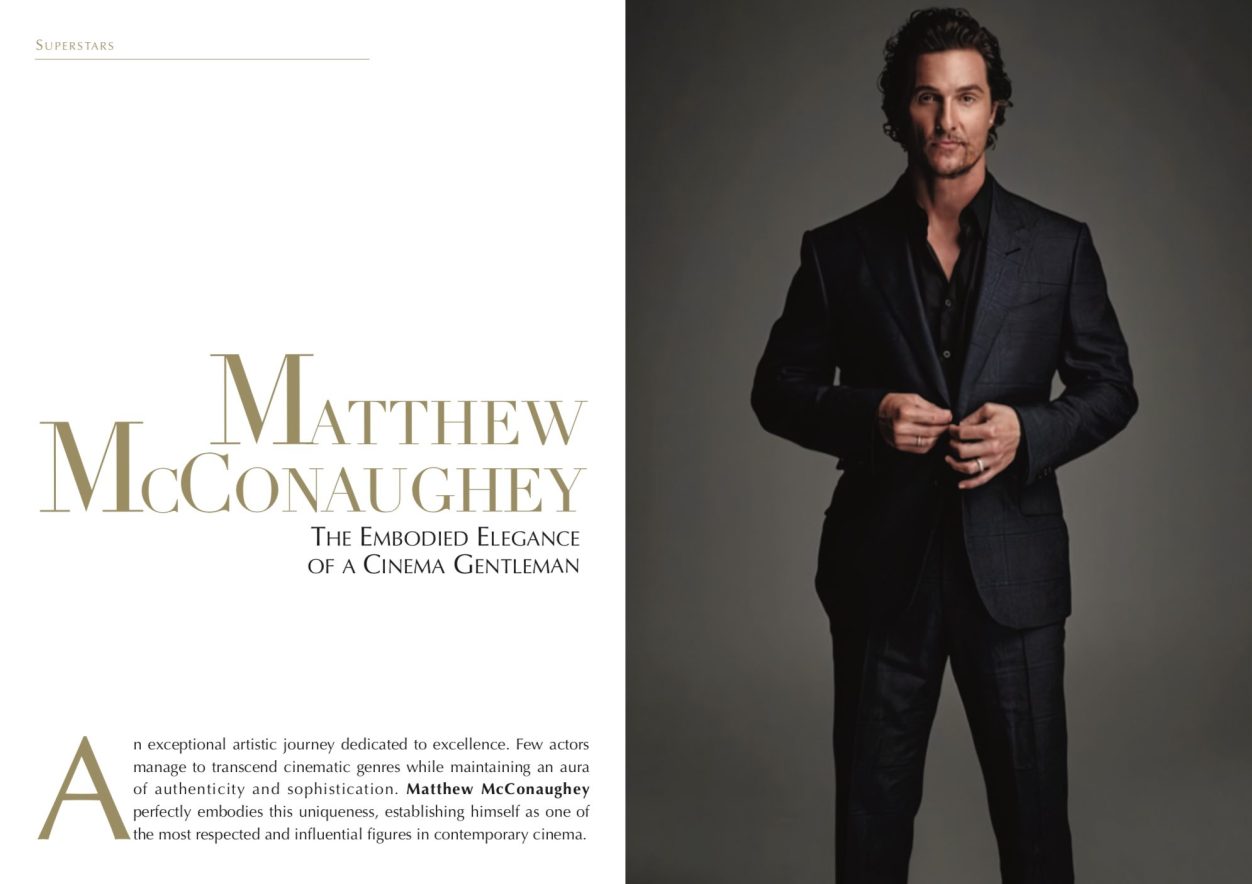
MATTHEW MCCONAUGHEY
THE EMBODIED ELEGANCE OF A CINEMA GENTLEMAN
An exceptional artistic journey dedicated to excellence. Few actors manage to transcend cinematic genres while maintaining an aura of authenticity and sophistication. Matthew McConaughey perfectly embodies this uniqueness, establishing himself as one
of the most respected and influential figures
in contemporary cinema....
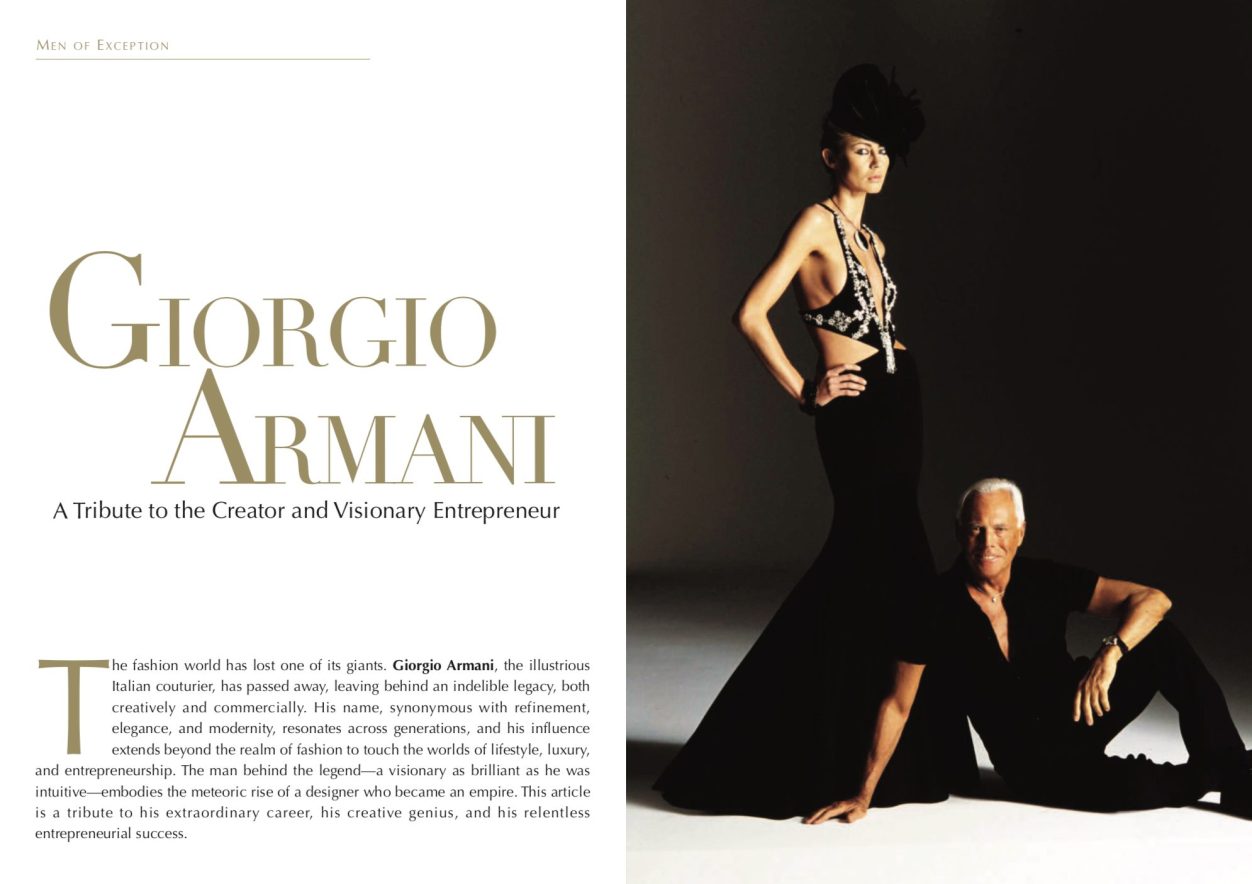
GIORGIO ARMANI
A Tribute to the Creator and Visionary Entrepreneur
The fashion world has lost one of its giants. Giorgio Armani, the illustrious Italian couturier, has passed away, leaving behind an indelible legacy, both creatively and commercially. His name, synonymous with refinement, elegance, and modernity, resonates across generations, and his influence extends beyond the realm of fashion to touch the worlds of lifestyle, luxury, and entrepreneurship. The man behind the legend—a visionary as brilliant as he was intuitive—embodies the meteoric rise of a designer who became an empire. This article is a tribute to his extraordinary career, his creative genius, and his relentless entrepreneurial success...
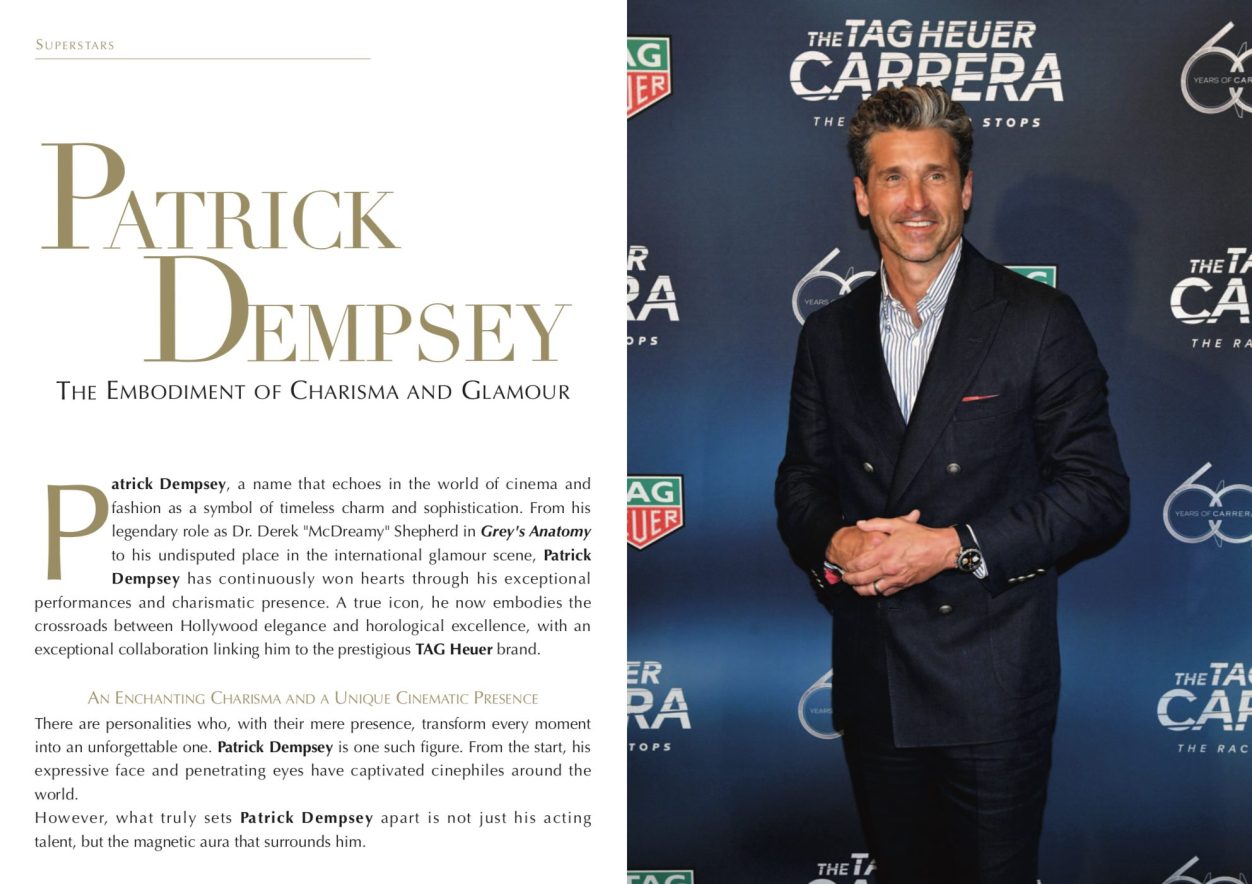
PATRICK DEMPSEY
THE EMBODIMENT OF CHARISMA AND GLAMOUR
Patrick Dempsey, a name that echoes in the world of cinema and fashion as a symbol of timeless charm and sophistication. From his legendary role as Dr. Derek "McDreamy" Shepherd in Grey's Anatomy to his undisputed place in the international glamour scene, Patrick Dempsey has continuously won hearts through his exceptional performances and charismatic presence. A true icon, he now embodies the crossroads between Hollywood elegance and horological excellence, with an exceptional collaboration linking him to the prestigious TAG Heuer brand...
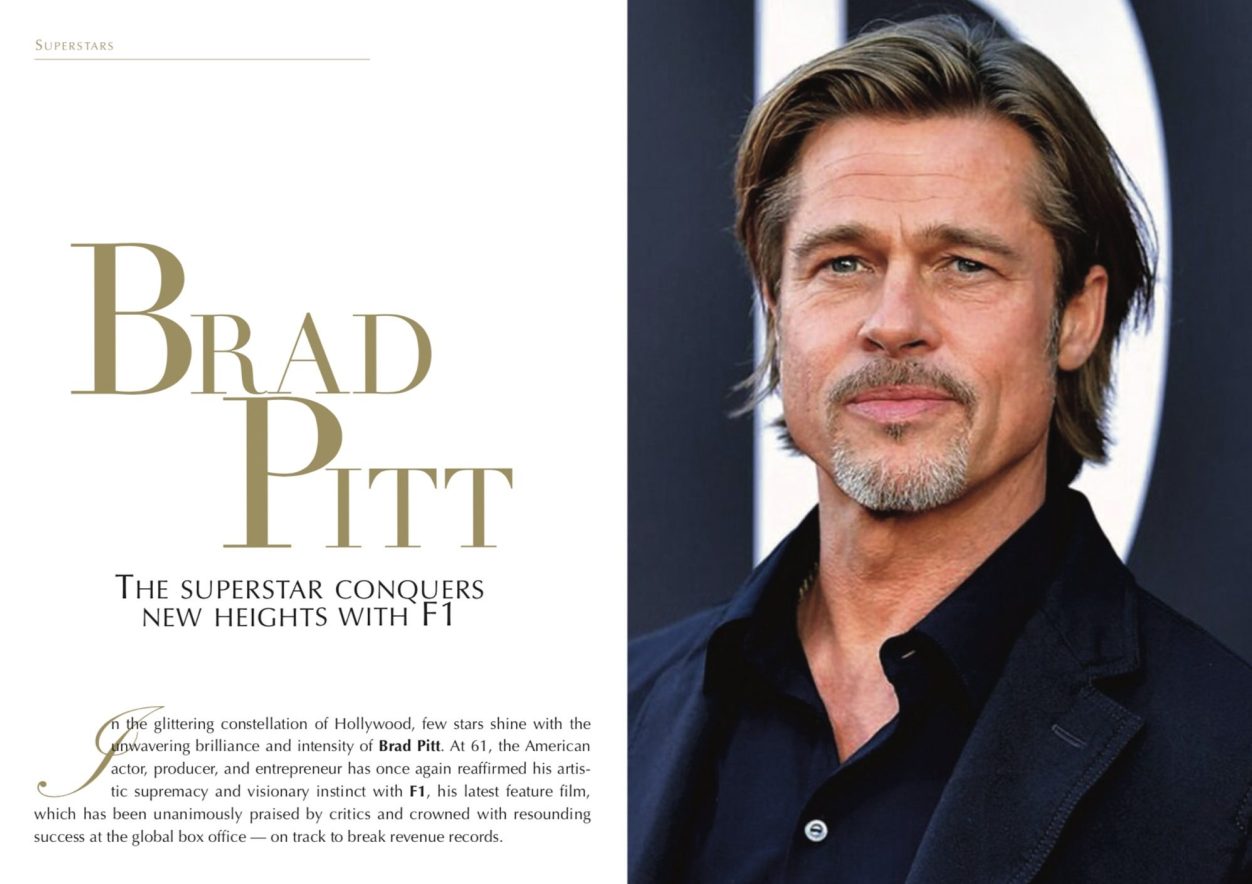
BRAD PITT
THE SUPERSTAR CONQUERS NEW HEIGHTS WITH F1
In the glittering constellation of Hollywood, few stars shine with the unwavering brilliance and intensity of Brad Pitt. At 61, the American actor, producer, and entrepreneur has once again reaffirmed his artis- tic supremacy and visionary instinct with F1, his latest feature film, which has been unanimously praised by critics and crowned with resounding success at the global box office — on track to break revenue records...
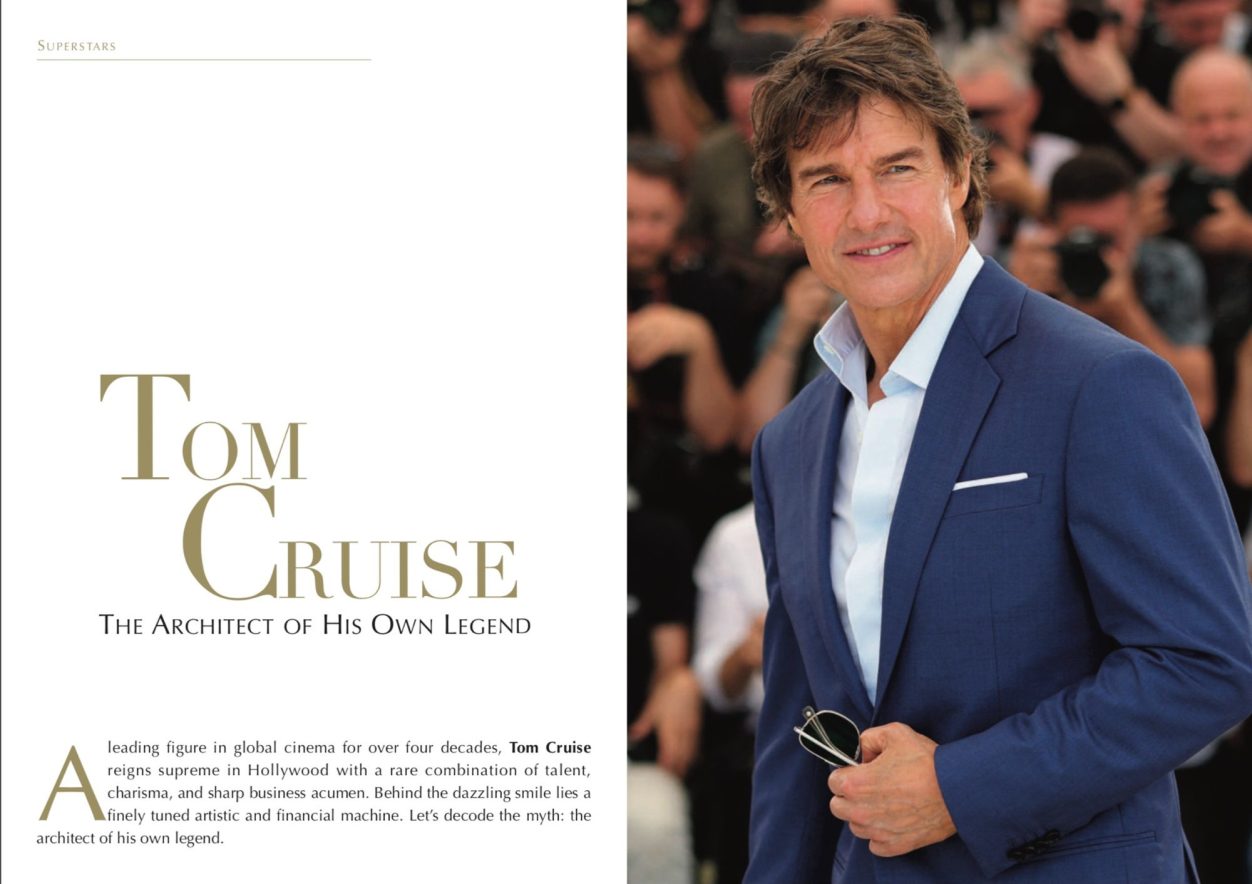
TOM CRUISE
THE ARCHITECT OF HIS OWN LEGEND
A leading figure in global cinema for over four decades, Tom Cruise reigns supreme in Hollywood with a rare combination of talent, charisma, and sharp business acumen. Behind the dazzling smile lies a finely tuned artistic and financial machine. Let’s decode the myth: the architect of his own legend...
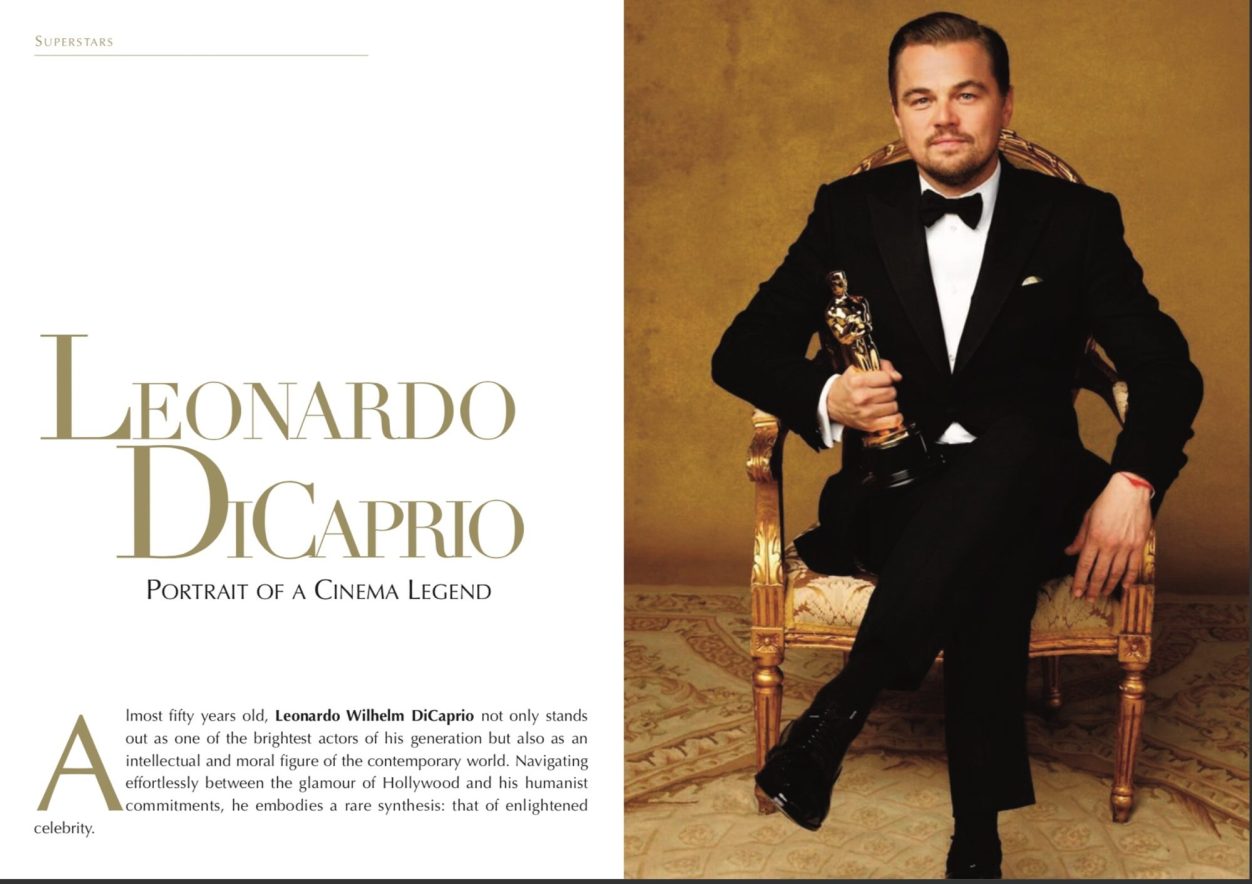
LEONARDO DICAPRIO
PORTRAIT OF A CINEMA LEGEND
Almost fifty years old, Leonardo Wilhelm DiCaprio not only stands out as one of the brightest actors of his generation but also as an intellectual and moral figure of the contemporary world. Navigating effortlessly between the glamour of Hollywood and his humanist...
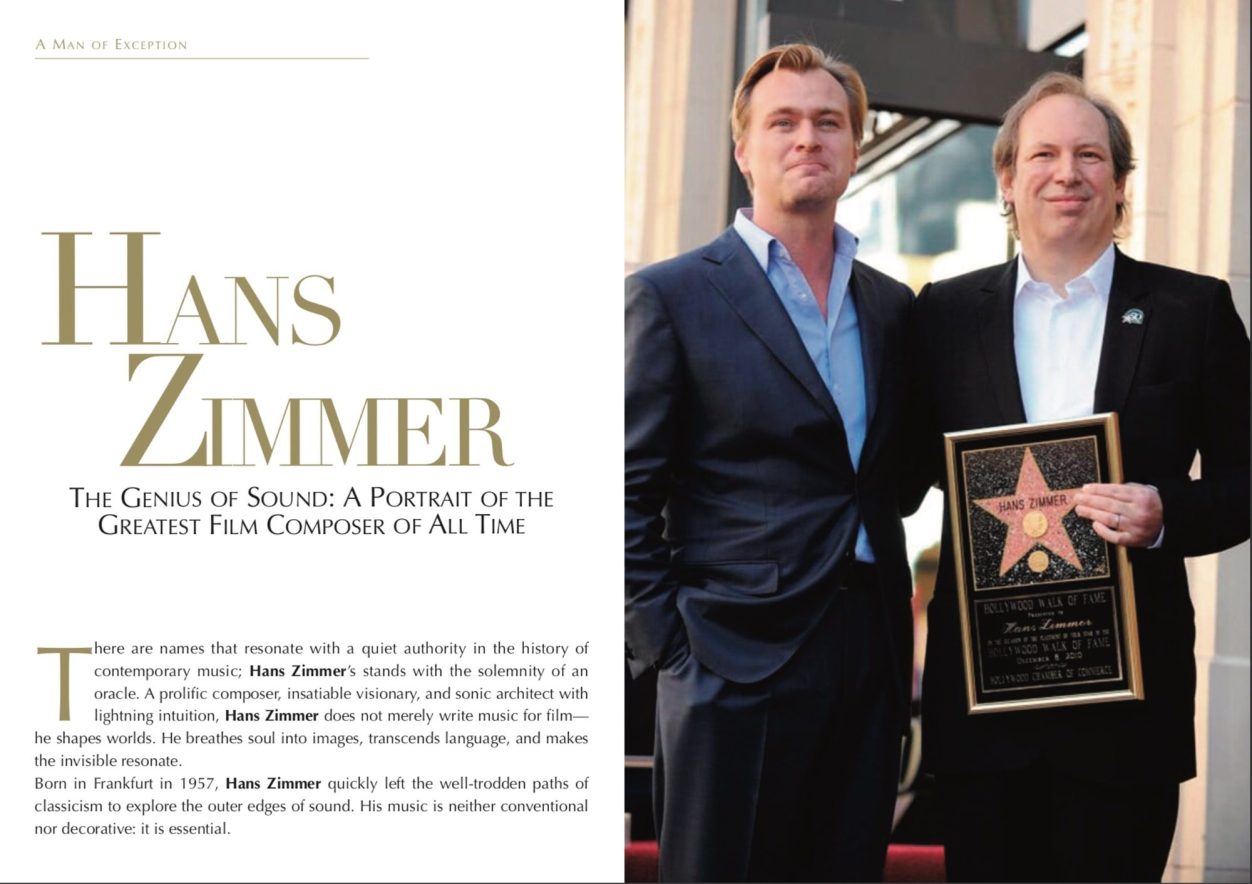
HANS ZIMMER
THE GENIUS OF SOUND:
A PORTRAIT OF THE GREATEST FILM COMPOSER OF ALL TIME
There are names that resonate with a quiet authority in the history of contemporary music; Hans Zimmer’s stands with the solemnity of an oracle. A prolific composer, insatiable visionary, and sonic architect with lightning intuition, Hans Zimmer does not merely write music for film— he shapes worlds. He breathes soul into images, transcends language, and makes the invisible resonate...
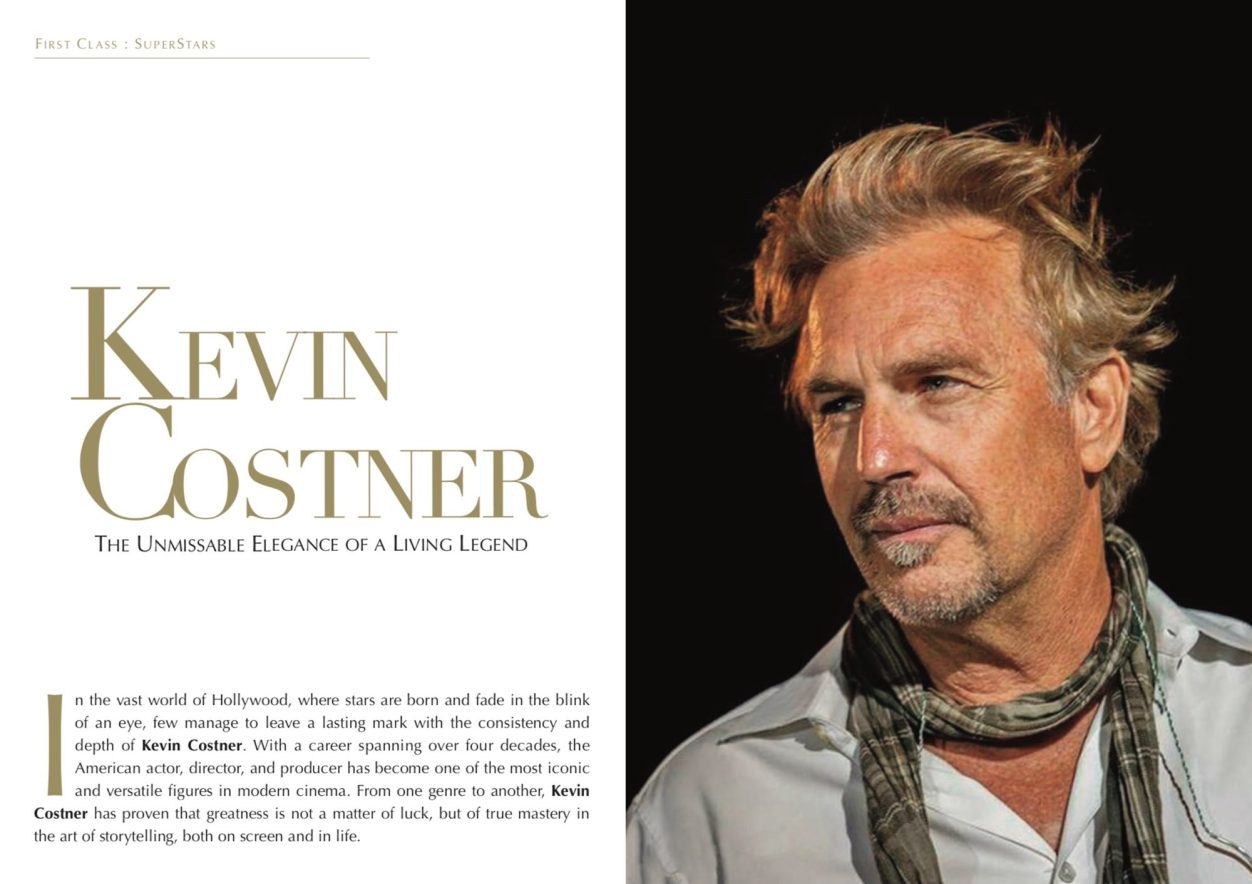
KEVIN COSTNER
THE UNMISSABLE ELEGANCE OF A LIVING LEGEND
In the vast world of Hollywood, where stars are born and fade in the blink of an eye, few manage to leave a lasting mark with the consistency and depth of Kevin Costner. With a career spanning over four decades, the American actor, director, and producer has become one of the most iconic and versatile figures in modern cinema. From one genre to another, Kevin Costner has proven that greatness is not a matter of luck, but of true mastery in the art of storytelling, both on screen and in life...
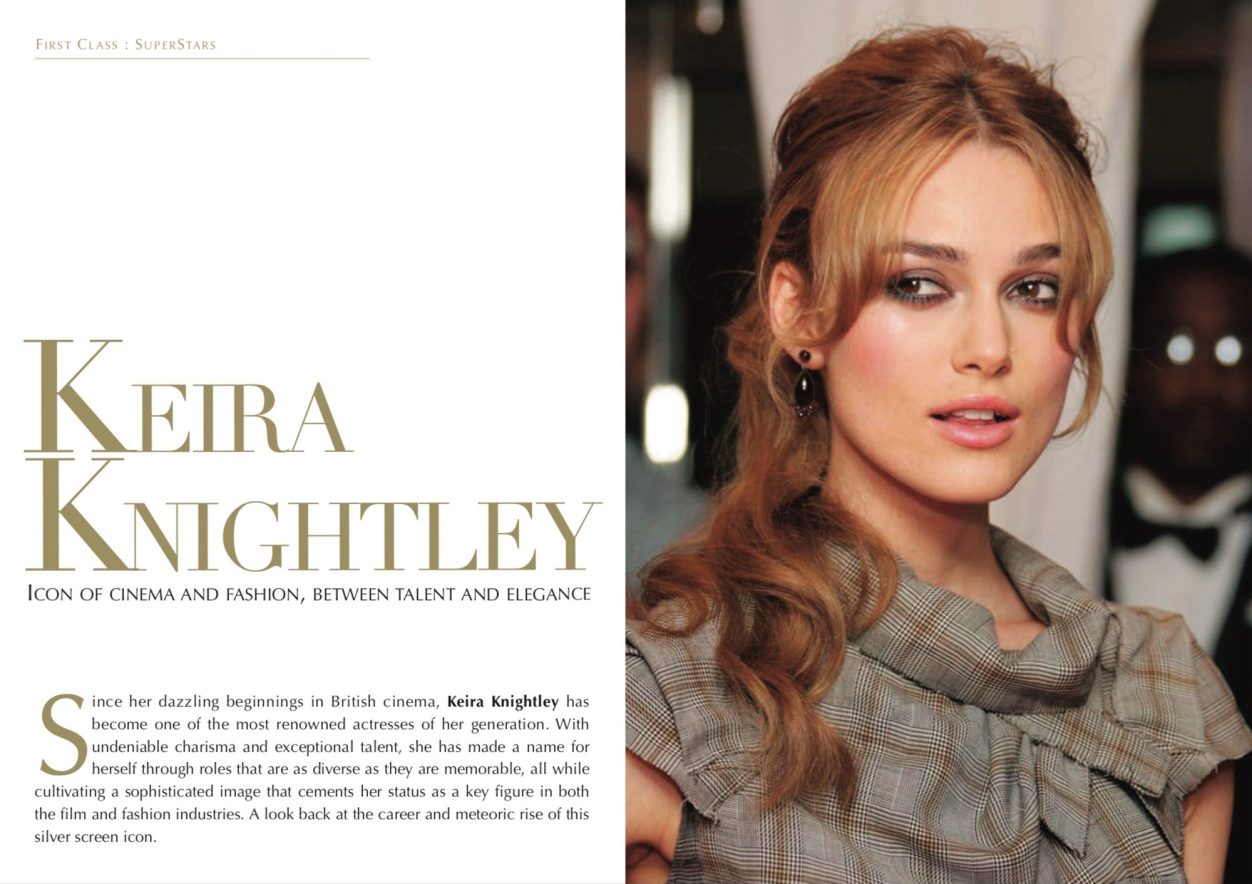
KEIRA KNIGHTLEY
ICON OF CINEMA AND FASHION, BETWEEN TALENT AND ELEGANCE.
Since her dazzling beginnings in British cinema, Keira Knightley has become one of the most renowned actresses of her generation. With undeniable charisma and exceptional talent, she has made a name for herself through roles that are as diverse as they are memorable, all while cultivating a sophisticated image that cements her status as a key figure in both the film and fashion industries. A look back at the career and meteoric rise of this silver screen icon...
MIRIAM ADELSON
A LEGENDARY PHILANTHROPIST, HEIR TO AN EMPIRE,
AND A WOMAN OF GLOBAL INFLUENCE...
SAM ALTMAN
The AI Genius partners with Larry Ellison and Masayoshi Son on the $500 Billion Stargate Project driven by Donald Trump...
LARRY ELLISON
The oracle of Silicon Valley
Few men in the history of modern entrepreneurship have been able to combine with such mastery technological innovation, a forward-thinking vision, and a flamboyant lifestyle. Larry Ellison, co-founder of Oracle Corporation, is a true living legend whose journey and achievements inspire admiration and respect. Larry Ellison embodies the meteoric rise of a self-taught visionary who became one of the richest and most influential men on the planet. His path, marked by resounding successes and bold risks, perfectly illustrates the entrepreneurial spirit that drives the technology industry...
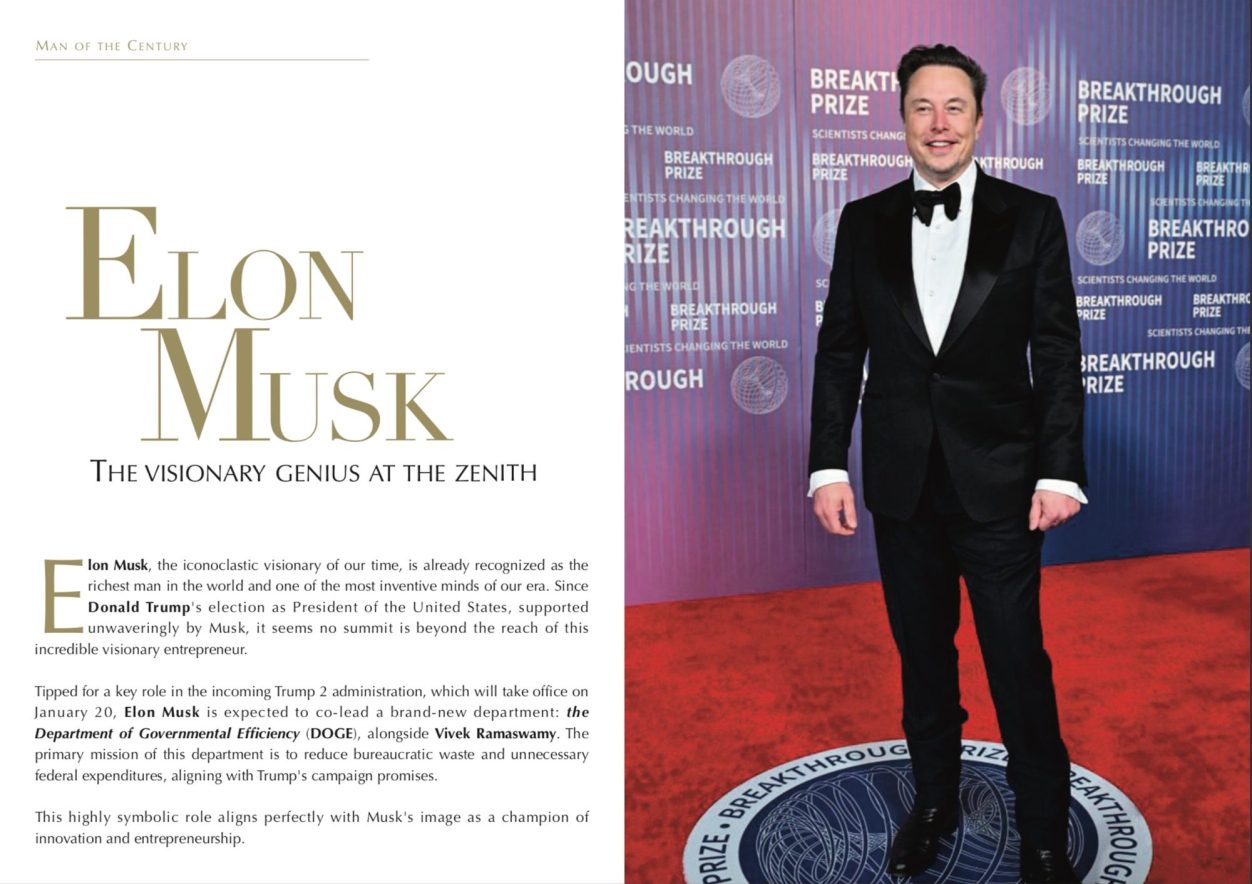
ELON MUSK
The Visionary Genius at the Zenith
Elon Musk, the iconoclastic visionary of our time, is already recognized as the richest man in the world and one of the most inventive minds of our era. Since Donald Trump's election as President of the United States, supported unwaveringly by Musk, it seems no summit is beyond the reach of this incredible visionary entrepreneur...
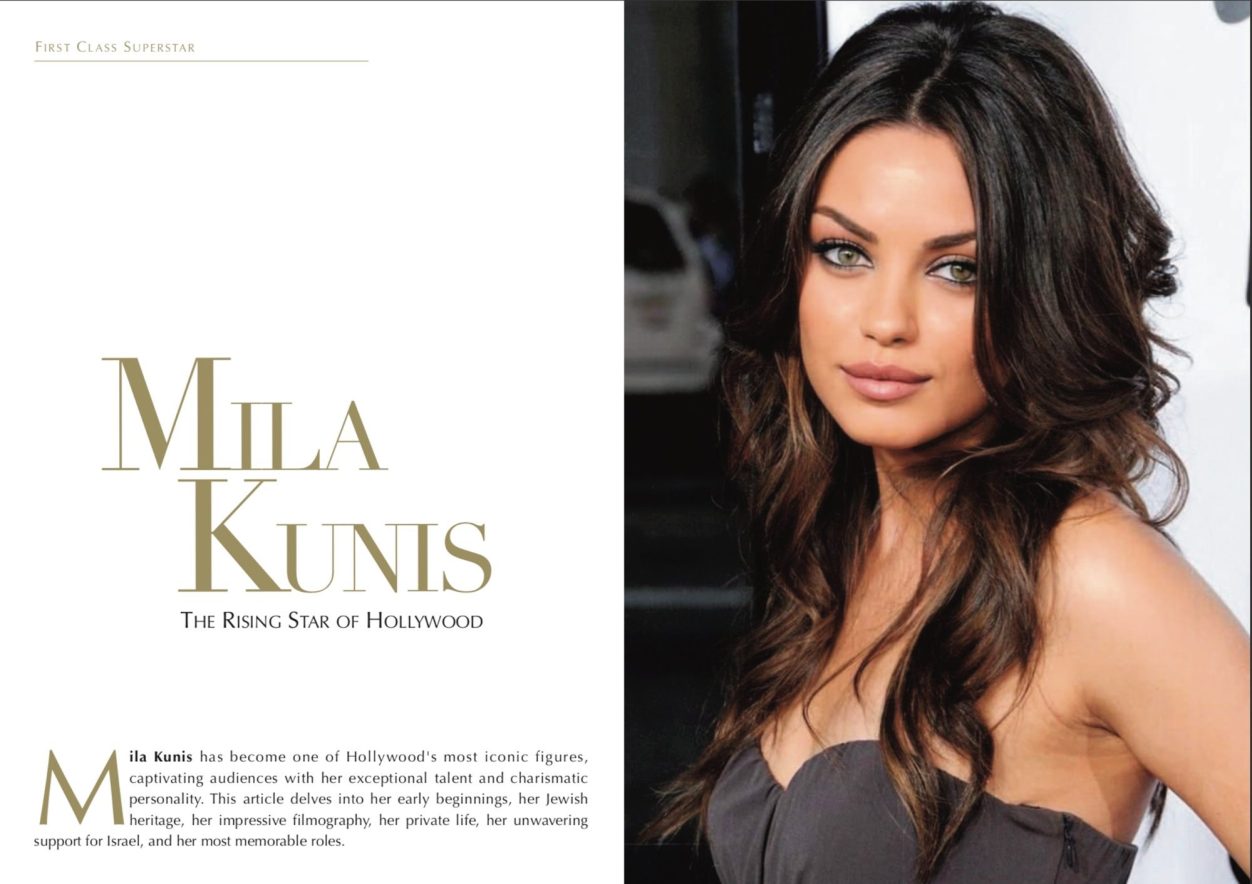
MILA KUNIS
The RISING STAR OF HOLLYWOOD
Mila Kunis has become one of Hollywood's most iconic figures, captivating audiences with her exceptional talent and charismatic personality. This article delves into her early beginnings, her Jewish heritage, her impressive filmography, her private life, her unwavering support for Israel, and her most memorable roles....
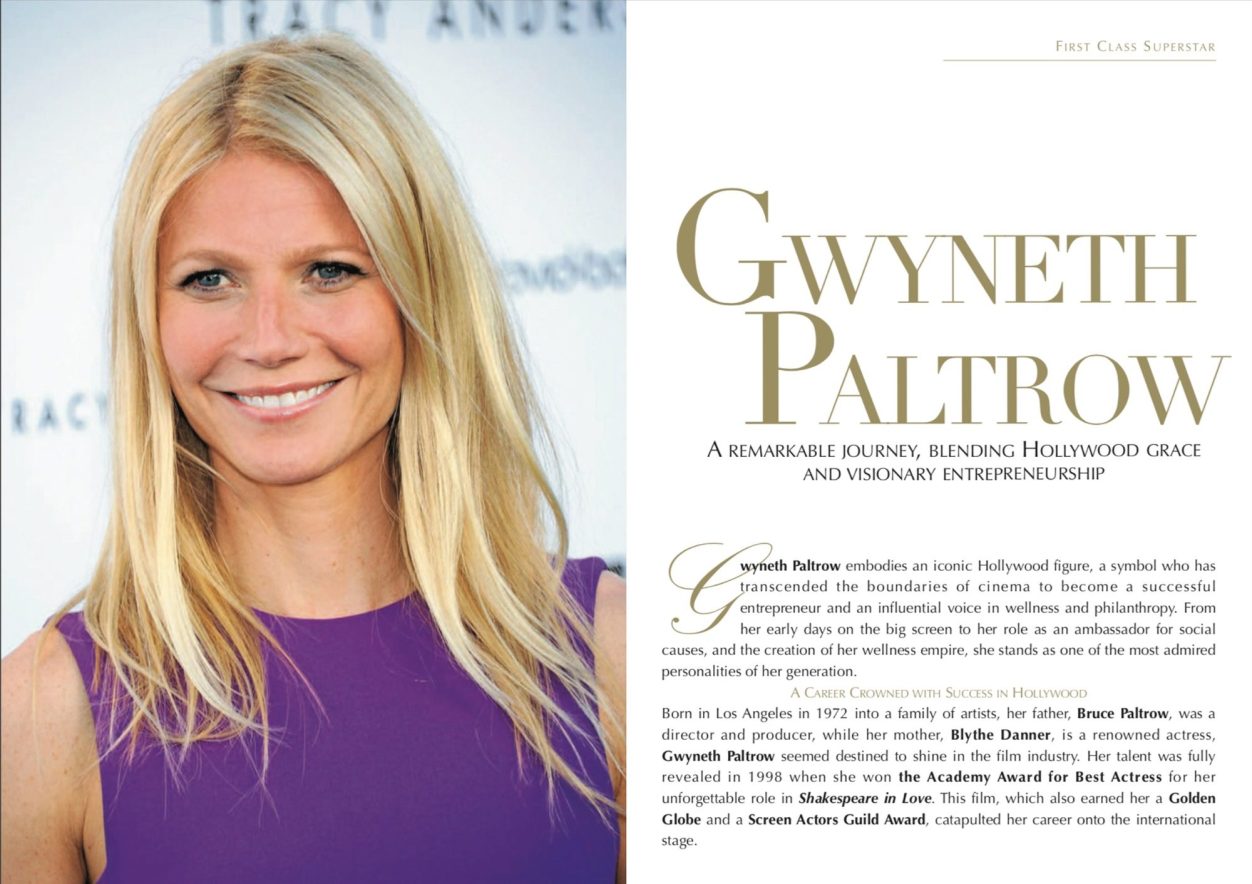
GWYNETH PALTROW
A REMARKABLE JOURNEY, BLENDING HOLLYWOOD GRACE
AND VISIONARY ENTREPRENEURSHIP
Gwyneth Paltrow embodies an iconic Hollywood figure, a symbol who has transcended the boundaries of cinema to become a successful entrepreneur and an influential voice in wellness and philanthropy. From her early days on the big screen to her role as an ambassador for social causes, and the creation of her wellness empire, she stands as one of the most admired personalities of her generation...
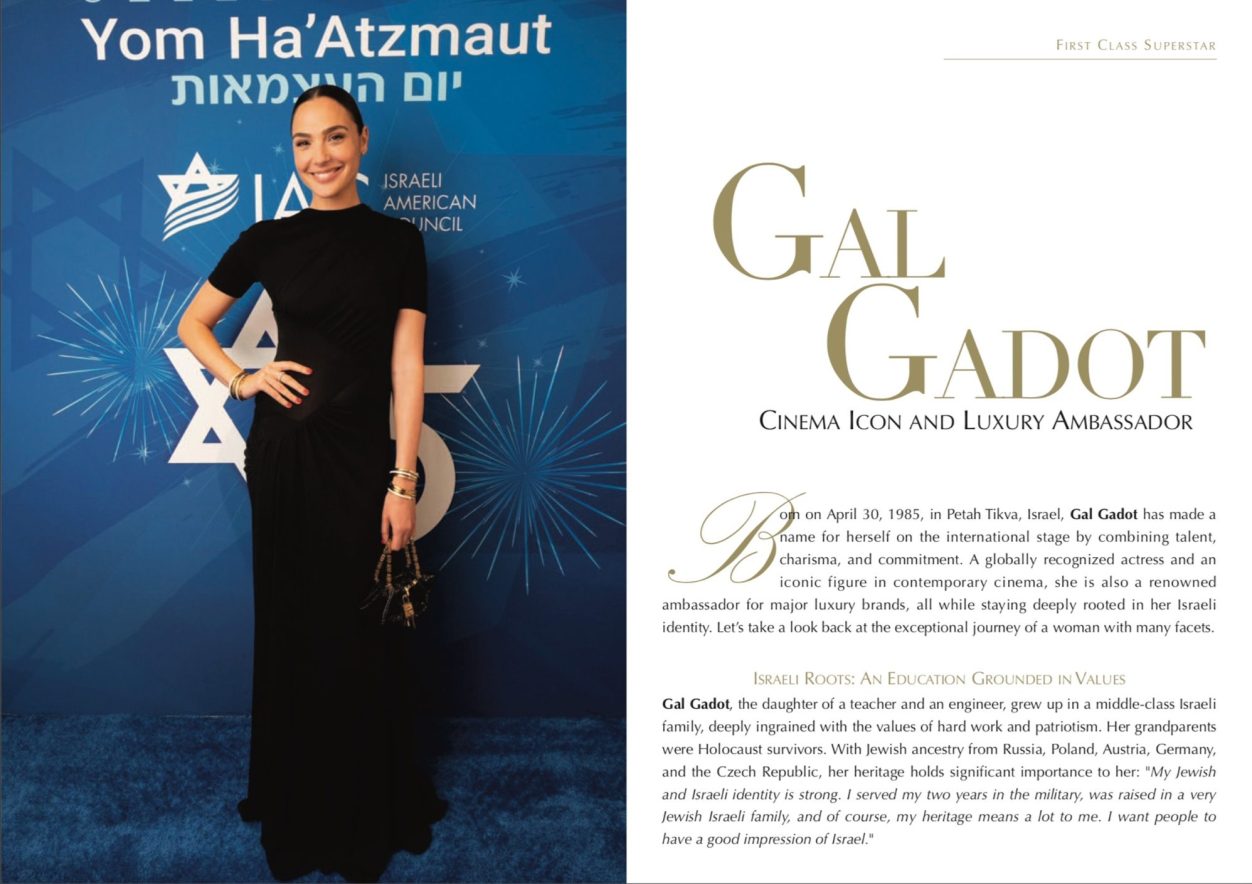
GAL GADOT
CINEMA ICON AND LUXURY AMBASSADOR
Born on April 30, 1985, in Petah Tikva, Israel, Gal Gadot has made a name for herself on the international stage by combining talent, charisma, and commitment. A globally recognized actress and an iconic figure in contemporary cinema, she is also a renowned ambassador for major luxury brands, all while staying deeply rooted in her Israeli identity. Let’s take a look back at the exceptional journey of a woman with many facets...
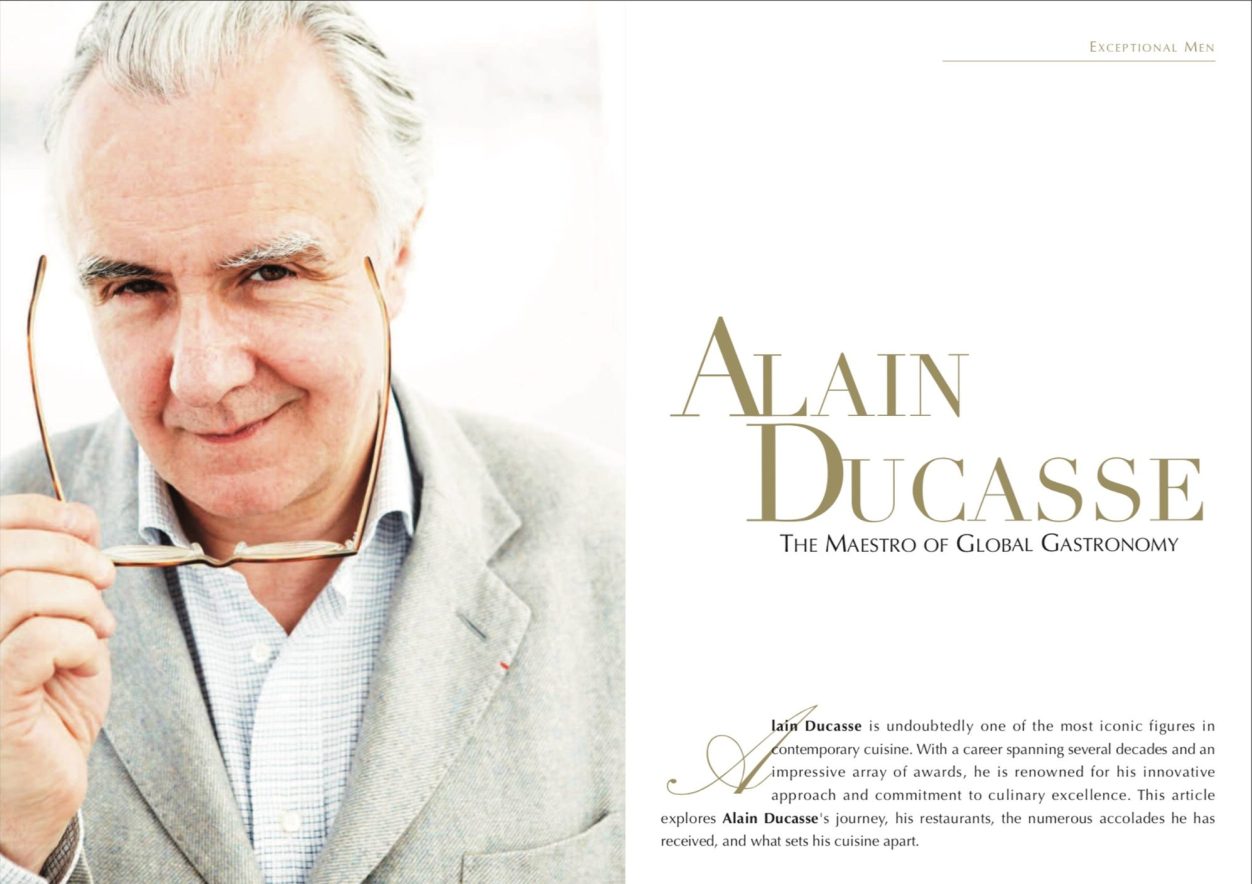
ALAIN DUCASSE
THE MAESTRO OF GLOBAL GASTRONOMY
Alain Ducasse is undoubtedly one of the most iconic figures in contemporary cuisine. With a career spanning several decades and an impressive array of awards, he is renowned for his innovative approach and commitment to culinary excellence. This article explores Alain Ducasse's journey, his restaurants, the numerous accolades he has received, and what sets his cuisine apart...
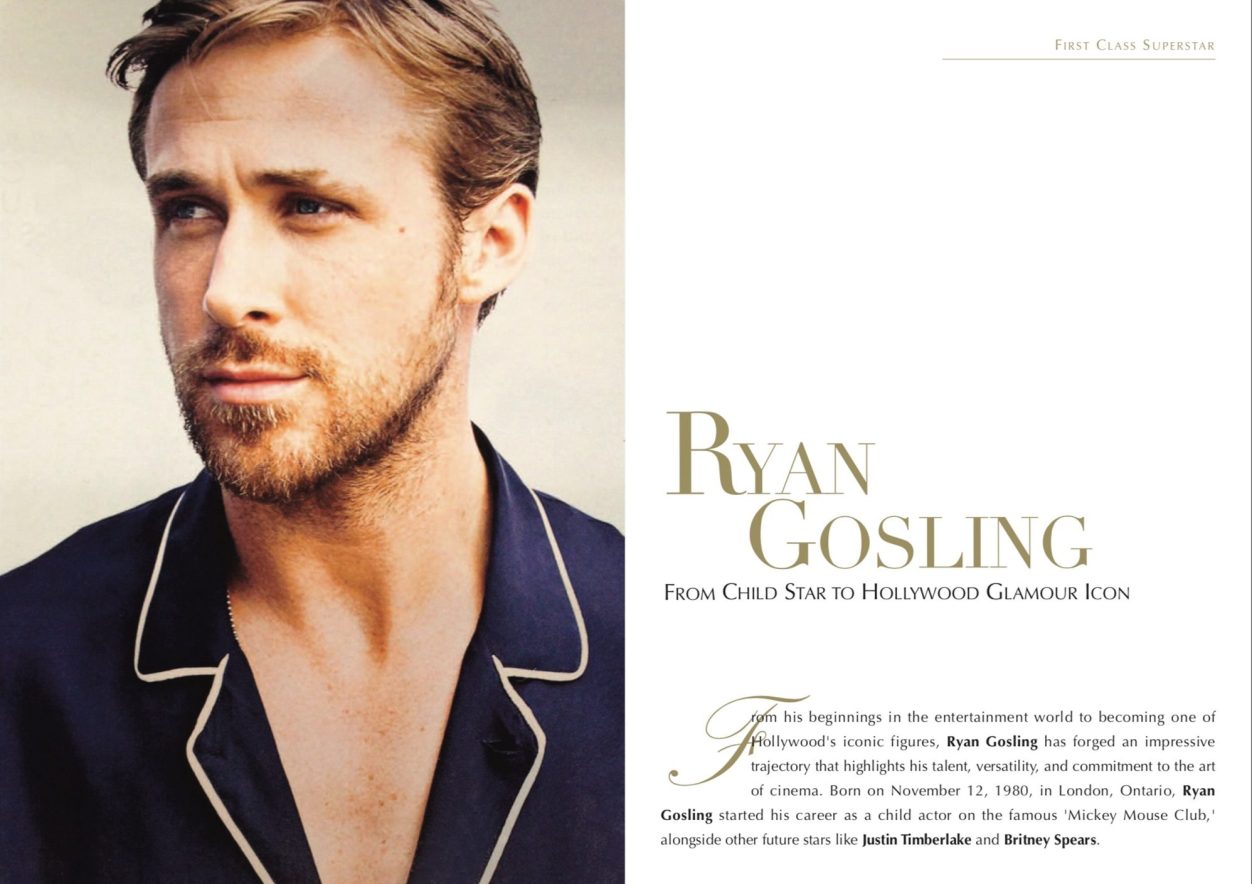
RYAN GOSLING
FROM CHILD STAR TO HOLLYWOOD GLAMOUR ICON
From his beginnings in the entertainment world to becoming one of Hollywood's iconic figures, Ryan Gosling has forged an impressive trajectory that highlights his talent, versatility, and commitment to the art of cinema. Born on November 12, 1980, in London, Ontario, Ryan Gosling started his career as a child actor on the famous 'Mickey Mouse Club,' alongside other future stars like Justin Timberlake and Britney Spears...
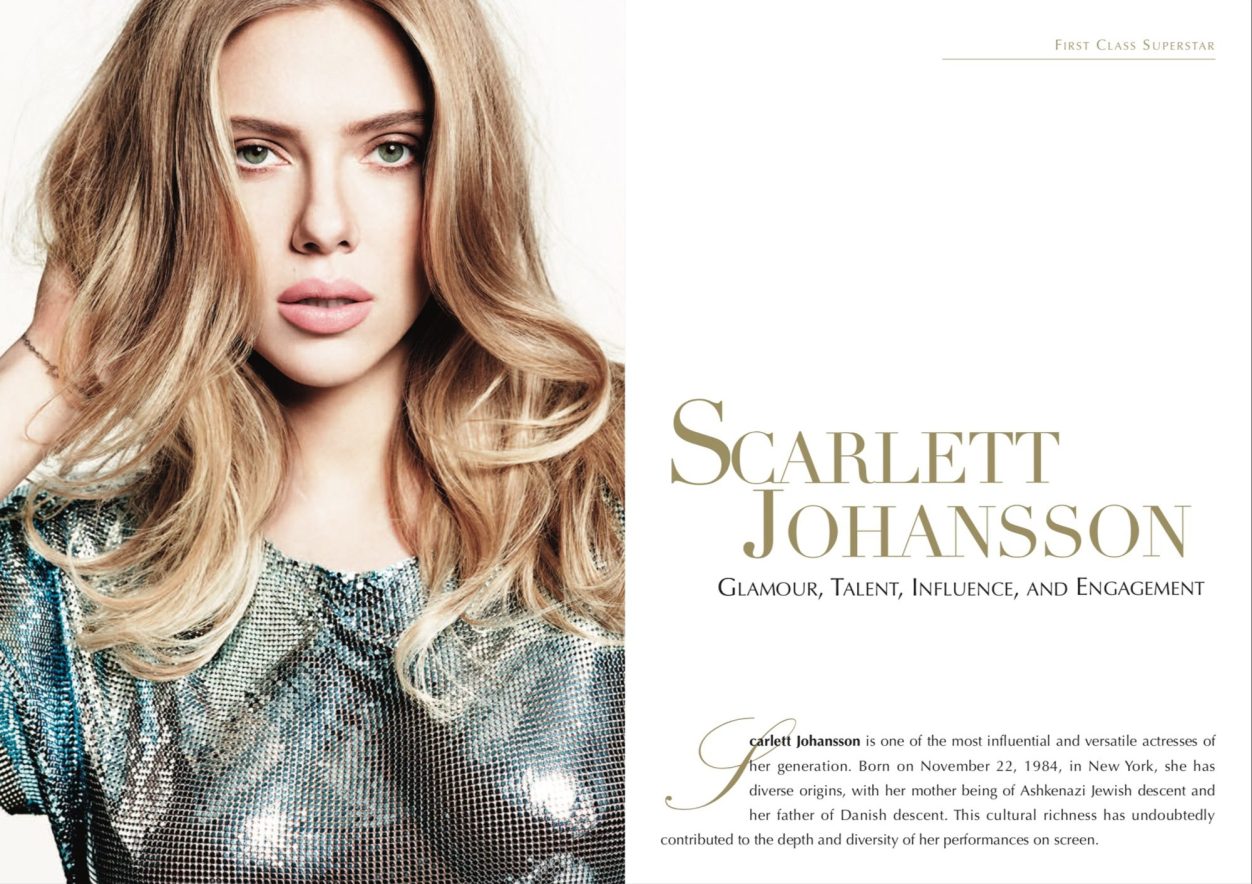
SCARLETT JOHANSSON
GLAMOUR, TALENT, INFLUENCE, AND ENGAGEMENT
Scarlett Johansson is one of the most influential and versatile actresses of her generation. Born on November 22, 1984, in New York, she has diverse origins, with her mother being of Ashkenazi Jewish descent and her father of Danish descent. This cultural richness has undoubtedly contributed to the depth and diversity of her performances on screen...
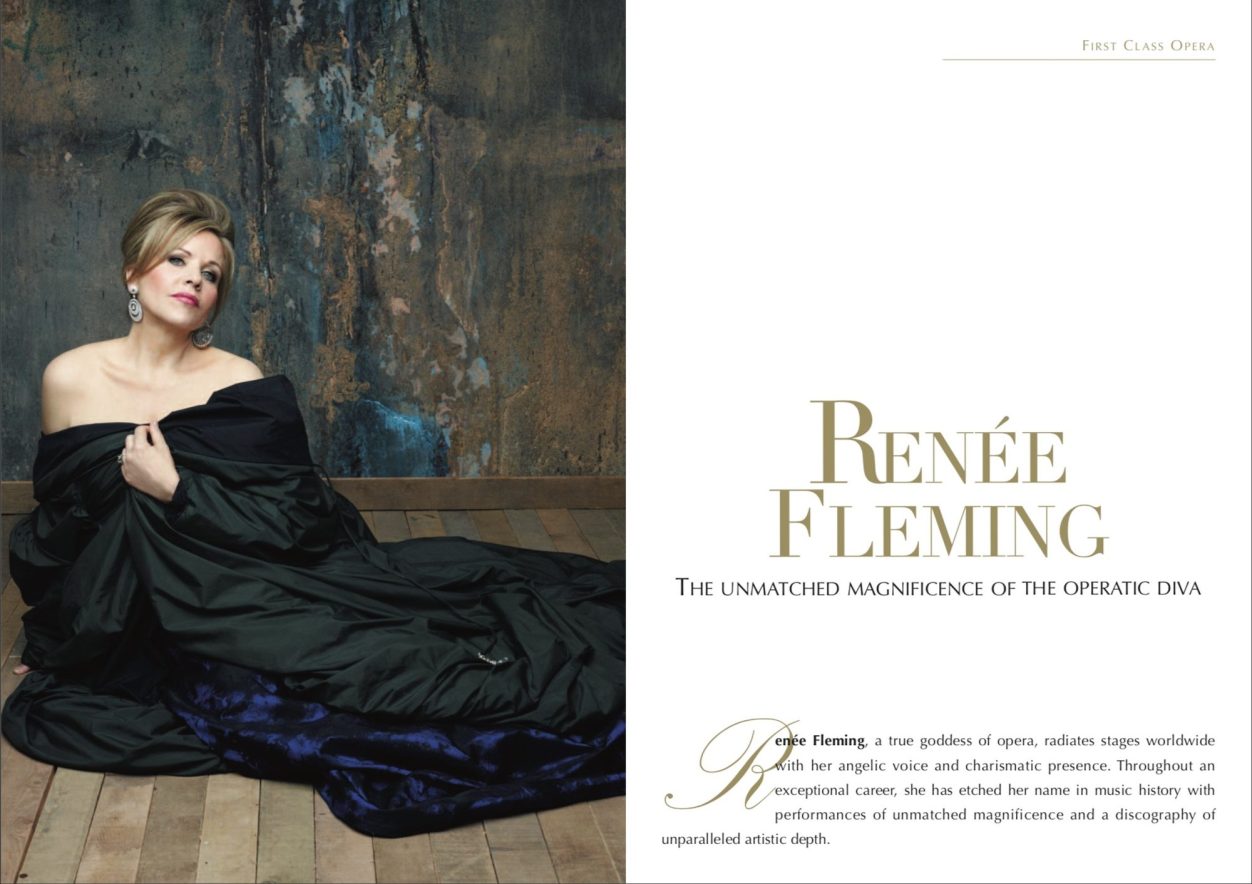
RENÉE FLEMING
THE UNMATCHED MAGNIFICENCE
OF THE OPERATIC DIVA
Renée Fleming, a true goddess of opera, radiates stages worldwide with her angelic voice and charismatic presence. Throughout an exceptional career, she has etched her name in music history with performances of unmatched magnificence and a discography of unparalleled artistic depth...
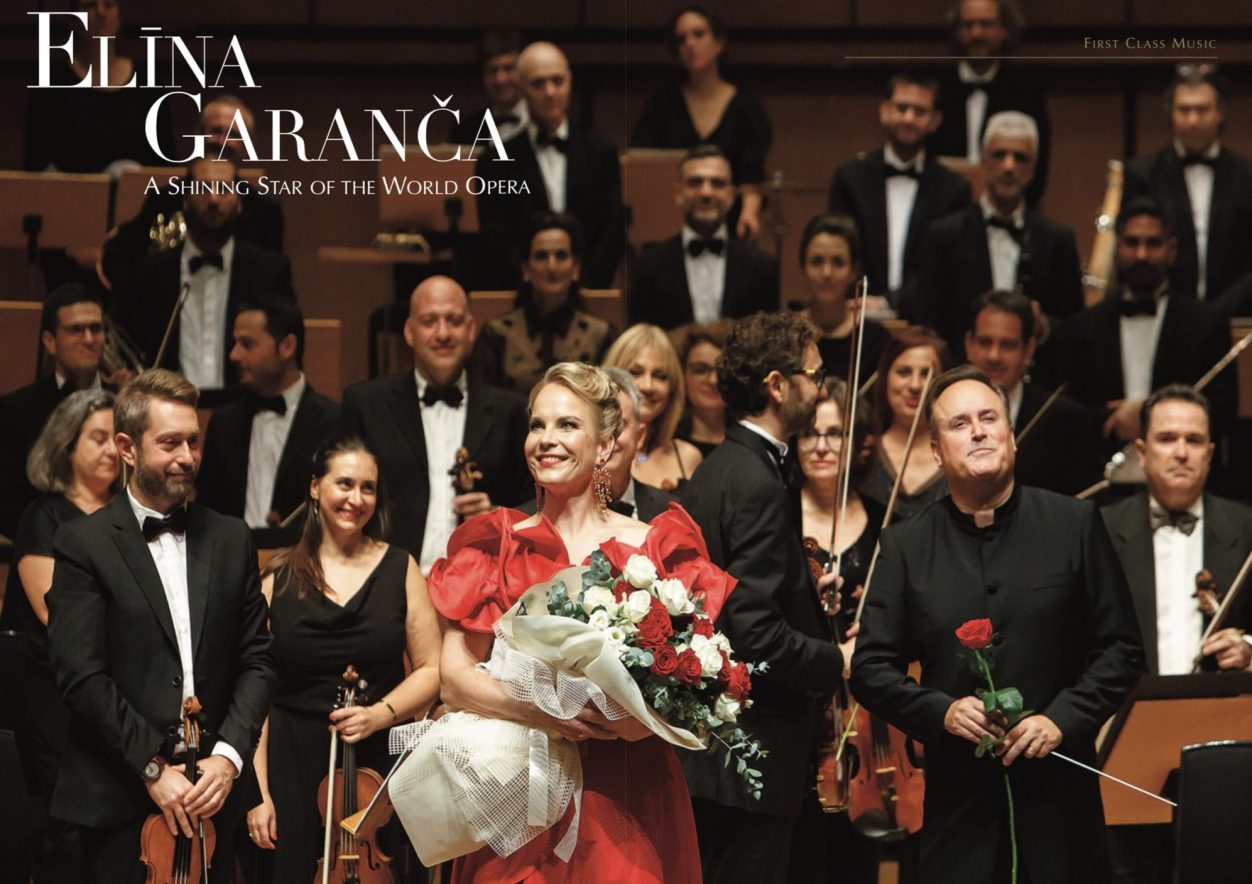
ELINA GARANCA
A Shining Star of the World Opera
Since her emergence on the operatic stage, Elīna Garanča has captivated the world of opera with her enchanting timbre and masterful interpretation. Hailing from Latvia, this distinguished mezzo-soprano has won over the hearts of classical music enthusiasts across the globe, rising to the top of her discipline with undeniable grace and power...
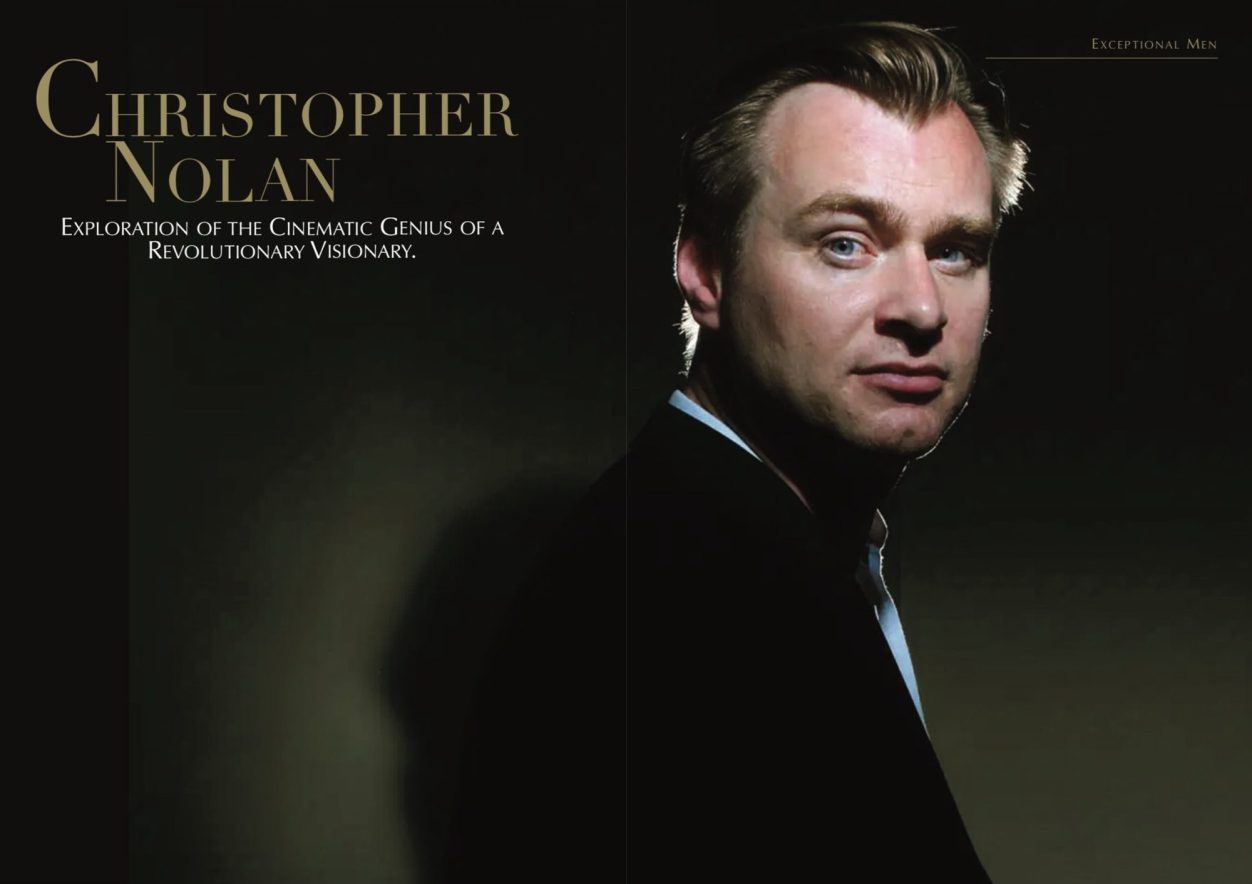
CHRISTOPHER NOLAN
Exploration of the Cinematic Genius
of a Revolutionary Visionary.
Christopher Nolan, the towering British-American film director, screenwriter, and producer whose name is synonymous with films that defy narrative and visual conventions, creating a cinematic universe that is both intricate, intelligent, and captivating...
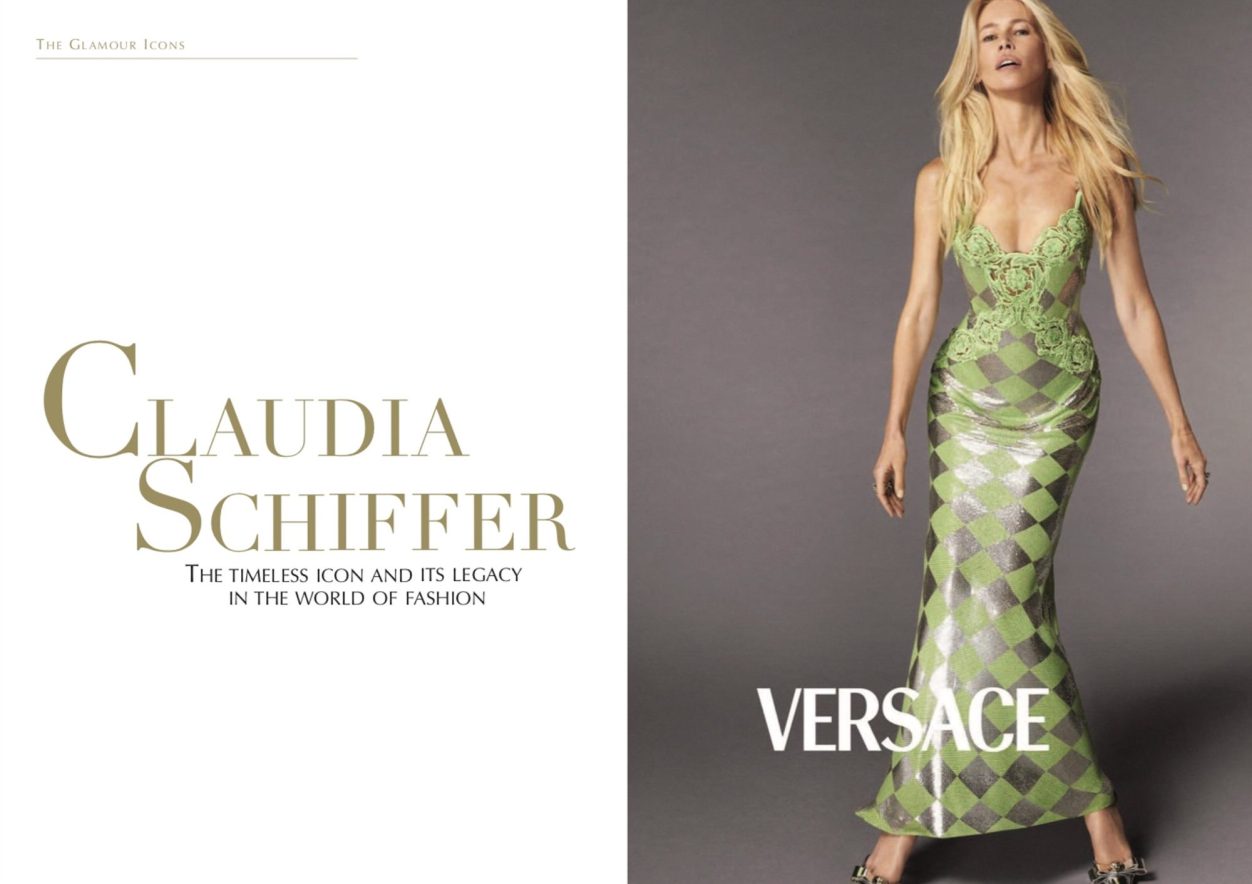
CLAUDIA SCHIFFER
THE TIMELESS ICON AND ITS LEGACY
IN THE WORLD OF FASHION
Claudia Schiffer embodies elegance, grace, and sophistication for several decades. Born on August 25, 1970, in Rheinberg, Germany, Claudia has conquered the world of fashion with her timeless beauty and captivating charisma. Over time, she has become an iconic and essential figure in the fashion industry, attaining the status of a supermodel in the 1990s…
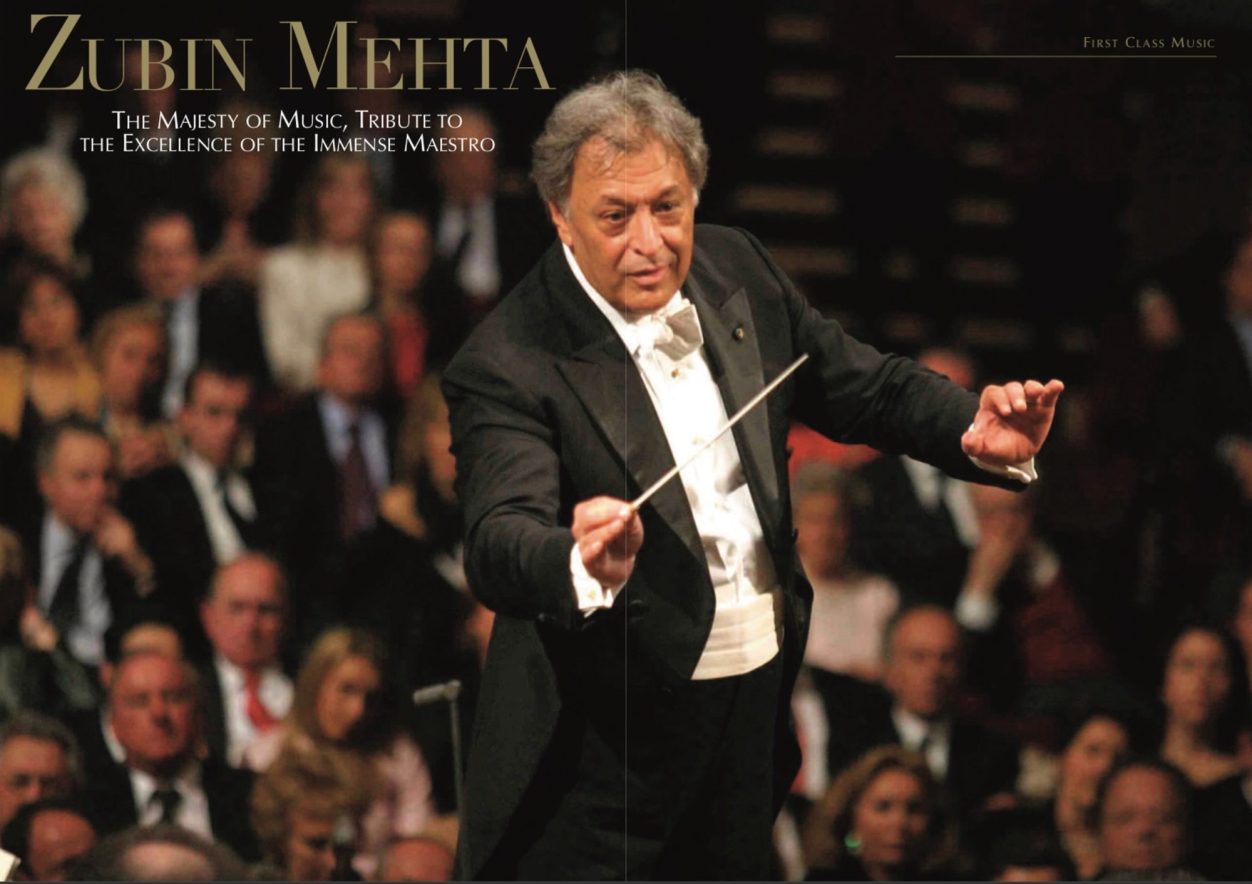
ZUBIN MEHTA
THE MAJESTY OF MUSIC, TRIBUTE TO
THE EXCELLENCE OF THE IMMENSE MAESTRO
Throughout an illustrious career, Zubin Mehta has elevated the art of orchestral conducting to dizzying heights, captivating hearts and minds worldwide with his virtuosity, passionate commitment, and profound understanding of music. Born in 1936 in Bombay, in a India steeped in music and culture, Zubin Mehta was raised in an environment that nurtured his innate love for musical art. Coming from a family of musicians, he received exceptional education, combining rigorous training in orchestral conducting with immersion in the rich musical tradition of his homeland…
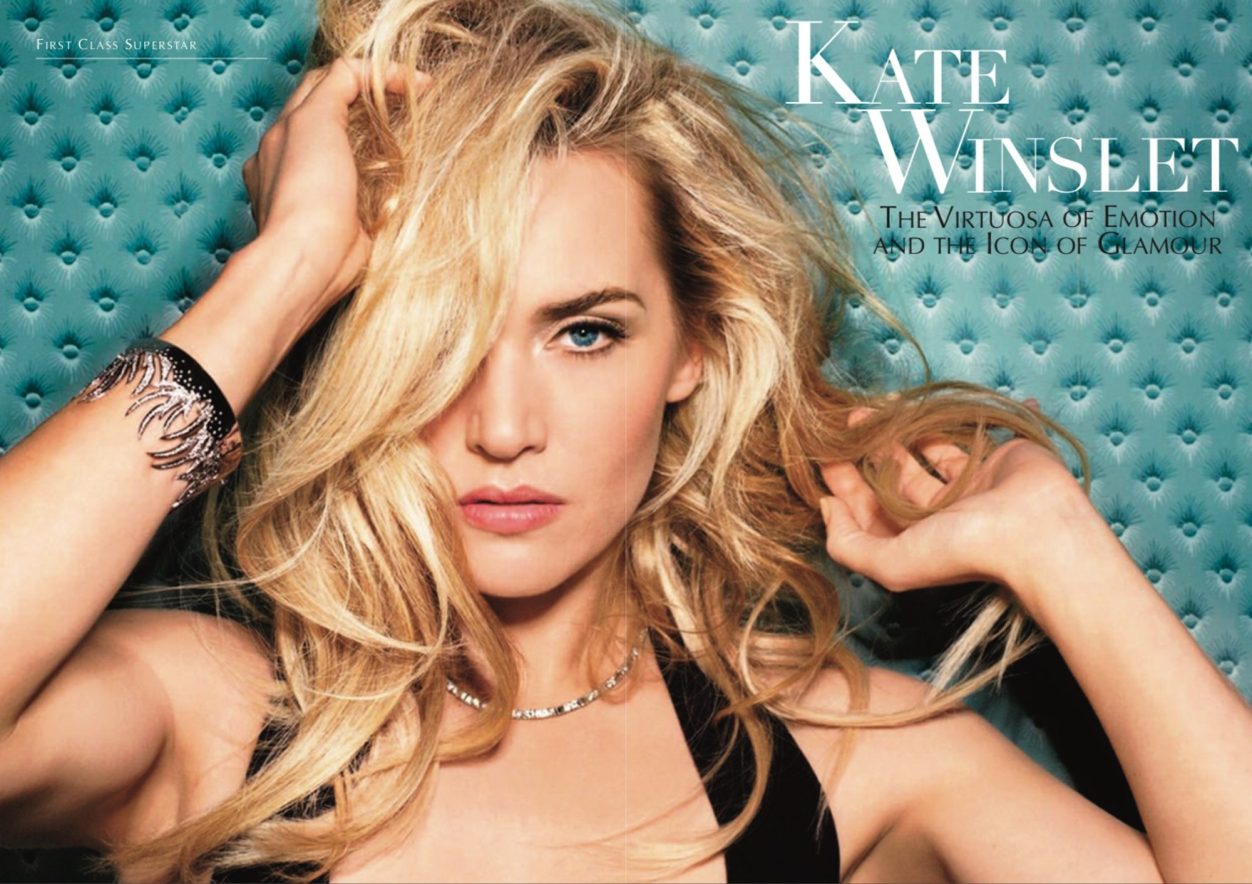
KATE WINSLET
The Virtuosa of Emotion and the Icone of Glamour
When the spotlights come on and the curtain rises, a magnetic presence fills the screen. This presence is none other than Kate Winslet, an actress whose talent transcends the boundaries of cinema. In the constellation of dazzling stars in contemporary cinema, Kate Winslet shines with a singular brilliance. Her prodigious talent transcends the confines of mere acting to elevate the art of performance to unparalleled heights…
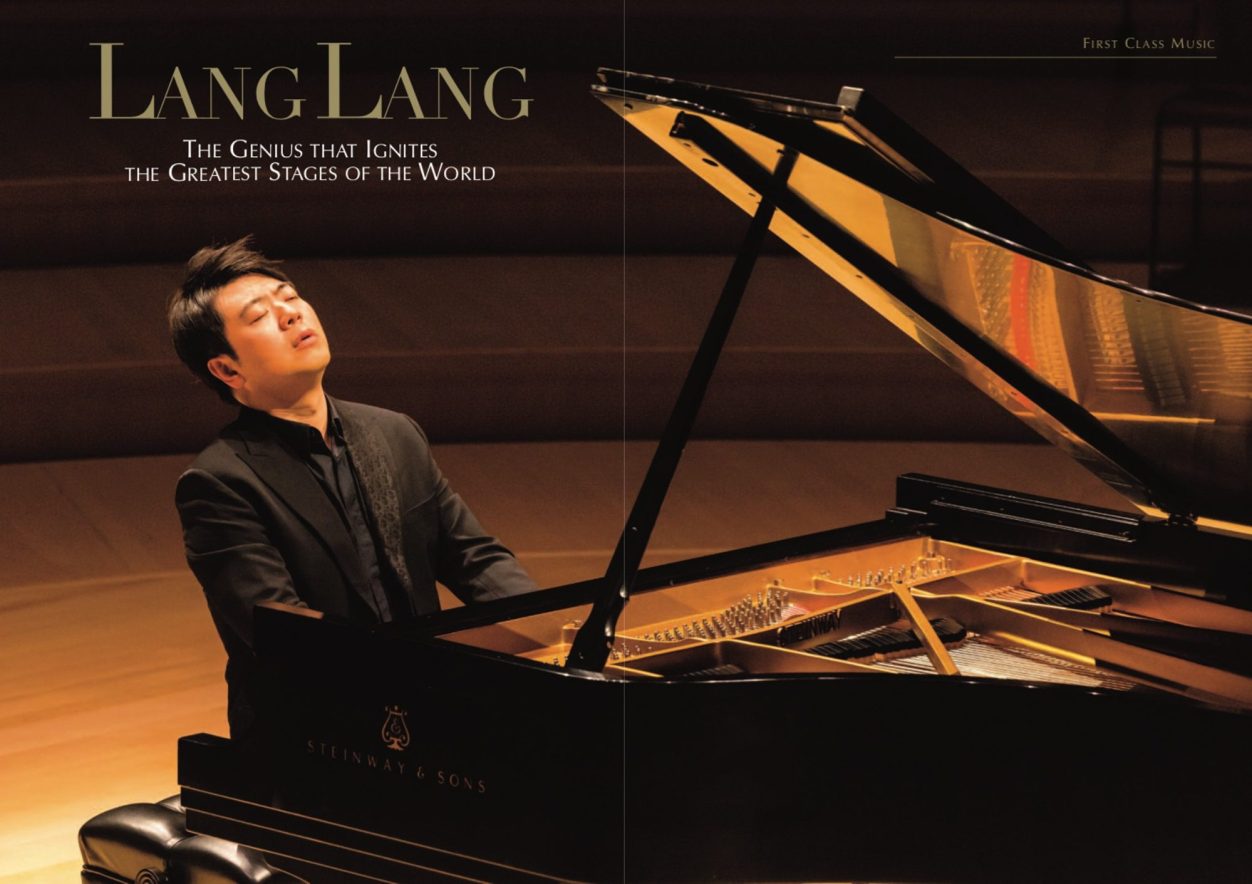
LANG LANG
The Genius that ignites the greatest stages of the world
In the annals of modern classical music, few figures manage to embody artistic excellence with as much splendor as the Chinese piano prodigy, Lang Lang. Like a shining beacon emerging from the mists of history, his dazzling career and undeniable talent have captivated the minds and hearts of music lovers worldwide, elevating the piano to the status of a divine instrument…
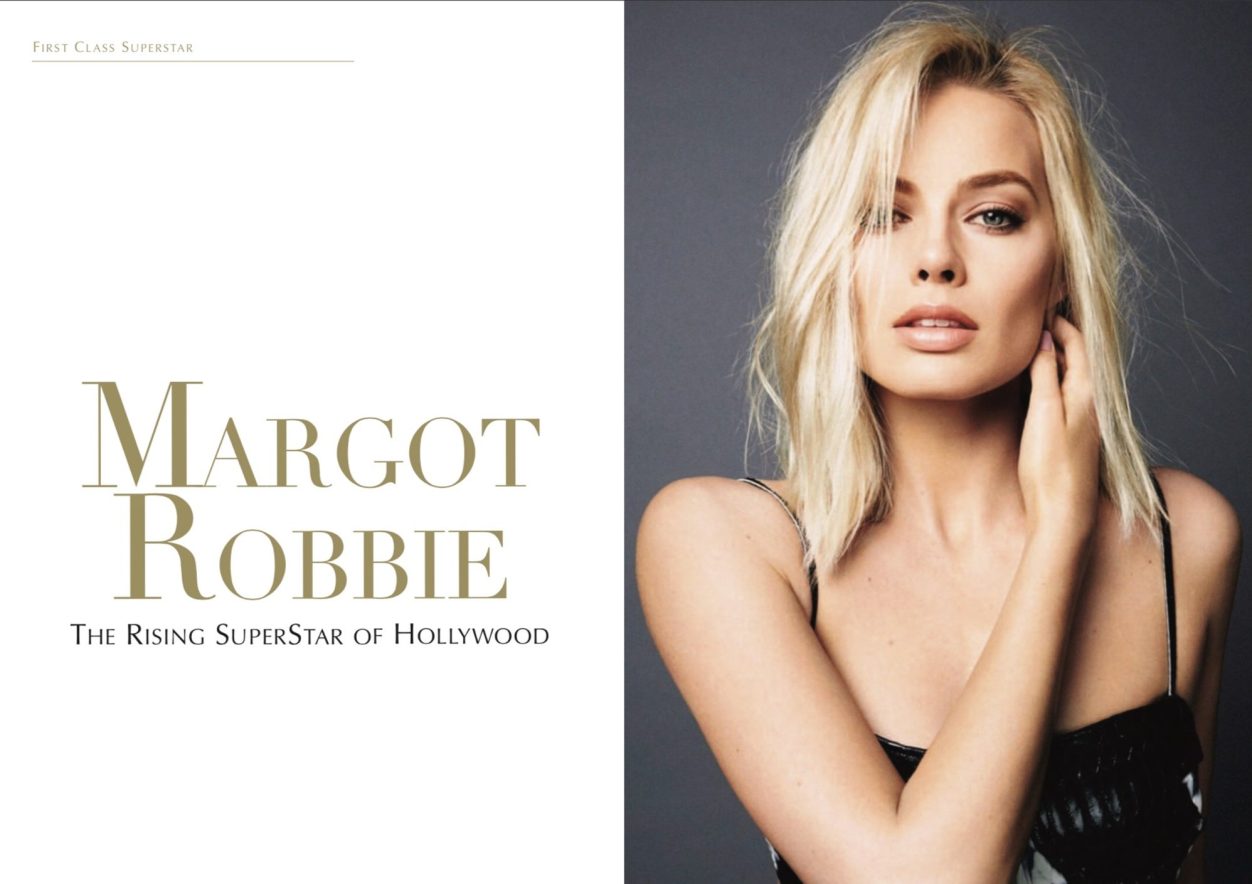
MARGOT ROBBIE
THE RISING SUPERSTAR OF HOLLYWOOD
Hollywood, the city of angels, has witnessed the emergence of numerous stars over the decades. Among them, an actress has managed to captivate the audience with her exceptional talent, dazzling beauty, and magnetic personality: Margot Robbie. Hailing from Australia, this rising star has won the hearts of mil- lions of viewers worldwide through her versatility and charisma on the big screen…
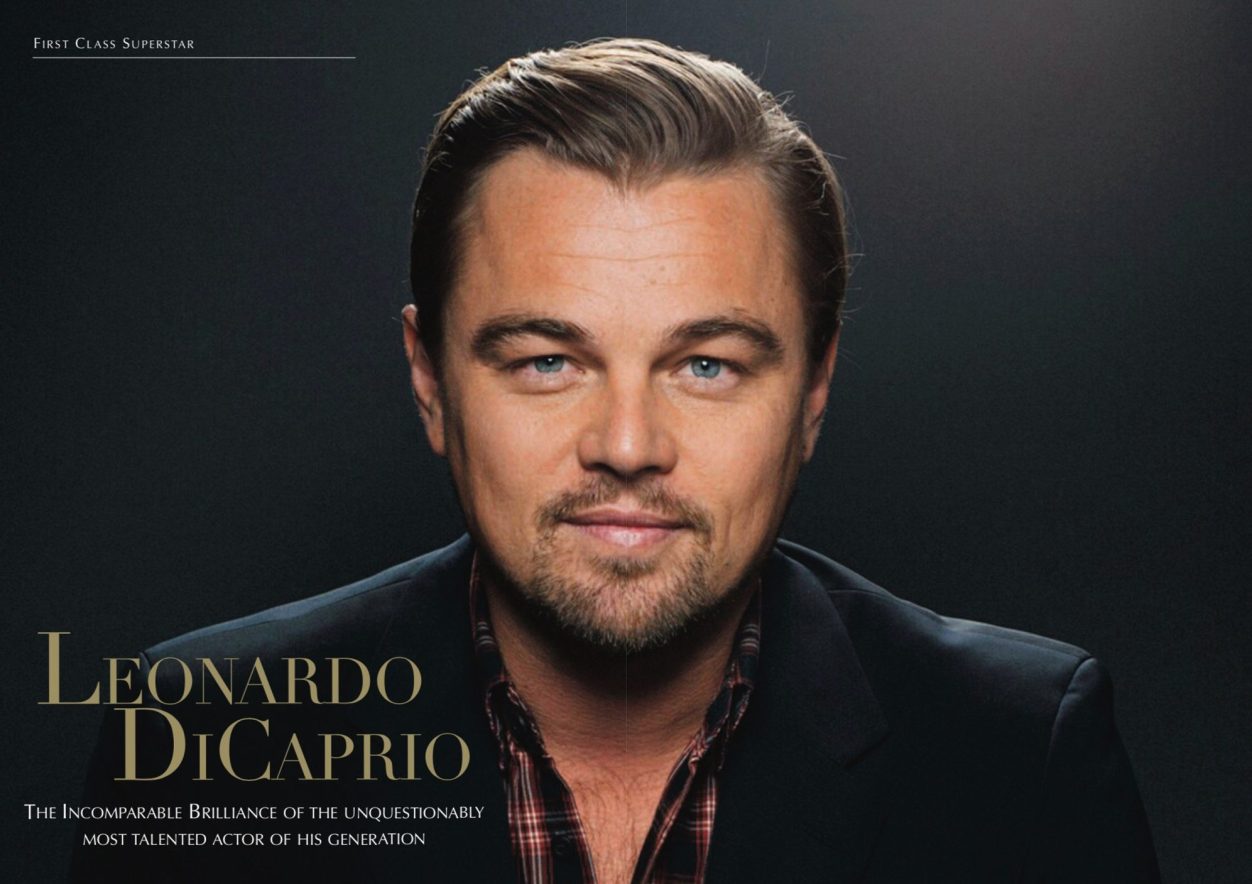
LEONARDO DICAPRIO
THE INCOMPARABLE BRILLIANCE OF THE UNQUESTIONABLY MOST TALENTED ACTOR OF HIS GENERATION
The film industry has undergone numerous changes over the decades, but one constant remains: the exceptional talent of Leonardo DiCaprio.
Born in 1974 in Los Angeles, this charismatic actor has emerged as one of the most powerful and versatile forces in contemporary cinema.
In many ways, Leonardo DiCaprio embodies artistic excellence, captivating the audience with his magnetic on-screen presence and elevating every project he undertakes…
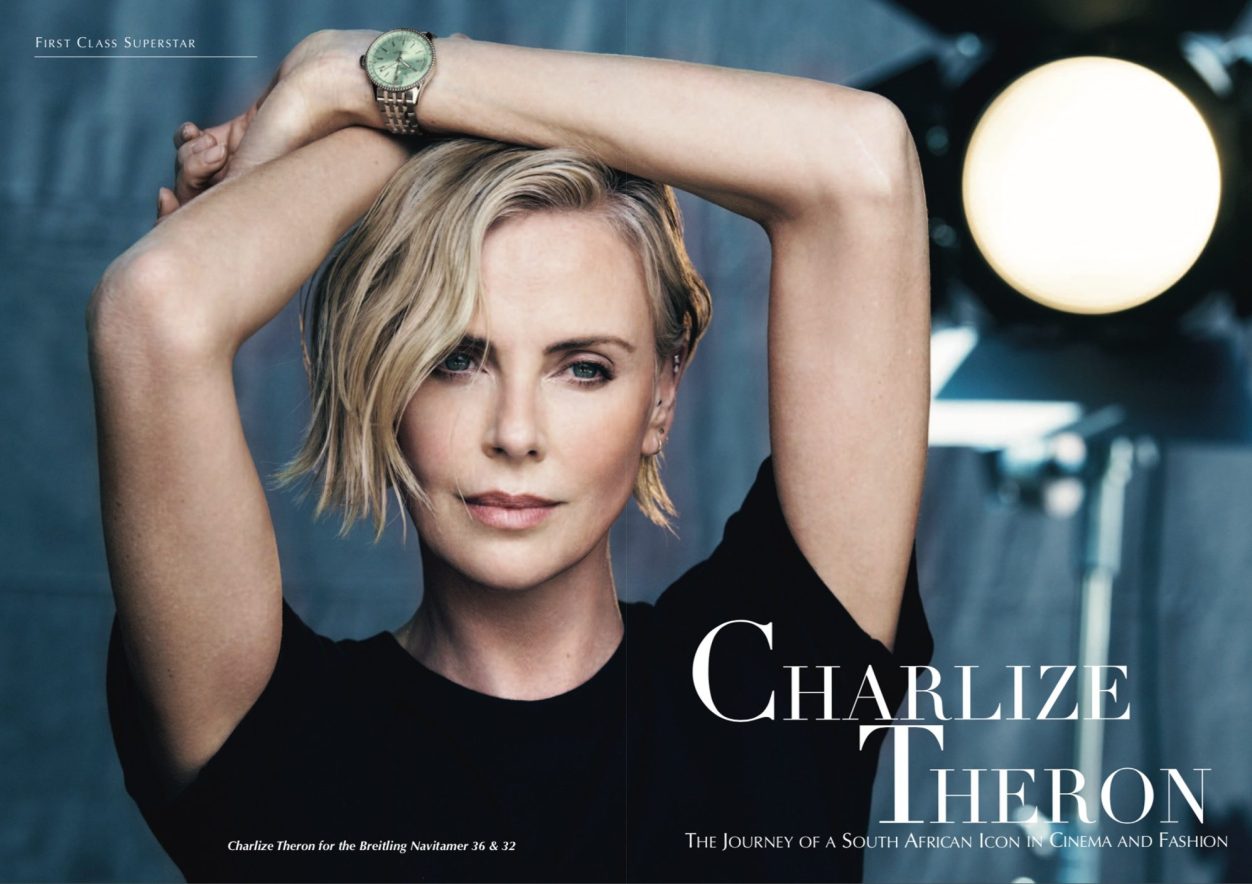
CHARLIZE THERON
The Journey of a South African Icon
in Cinema ans Fashion
Charlize Theron, a name synonymous with elegance, talent, and philanthropy, has left an indelible mark on the global stage.
Born on August 7, 1975, in Benoni, South Africa,
Charlize Theron's journey from a small town to
Hollywood royalty is truly remarkable....
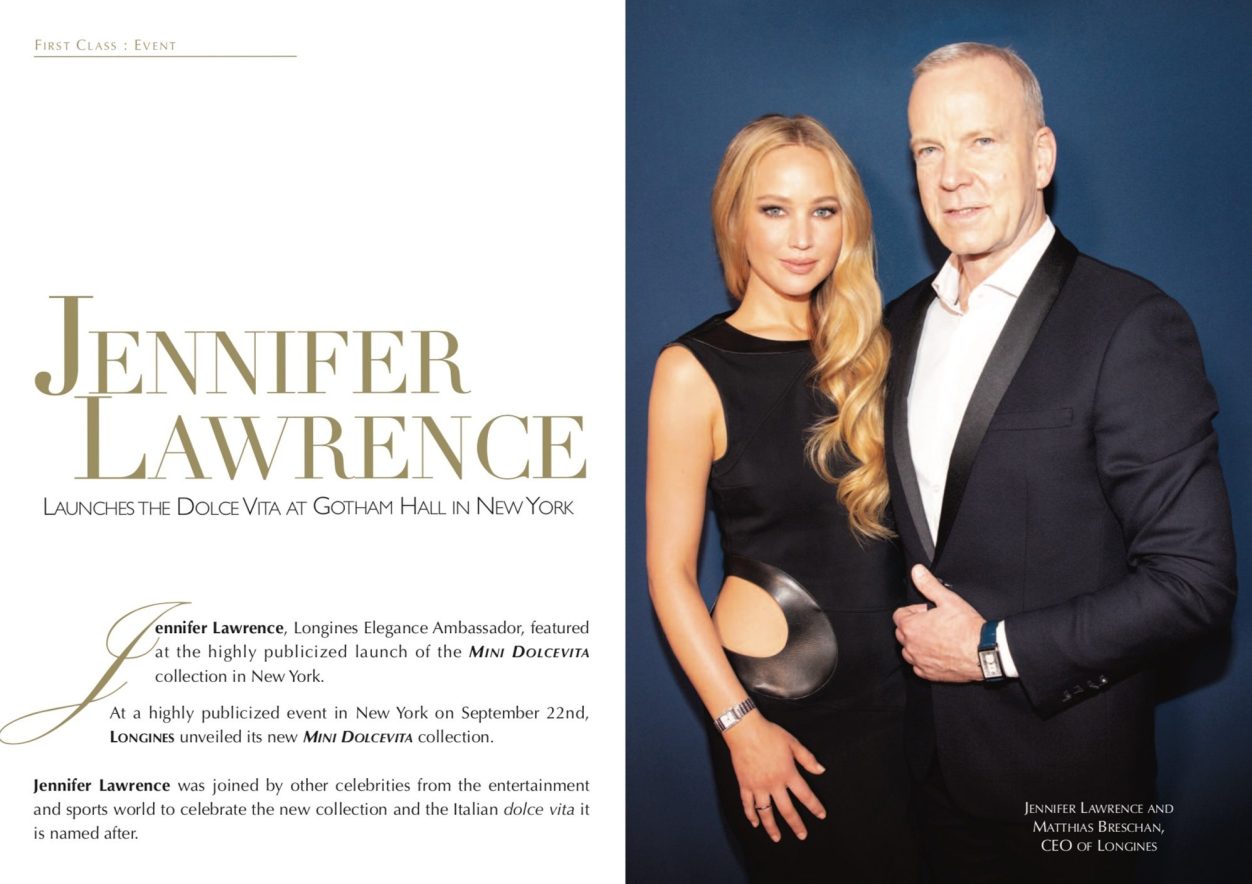
JENNIFER LAWRENCE
LAUNCHES THE DOLCE VITA AT GOTHAM HALL
IN NEW YORK
Jennifer Lawrence, Longines Elegance Ambassador, featured at the highly publicized launch of the MINI DOLCEVITA collection in New York. At a highly publicized event in New York on September 22nd, LONGINES unveiled its new MINI DOLCEVITA collection. Jennifer Lawrence was joined by other celebrities from the entertainment and sports world to celebrate the new collection and the Italian dolce vita it is named after…
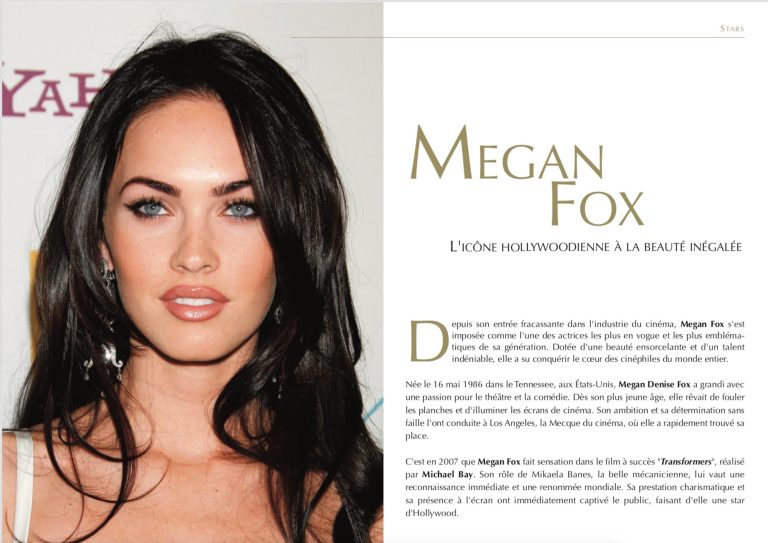
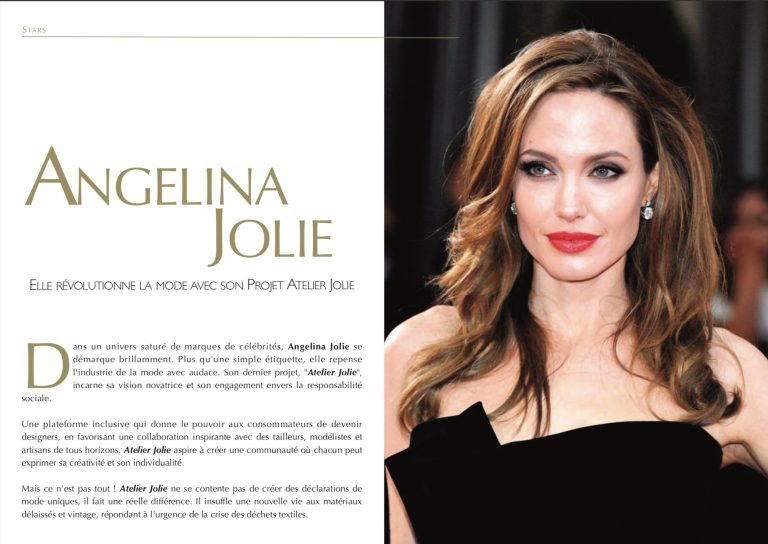
Angelina Jolie
revolutionizing fashion
with her project Atelier Jolie
In an oversaturated universe of celebrity brands, Angelina Jolie stands out brilliantly. More than just a label, she is boldly reimagining the fashion industry. Her latest project, "Atelier Jolie," embodies her innovative vision and commitment to social responsibility…
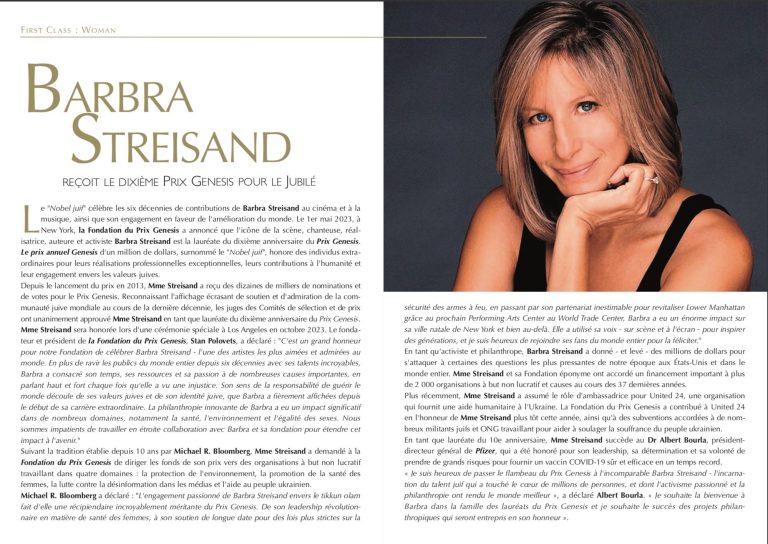
BARBRA STREISAND
AWARDED TENTH ANNIVERSARY GENESIS PRIZE
The “Jewish Nobel” will celebrate six decades of Barbra Streisand’s contributions to cinema and music and her commitment to improving the world. May 1, 2023, New York – Today, The Genesis Prize Foundation announced iconic actor, singer, director, author, and activist Barbra Streisand as the 10th Anniversary Genesis Prize Laureate…
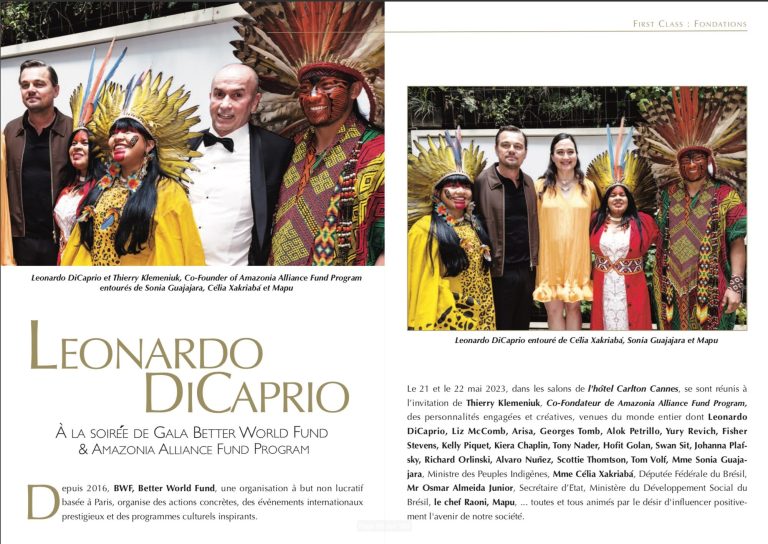
LEONARDO DICAPRIO
At the Better Better World Fund & Amazonia Alliance Fund Program Gala
Since 2016, BWF (Better World Fund), a non-profit organization based in Paris, has been organizing concrete actions, prestigious international events, and inspiring cultural programs…
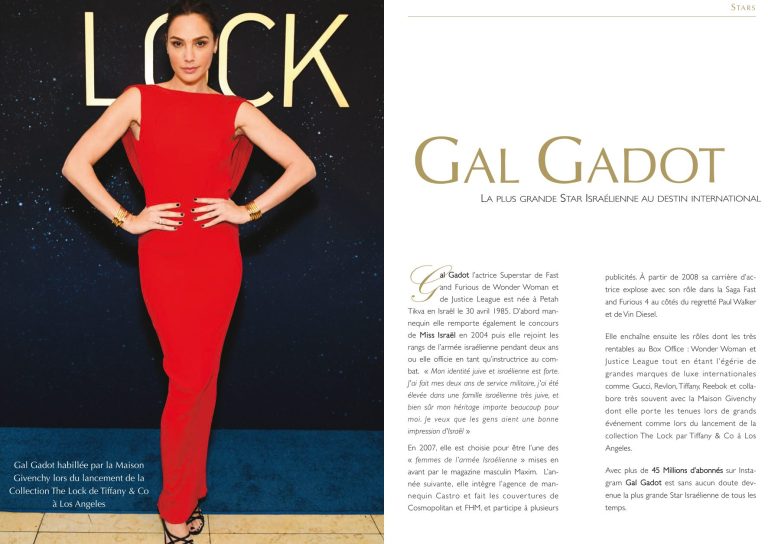
GAL GADOT
The biggest Israeli Star with an International destiny
Gal Gadot the Superstar actress of Fast and Furious, Wonder Woman and Justice League was born in Petah Tikva in Israel on April 30, 1985. First a model, she also won the Miss Israel contest in 2004 then she joined the ranks of the Israeli army for two years where she served as a combat instructor. “My Jewish and Israeli identity is strong. I did my two years of military service, I was raised in a very Jewish Israeli family, and of course my heritage means a lot to me. I want people to have a good impression of Israel”...