DREAM PROPERTIES
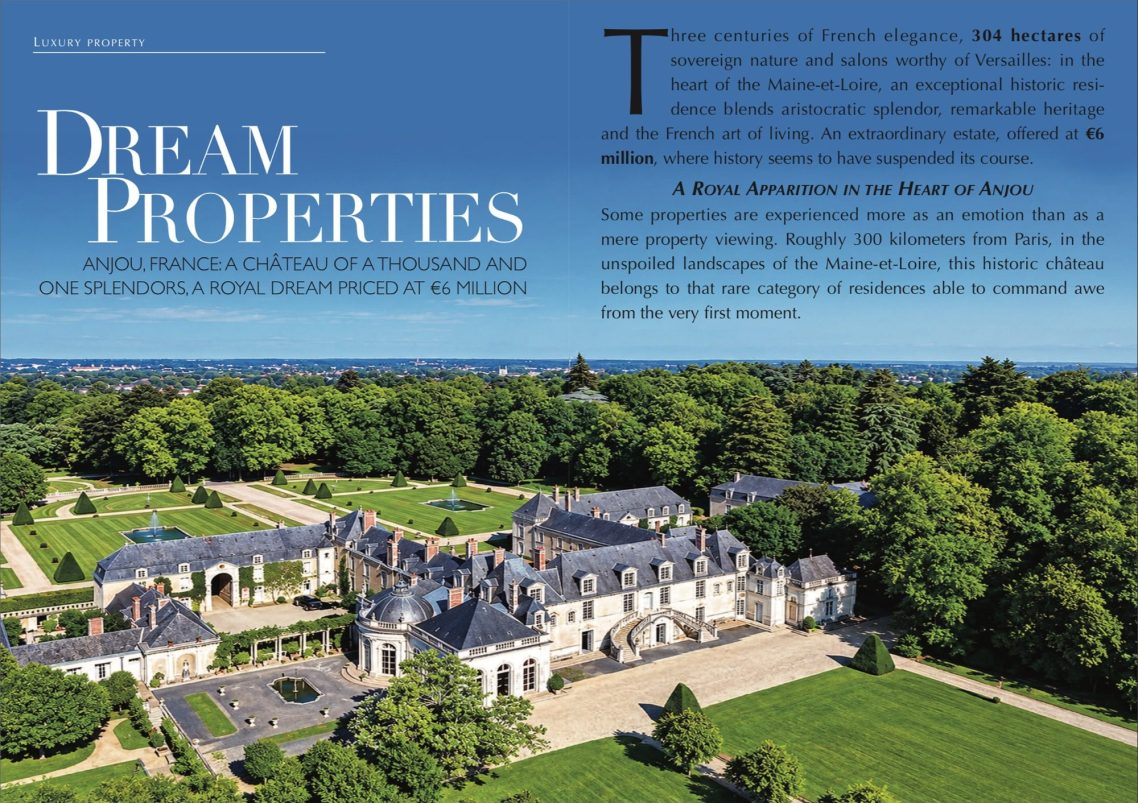
Anjou, France: A Château of a Thousand and One Splendors, a Royal Dream Priced at €6 Million
Three centuries of French elegance, 304 hectares of sovereign nature and salons worthy of Versailles: in the heart of the Maine-et-Loire, an exceptional historic residence blends aristocratic splendor, remarkable heritage and the French art of living. An extraordinary estate, offered at €6 million, where history seems to have suspended its course. A Royal Apparition in the Heart of Anjou Some properties are experienced more as an emotion than as a mere property viewing. Roughly 300 kilometers from Paris, in the unspoiled landscapes of the Maine-et-Loire, this historic château belongs to that rare category of residences able to command awe from the very first moment. Built from 1635 and later expanded and embellished in the 18th century, the ensemble displays a classical architecture inspired by Versailles, distinguished by monumental proportions and a remarkably sophisticated landscaped setting.
In the 19th century, the property is said to have belonged to descendants of the British royal family, adding a dynastic dimension to its history. Today, its almost royal character remains intact: 2,500 m² of living space, 40 rooms, 25 bedrooms and some 304 hectares make up an estate whose scale evokes a residence of state more than an ordinary private home. The asking price of €6 million lends this property a further distinction on the market for great French châteaux: that of a monumental heritage offered at a value that deserves the attention of lovers of historic homes. A Park Signed by Édouard André, Between Perspectives and Grandeur The approach is already a spectacle. A private drive of more than a kilometre, lined with century-old plane trees, leads gradually towards the residence, revealing along the way glimpses of the gardens and the vistas of the estate. The park bears the signature of landscape architect Édouard André, a major figure in French landscape art, particularly known for his work in Monte-Carlo.
Here, his vocabulary finds expression in a skilfully orchestrated composition: formal gardens, topiaries, ponds and fountains structure the grounds around the château, while three grand perspectives organise a theatrical arrival, in the spirit of the great aristocratic residences. The cour d'honneur, laid out around the main building and its side wings, reinforces this impression of controlled power. Within this vast setting, the east-west orientation allows the light to accompany the spaces throughout the day. But the estate holds a distinction almost impossible to find among private properties: a private racecourse, still in operation, stretching across the landscape like an open-air stage. From certain salons, the commanding view over the racetrack composes a living tableau, where equestrian passion meets the art of entertaining. The Grand Siècle and the Enlightenment, Inherited Beyond the threshold, the château reveals a succession of spaces where historical richness is never reduced to decorative accumulation. It lies in the coherence of the whole, in the quality of the materials and in the art of making architecture, light and perspective speak to one another.
The centrepiece of this scenography, a 24-metre-long through gallery connects the principal reception rooms. Punctuated by monumental columns, laid with a cabochon-patterned floor and opening broadly onto the gardens through eight French windows, it offers a majestic flow between interior and exterior. Nearby, a library with antique panelling extends this atmosphere of a cultivated home, while a stone staircase with a soaring flight, set off by a wrought-iron banister, asserts the ceremonial character of the place. The private chapel is another precious testament to the estate's history. Its carved wooden high altar, religious paintings and 16th-century armorial stained-glass windows lend it a singular heritage depth. Far from being a mere decorative feature, it recalls the place that spirituality once held in the organisation of the great aristocratic residences.
A Marble Salon with Echoes of Versailles The pinnacle of this discovery is undoubtedly the grand marble salon, fitted out in 1780 within a neoclassical pavilion built specially for the purpose. With its 80 m², six-metre ceiling height and a dome rising to 8.4 metres, the room impresses as much by its proportions as by the sophistication of its decor. French marbles, mirrors, pilasters with Ionic capitals, a chimneypiece adorned with gilt bronze and Italian micromosaics: every detail bears witness to a confident taste for the excellence of 18th-century decorative arts. The marble mosaic floor and the compositions in Italian stone marquetry further reinforce the exceptional character of this space. The inspiration of the famous Salons of War and Peace at the Château de Versailles can be read in the decorative ambition of the whole, without overshadowing its own personality. Two terracotta tympana, set above the doors, quote La Fontaine and Voltaire.
A presence of the spirit of the Enlightenment that lends the splendour an intellectual, almost philosophical dimension. Beneath the dome with its trellis-work decoration, a balustraded gallery completes this interior architecture. Thanks to its east- and south-facing openings, the salon enjoys generous light and a spectacular view over the racecourse. A state decor whose preservation in private hands is one of the château's major heritage attractions. L’art de recevoir, version grandes maisons The main dining room occupies a neoclassical rotunda built in 1905. Its roughly 70 m², 5.5-metre ceiling height and 18th-century natural oak panelling make for a setting for entertaining as elegant as it is unique. Three French windows open to the south onto a terrace extended by an Italian-style pergola. Further salons, a second dining room, a spacious kitchen and several scullery and back-kitchen spaces suggest an organisation suited both to private receptions and to large family gatherings. The whole thus preserves the spirit of houses designed to welcome, to entertain and to keep conversations going.
The sleeping quarters continue this variety. Three large bedrooms in the central block have their own bathrooms and retain remarkable period panelling. The south wing houses five further bedrooms, while the upper floors contain additional bedrooms, service areas, a self-contained apartment and attics. In all, 25 bedrooms and ten bathrooms are advertised. Certain parts, notably on the upper floors of the north wing, nevertheless require restoration work. For a buyer, this reality represents both an additional investment to anticipate and an opportunity to rethink certain volumes, while respecting the historic identity of the property. 304 hectares pour une autre idée du luxe At a time when prestige real estate is so often measured by the rarity of an urban address or the beauty of a sea view, this estate champions a different conception of luxury: that of space, privacy and mastery over a territory.
Its 304 hectares, vaulted cellars, swimming pool facing the landscape and private racecourse create a world apart. An exceptional family residence, a collector's property or a heritage project with a specific purpose, the château opens up several possibilities, subject to the regulatory, heritage-related and operational constraints that apply. Its status as a listed historic monument (Monument historique), mentioned in the presentation of the property, is an essential part of its identity. It naturally calls for particular vigilance regarding works, maintenance and any potential transformation projects. The condition of the buildings, the exact protections in place and the terms of operation must therefore be examined before any decision to purchase. A Heritage Signature at €6 Million This Anjou château does not merely offer a spectacular floor area or a park of exceptional dimensions. It brings together, within a single ensemble, an architecture inherited from the 17th and 18th centuries, remarkable interior decoration, a park designed by a great landscape architect and a singular equestrian infrastructure.
Offered at €6 million, it appeals to a buyer who is sensitive to the value of heritage as much as to the evocative power of a place. For some houses are not bought solely for what they offer, but for what they embody: a certain idea of France, of its history and of its art of living. In this estate where the vistas stretch as far as the eye can see and where marble converses with the gardens, luxury rediscovers its most timeless expression: that of the exceptional. www.dennielimmobilier.fr
DREAM PROPERTIES
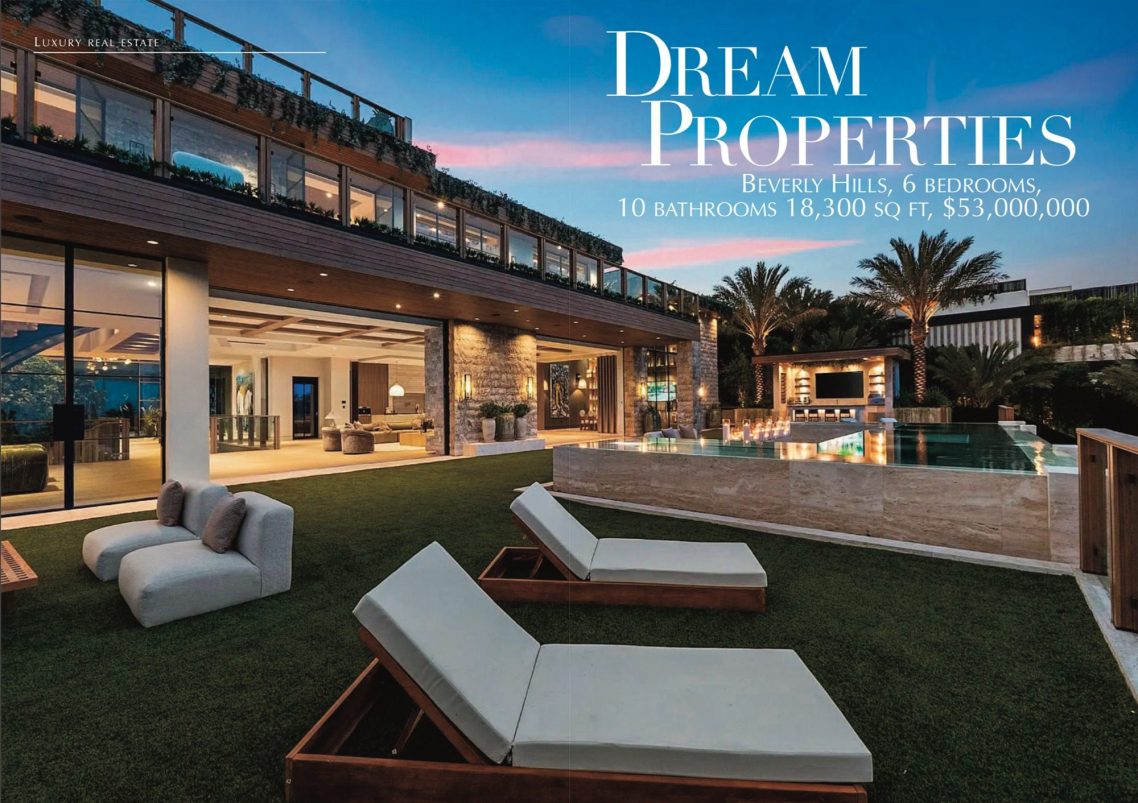
Beverly Hills, 6 bedrooms, 10 bathrooms
18,300 sq ft, $53,000,000
One of the most anticipated projects in the city's history, this sumptuous residence is a masterpiece of refinement, a transformative artistic vision by Ramtin Ray Nosrati, the renowned designer and developer, created for an elite clientele. Custom European furnishings are included in the sale.
Close to the famed Beverly Hills Hotel, the haute couture boutiques of Rodeo Drive, and everything that makes Los Angeles a world-class international destination, surrounded by some of the most expensive homes in the world, OPAL represents not only a new chapter in architectural evolution, but also an avant-garde reinvention of luxury for the modern era, through the use of rare and exceptional materials.
One of the most impressive features of the owner's wing is its dressing room, worthy of the grandest department stores, one of the An ultra-private contemporary château Nestled behind a fortified enclosure, this ultra-private contemporary château is set within a lush green oasis, surrounded by ficus trees, century-old olive trees, and palms, with an expansive motor court accommodating up to 12 vehicles. Shimmering cascades spill into the waters of a majestic pool, evocative of a moat, encircling a grand entrance drive. Soaring glass-and-iron windows form the main entrance and offer sweeping views of downtown Los Angeles and its iconic skyline, as well as the Pacific Ocean.
In the double-height entry hall, glimmering illuminated globes welcome visitors into this resort-like sanctuary, with its soaring ceilings and exceptional views from every room. Downtown Los Angeles takes center stage A pedestrian pathway, running alongside a colossal hand-carved rock wall and an art installation featuring an eight-meter-tall tree, leads to the expansive living room, where downtown Los Angeles takes center stage.
A monumental limestone fireplace separates two floor-to-ceiling, mailbox-shaped openings through which guests flow for seamless indoor-outdoor entertaining. Coffered ceilings draw the eye toward the two-story dining room, adorned with an imposing library, seven-meter-high ceilings, and skylights that cast natural light across its limewashed walls and organic accents. Adjacent to a cozy breakfast nook, the stunning kitchen echoes the property's travertine theme, featuring custom-built appliances and an oversized center island.
Toward the rear, discover a catering kitchen equipped with a double commercial cold room. The family room, also featuring an imposing fireplace and floor-to-ceiling iron-framed windows, is anchored by a natural-edge "Tiffany" Brazilian stone bar with turquoise veining. A panoramic windowed elevator serves all levels. Take the majestic floating wood staircase up to the sumptuous primary suite, with herringbone hardwood flooring, a panoramic terrace, an espresso nook, and concealed double doors leading to a sauna, a spa-worthy bathroom, and dressing rooms. The triple rain shower with soaking tub and shelf is clad in book-matched stone, and an immense double-vanity offers generous, intimate personal space.
One of the finest screening rooms to date On the richly appointed leisure level, a spectacular temperature-controlled glass-enclosed wine-tasting room is more expansive than most dining rooms, and one of the finest screening rooms to date features a celestial ceiling and a snack bar. Billiards and card-game areas are set beneath expansive windows overlooking the brow-shaped glass-bottom pool, topped with submerged sun ledges, one of two infinity pools found across the garden terraces.
The level also features a gym, two reading nooks, and a media lounge with a nine-screen video wall capable of streaming multiple channels and feeds simultaneously. On the rooftop terrace, wrapped in sweeping 360-degree views of the ocean, the city, the mountains, and the ridgeline, enjoy a game of pickleball, dine alfresco, or gather around one of the many fire-pit tables scattered throughout this stone-clad palace.
The ground-floor barbecue pavilion is equipped with a pizza oven, bar, counter seating, and a 116-inch television. A vast garage accommodates up to eight cars. The pinnacle of luxury has finally arrived — and it raises the bar even higher. www.carolwoodre.com
DREAM PROPERTIES
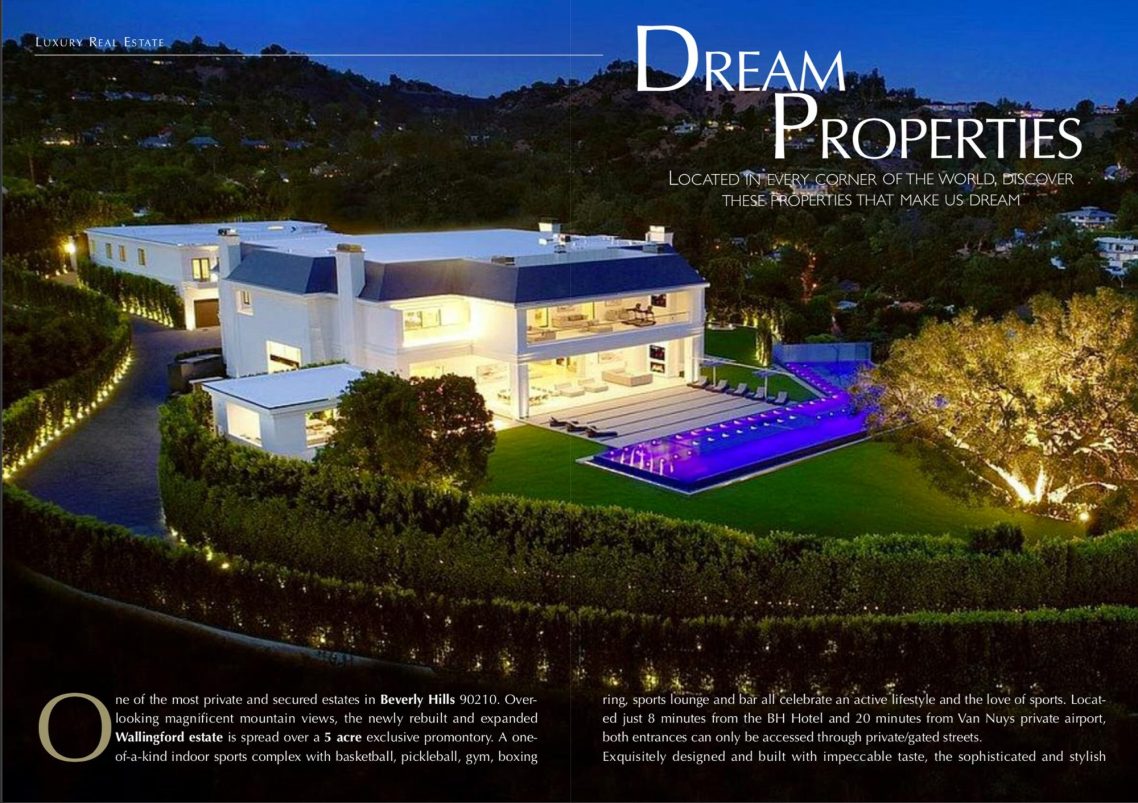
One of the most private and secured estates in Beverly Hills 90210. Overlooking magnificent mountain views, the newly rebuilt and expanded Wallingford estate is spread over a 5 acre exclusive promontory. A one-of-a-kind indoor sports complex with basketball, pickleball, gym, boxing ring, sports lounge and bar all celebrate an active lifestyle and the love of sports.
Located just 8 minutes from the BH Hotel and 20 minutes from Van Nuys private airport, both entrances can only be accessed through private/gated streets. Exquisitely designed and built with impeccable taste, the sophisticated and stylish estate infuses today's technology with refined rooms.
Totaling approx. 46.000 Square Footage under roof and approx. 38.000 Square Footage under A/C and boosting 12 bedrooms and 24 baths, approx. 5.000 Square Footage guest penthouse, caretaker house, 2 bedroom guardhouse, 12 car garage and parking for 80. Stunning zero edge pool perfectly frames the extensive grounds & views. 2571 Wallingford Drive, Beverly Hills Square Footage : 46,000 12 bedrooms & 24 bathrooms Price : $ 74,995,000
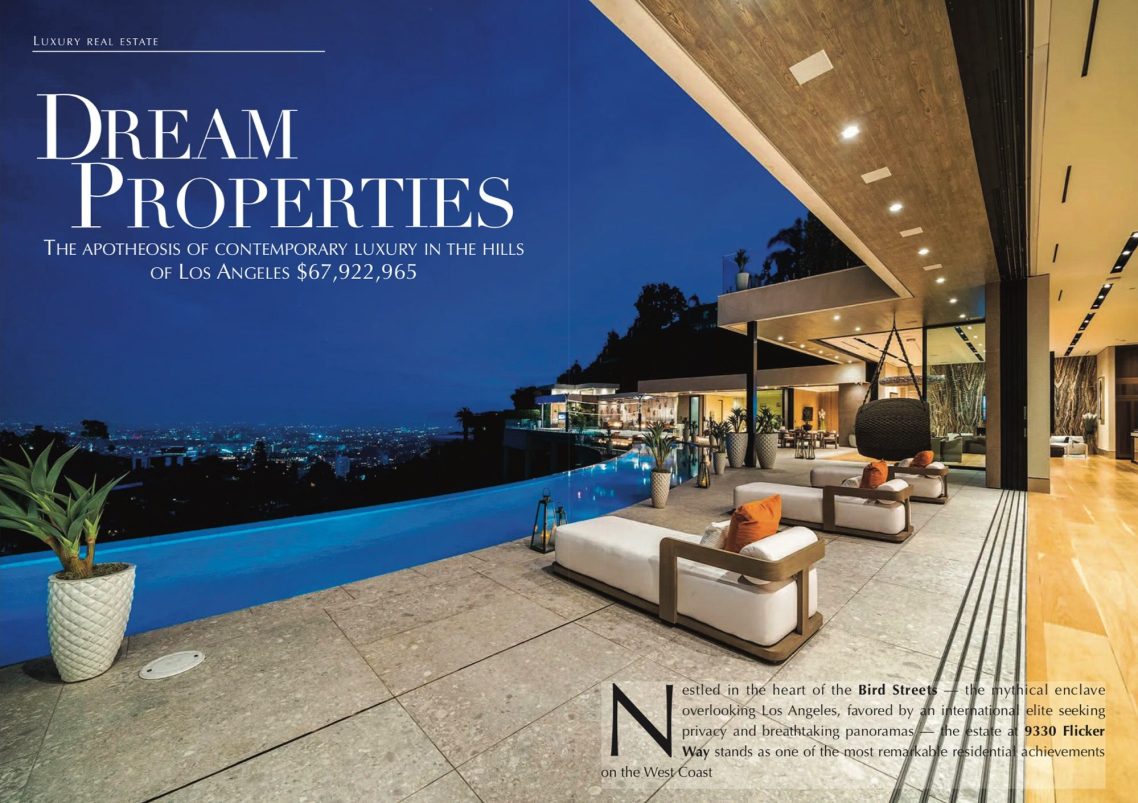
DREAM PROPERTIES
The apotheosis of contemporary luxury in the hills
of Los Angeles $67,922,965
Nestled in the heart of the Bird Streets — the mythical enclave overlooking Los Angeles, favored by an international elite seeking privacy and breathtaking panoramas — the estate at 9330 Flicker Way stands as one of the most remarkable residential achievements on the West Coast Offered at nearly 68 million dollars, this contemporary palace masterfully combines architectural grandeur, technological sophistication, and the California art of living in its purest expression.
From the very first moment, the property unveils a carefully orchestrated staging. The entrance, elevated by a bespoke sculptural chandelier, is accompanied by cascading fountains that establish a subtle dialogue between water, light, and material. This staging inaugurates a residential journey conceived as an immersive experience, where each space reveals a deliberate aesthetic intention. The main living room, the true beating heart of the home, impresses with its generous proportions and ceiling height of over thirteen feet. Anchored by layered stone fireplaces, it embodies a perfect balance between monumentality and intimacy.
Noble materials engage in dialogue with a contemporary palette, while the views open expansively onto the horizon through floor-to-ceiling glass walls — the architectural signature of the project. The Arclinea kitchen, both refined and highly functional, meets the standards of the most discerning chefs. It flows naturally into a European-inspired wine cellar, whose carefully designed lighting and artistic pendant fixture make it a space as aesthetic as it is convivial. This ensemble reflects a vision of luxury in which gastronomy and the art of entertaining hold a central place. The property houses nine bedrooms and fourteen bathrooms, each conceived as a sanctuary of absolute comfort. The primary suite, a true residence within the residence, embodies in itself the very quintessence of refinement. It opens onto an intimate reading vestibule, extending onto a balcony of over 1,500 square feet offering a panoramic view of the canyon and the city. Equipped with a jacuzzi and a fireplace, this private outdoor space becomes a privileged place of contemplation. Inside, two spacious walk-in closets and a travertine bathroom, featuring two bathtubs, complete this universe dedicated to well-being.
The architecture of the home rests on a deliberate intent to erase the boundaries between interior and exterior. The wide sliding glass panels transform the living spaces into open terraces, where the eye wanders across the California landscape. As night falls, the lights of Los Angeles compose a living backdrop, further enhancing the spectacular character of the property. The outdoor spaces, true extensions of the home, fully contribute to this sensory experience. A ninety-eight-foot infinity pool appears to merge with the horizon, while a built-in fireplace spanning over sixteen feet invites elegant evenings under the stars. A spa accommodating up to thirty guests, along with a sand volleyball court, complete this ensemble conceived to combine relaxation, conviviality, and theatrical staging. Beyond its spectacular attributes, the estate distinguishes itself through an exceptional level of amenities. An office designed as a true command center meets the demands of a hyperconnected lifestyle, while a professional screening room delivers an immersive cinematic experience. A fully equipped fitness center, dedicated lounges for hookah and meditation, as well as a panic room, reflect a comprehensive approach to comfort and security.
With a rare attention to detail, the property also integrates such singular installations as a shoe-shining station, revealing a commitment to every aspect of daily life. Built on a 39,225-square-foot lot, this residence does not merely offer an array of exceptional amenities — it embodies a vision. That of a contemporary luxury where architecture becomes experience, where technology quietly serves comfort, and where every space is conceived to elevate life's most precious moments. In a city where prestige real estate reaches new heights, 9330 Flicker Way stands as an absolute benchmark — a living work of art, at the crossroads of art, design, and excellence. More than a property, this estate is a statement. One of an uncompromising art of living, suspended between sky and city, where every detail contributes to a staging of daily life elevated to the level of the exceptional. www.thefridmangroup.com
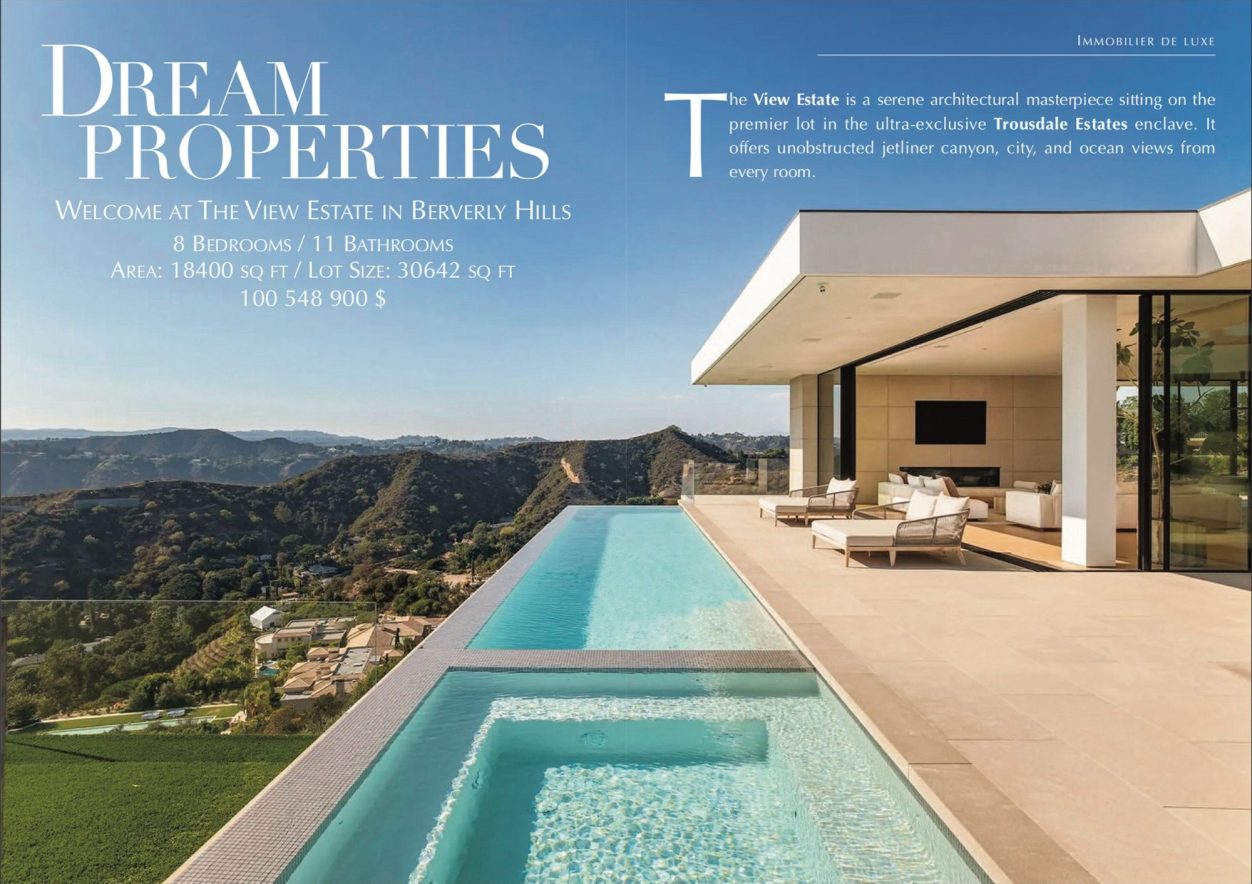
DREAM PROPERTIES
Welcome at The View Estate in Beverly Hills 8 Bedrooms / 11 Bathrooms Area: 18400 sq ft / Lot Size: 30642 sq ft 100 548 900 $
The View Estate is a serene architectural masterpiece sitting on the premier lot in the ultra-exclusive Trousdale Estates enclave. It offers unobstructed jetliner canyon, city, and ocean views from every room. This new construction showcases unparalleled fit and finishes, imported stonework, floor-to-ceiling glass walls, custom furniture, and soaring ceilings. Designed by world-renowned architect Paul McClean with interiors designed by LA based Bespoke interior design firm GD Studio. Greeted by a 100-year-old olive tree, pass through the gates to discover dramatic water features and a zero-edge waterfall leading to a 10+ car garage with turntable. Inside, tranquil formal living and dining rooms with warm European oak paneling and a marble fireplace open to a breathtaking backyard oasis complete with multiple fire features, flat lush lawns, and an infinity pool/spa that spills seamlessly into the skyline.
There are two world class gourmet kitchen’s that are outfitted with Calacatta Borghini marble and Miele appliances. The main Kitchen is the perfect gathering space and the Chef’s kitchen is clearly Michelin star. Two expansive primary suites feature fireplaces, spa-like bathrooms, and dual closets. Take the elevator down to a day-lit entertainment lounge bathed in natural light, featuring a bar, wine room, world-class spa with infrared sauna and private massage room, and a state-of-the-art fitness center curated by Technogym. World class cinema with Candy Wall with additional lounge areas complete the experience. An estate of this scale, craftsmanship, and architectural pedigree can never be built again in Trousdale a true private sanctuary that masterfully blends design, luxury, and tranquility.
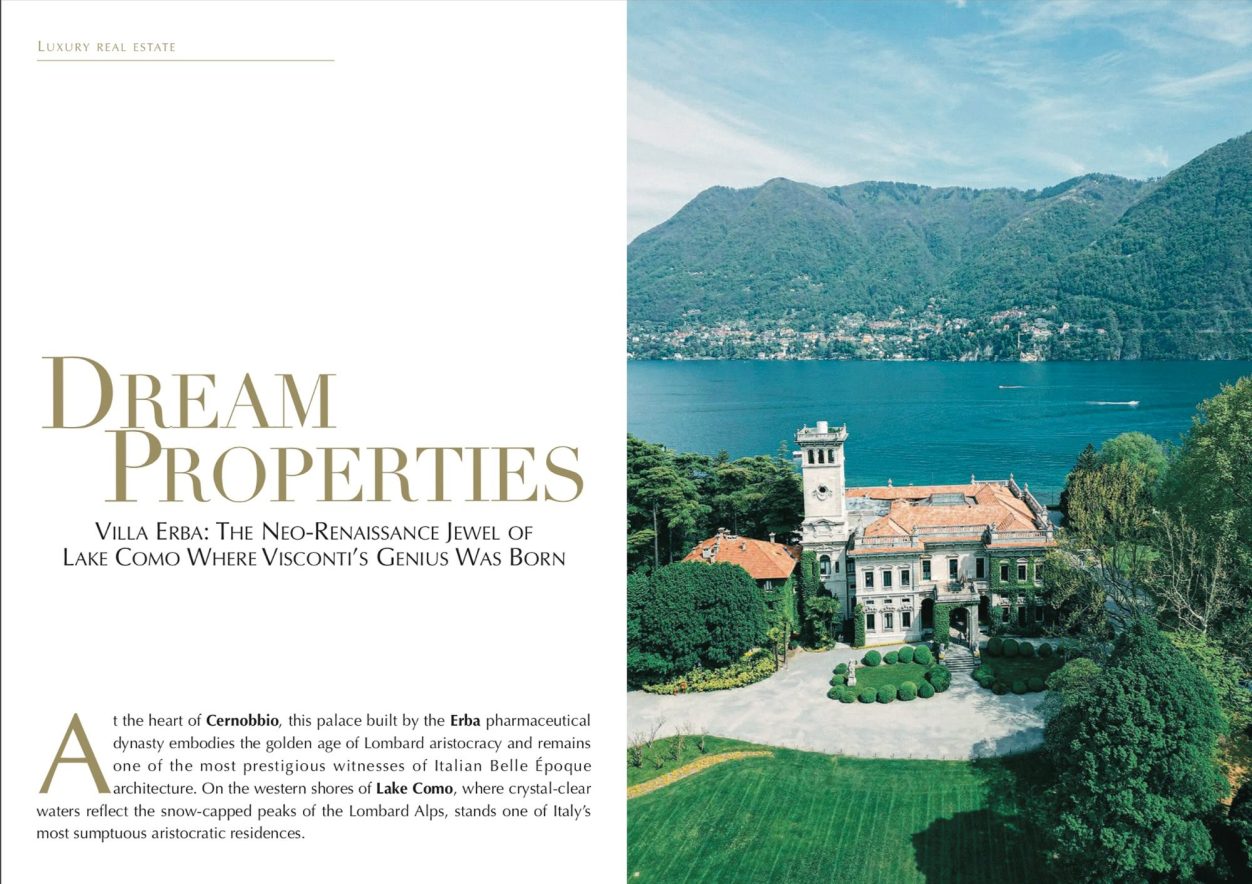
DREAM PROPERTIES
Villa Erba: The Neo-Renaissance Jewel of Lake Como
Where Visconti’s Genius Was Born
At the heart of Cernobbio, this palace built by the Erba pharmaceutical dynasty embodies the golden age of Lombard aristocracy and remains one of the most prestigious witnesses of Italian Belle Époque architecture. On the western shores of Lake Como, where crystal-clear waters reflect the snow-capped peaks of the Lombard Alps, stands one of Italy’s most sumptuous aristocratic residences.
Villa Erba, a 19th-century Neo-Renaissance palace nestled in the heart of a ten-hectare botanical park, embodies the very pinnacle of Belle Époque architecture and the refinement of Italy’s great industrial bourgeoisie. A close neighbor of the famous Villa d’Este—now a legendary palace hotel—this extraordinary residence was the childhood home of Luchino Visconti, the undisputed master of Italian neorealist cinema, and today remains one of Europe’s most prestigious congress and event centers.
Five Centuries of History The history of Villa Erba traces back to the 15th century, when a convent of Benedictine nuns from the Cluny order was established on this privileged promontory overlooking the lake. In 1785, the convent was abandoned, and the convent buildings were sold to private owners. In 1816, on the very foundations of the former monastery, Marquise Vittoria Peluso Calderara had a sumptuous villa built, transforming the nuns’ former vegetable gardens into a magnificent English-style garden. This first aristocratic residence would change hands several times before entering its most glorious phase. The year 1882 marked a decisive turning point. Countess Anna Brivio and her husband Luigi Erba—brother and heir of the famous Carlo Erba, founder of Italy’s first pharmaceutical industry—acquired the property. Luigi Erba, from one of Milan’s wealthiest industrial families, immediately envisioned a grand project: to demolish the existing building and erect a residence worthy of his dynasty’s prestige and power.
An Architectural Masterpiece by Borsani and Savoldi In 1893, construction began on the current palace, entrusted to the era’s two most prominent architects: Gian Battista Borsani and Angelo Savoldi. The project would span a decade. The result of this exceptional collaboration remains today one of the most accomplished examples of Neo-Renaissance architecture on the shores of Lake Como. The main façade, facing the lake, is distinguished by an imposing ceremonial staircase that descends majestically toward the water. On the opposite side, facing the garden, a monumental portico welcomes visitors.
The entire architectural ensemble harmoniously blends echoes of Italian Renaissance with the technical innovations of the late 19th century, creating a stylistic synthesis of rare elegance. The interior design was entrusted to Angelo Lorenzoli for sculptural decorations and Ernesto Fontana for frescoes. These artists showcased their full talent in the reception rooms, creating decorative schemes of sumptuous grandeur reminiscent of the great Venetian palaces. Finely carved coffered ceilings, mural frescoes with allegorical motifs, gilded stuccoes, and polychrome marbles compose a décor of exceptional richness.
Outside, the sculptor Mazzucchelli adorned the park with his creations, notably two majestic lions flanking the carriage entrance—symbols of power and nobility that still welcome visitors today. The Golden Age: Lavish Receptions and a Cultural Salon Under the guidance of Luigi Erba and his wife Anna Brivio, Villa Erba experienced its most dazzling period of glory. The couple hosted sumptuous receptions attended by the leading figures of the political, industrial, and artistic worlds of the time. The villa quickly became one of the most sought-after salons in Milanese and European high society, rivaling Venetian palaces and Florentine villas for the splendor of its festivities.
The Visconti Legacy: A Villa That Nurtured Neorealist Cinema In 1922, Carla Erba, the only daughter of Luigi and Anna, inherited the property. Niece of the renowned composer and music publisher Giulio Ricordi, Carla married Duke Giuseppe Visconti di Modrone, thereby uniting the industrial fortune of the Erba family with the aristocratic prestige of one of Milan’s oldest noble families. From this union was born Luchino Visconti, who would become one of the greatest filmmakers in cinematic history. Although Villa Erba never appears directly in his films, it undeniably inspired the sumptuous settings and melancholic atmosphere of his masterpieces.
An Exceptional Botanical Jewel: The Park The park of Villa Erba is itself a unique landscape treasure on Lake Como: it is the only fully flat garden among all the major historic villas along the shores. The park also features modern amenities: private lake docks, a heliport, and a swimming pool located in the northeast corner of the estate, offering breathtaking views of the waters and surrounding mountains. A Venue for Exceptional Events Today, Villa Erba has established itself as one of Europe’s most prestigious event venues. Its dual identity—as a historic palace and a modern congress center—allows it to host a remarkable variety of gatherings.
Heritage Value and Appraisal Although Villa Erba has not been a private residence since 1986, its theoretical market value continues to spark curiosity among observers of the luxury real estate market. Although no recent transaction allows for a precise valuation, several factors help to estimate a range. Prestige lakeside properties regularly trade between €15,000 and €35,000 per square meter, depending on the exact location, state of preservation, and historical prestige. By extrapolating from observed transactions for comparable properties, a cautious estimate would place the heritage value of the entire Villa Erba between €100 and €200 million.
For comparison, the neighboring Villa d’Este—transformed into a luxury palace—would, according to some estimates, have a valuation exceeding €300 million. When Stone Preserves Memory Gazing upon Villa Erba from its terraces overlooking the lake, as the setting sun ignites the waters and bathes the Neo-Renaissance façades in golden light, one understands what so captivated Luchino Visconti about this residence. It is not merely the architectural beauty, nor the refinement of the interior decorations, nor even the majesty of the centennial park.
It is the mysterious alchemy between stone and memory, between a glorious past and a living present, between fallen aristocracy and triumphant modernity. It is the ability of exceptional places to crystallize the spirit of an era, to preserve the echo of brilliant conversations, the rustle of ball gowns, the clink of champagne glasses. Today, Villa Erba remains what it has always been: a place of gathering, exchange, and celebration. But whereas in the days of the Erba and Visconti families it hosted the aristocratic and industrial elite in the intimate hush of private receptions, it now opens its doors to a wider audience, democratizing access to beauty without diminishing its essence.
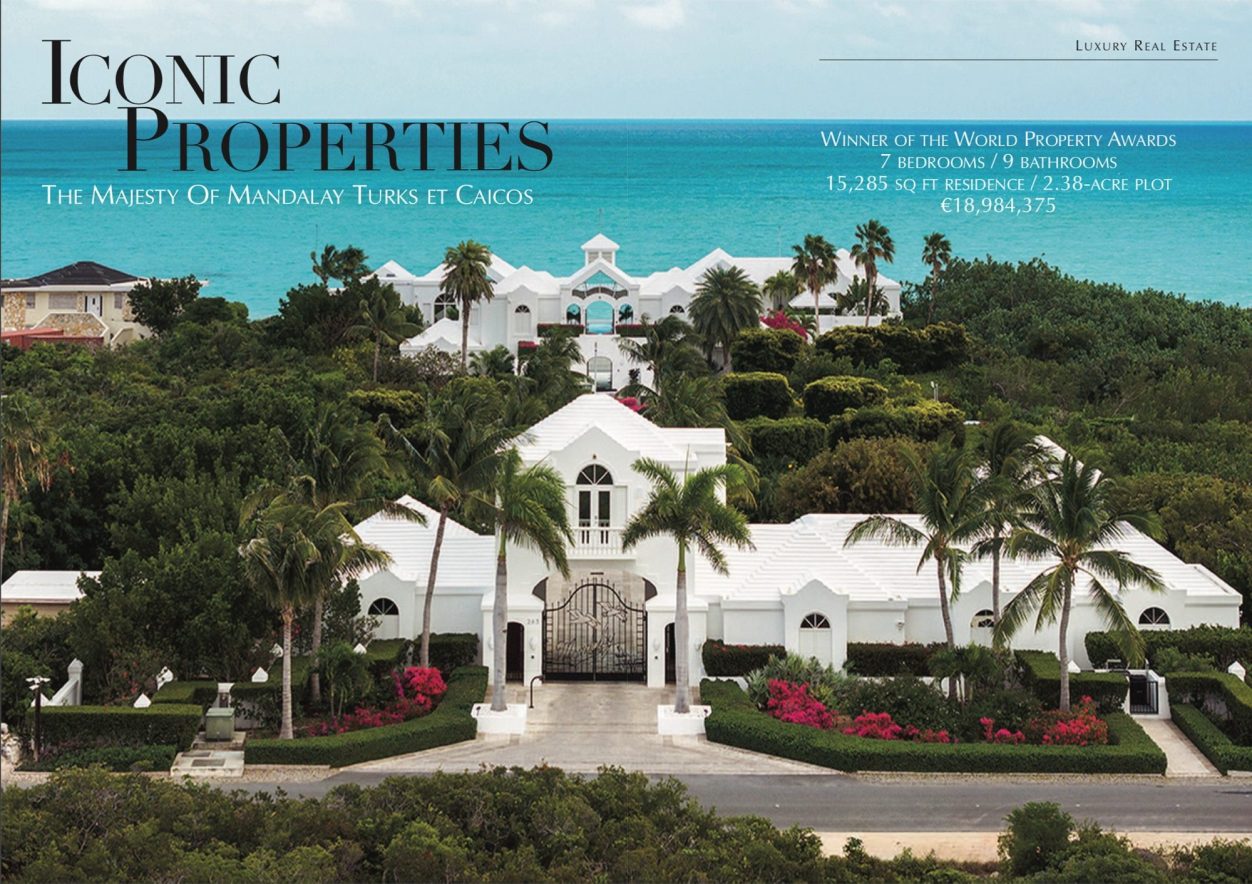
ICONIC PROPERTIES
The Majesty Of Mandalay Turks et Caicos
Discover the most prestigious real estate offering in the Turks and Caicos Islands at Mandalay — a vast seven-bedroom estate set along 190 feet of pristine beachfront on Long Bay.
This fully air-conditioned sanctuary showcases award-winning architecture and embodies the essence of Caribbean living through a masterfully designed layout centered around a spectacular multi-level swimming pool, outdoor lounge areas, a fire pit, and cascading water features. Stretching the full length of the residence, the pool flows seamlessly into an infinity edge, revealing breathtaking views across the mesmerizing shades of blue of the Caicos Banks.
Easily move from the upstairs bar to the wine cellar, then on to an elegant seaside dining room that seats 12. Accessible through electronic security gates, Mandalay ensures maximum privacy, making it a favored retreat for celebrities. Entertain in style with luxurious formal and informal spaces, both indoors and out, featuring a family kitchen, a professional chef’s kitchen, and a wine cellar. The master suite is a seaside sanctuary, complete with a private outdoor lounge, a spa, and an open-air shower. Each guest suite offers a personalized experience with uniquely designed bathrooms and décor. The estate also features a fully equipped gym, a maze-like garden, secure garages for vehicles and jet-skis, and a smart home system controlling lighting and temperature.
With citrus trees, banana palms, and an herb garden, the landscaped grounds create a true tropical oasis. Experience the pinnacle of Caribbean luxury at Mandalay.
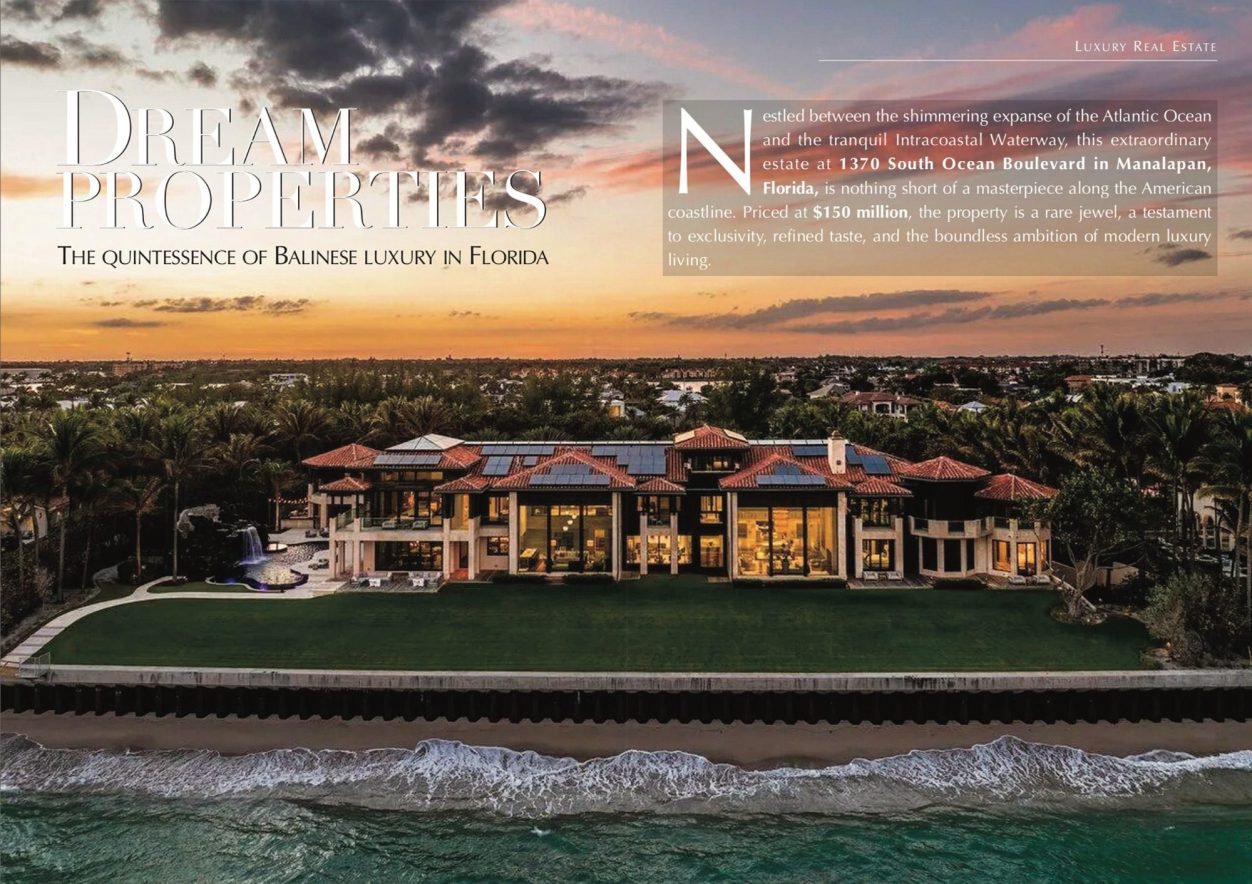
DREAM PROPERTIES
THE QUINTESSENCE OF BALINESE LUXURY IN FLORIDA
Nestled between the shimmering expanse of the Atlantic Ocean and the tranquil Intracoastal Waterway, this extraordinary estate at 1370 South Ocean Boulevard in Manalapan, Florida, is nothing short of a masterpiece along the American coastline. Priced at $150 million, the property is a rare jewel, a testament to exclusivity, refined taste, and the boundless ambition of modern luxury living.
It is a place where scale, elegance, and serenity converge in perfect harmony. Inspired by the clean, flowing lines of modern Balinese architecture, the residence unfolds across an impressive 3,200 square meters within a lush 2.83-acre estate—over one hectare of meticulously curated gardens, private courtyards, and serene outdoor spaces. With more than 91 meters of waterfront frontage, the property stretches gracefully from the Atlantic Ocean to the Intracoastal Waterway, offering an unparalleled dual perspective over Florida’s crystalline blue waters.
Whether bathed in the soft glow of sunrise or the golden hues of sunset, every view is a portrait of coastal perfection. Fully reimagined in 2015 and subsequently renovated with meticulous care, the estate harmoniously blends aesthetic sophistication with cutting-edge technological innovation. Every detail, from the tactile warmth of natural materials to the seamless integration of smart home systems, has been considered to create a living environment that is both sumptuous and supremely comfortable. The interiors, crafted by the world-renowned firm Marc-Michaels Interior Design Inc., evoke a tranquil, refined vision of tropical luxury: bespoke furniture, luminous design, subtle lighting effects, and soaring volumes work together to craft spaces that are at once intimate and monumental, serene and grand.
The estate offers nine sumptuous bedrooms, eleven full bathrooms, and five additional powder rooms. Among these, seven ocean-facing suites open onto private terraces, each presenting uninterrupted views of the glittering waters, while two guest suites are discreetly nestled within the lush gardens, providing privacy, serenity, and a direct connection to nature. Every suite is a sanctuary, a personal retreat infused with elegance, comfort, and understated glamour. The main salon and family room captivate with soaring nine-meter ceilings, reminiscent of the airy pavilions found in the most luxurious Balinese resorts. Light streams effortlessly through expansive windows, animating the spaces with natural brilliance and casting a gentle glow across the meticulously curated interiors. Here, the architectural design celebrates both openness and intimacy, creating spaces that invite gatherings yet remain deeply personal. Conceived as a living work of art, the estate offers an array of spaces dedicated to entertainment, relaxation, and refined leisure. A private cinema, a sunlit library, multiple game rooms, a climate-controlled wine cellar, panoramic offices, and adaptable lounges ensure that every desire can be fulfilled with elegance and discretion.
Each room is an invitation to experience absolute comfort, where privacy and grandeur coexist seamlessly, and where every detail—from hand-selected finishes to the play of light and shadow—is designed to delight the senses. Offered fully furnished and ready for immediate occupancy, this iconic Manalapan estate does more than exemplify prestige—it redefines the Balinese dream with a distinct American sensibility. It blends architectural perfection, hedonic luxury, and the understated pleasures of coastal living, inviting its inhabitants to immerse themselves in a lifestyle where every moment is imbued with beauty, tranquility, and sophistication.
Here, the horizon stretches endlessly, the waters glisten endlessly, and the promise of serenity is woven into every room, every terrace, every corner of this extraordinary property, and timeless elegance. www.raveis.com
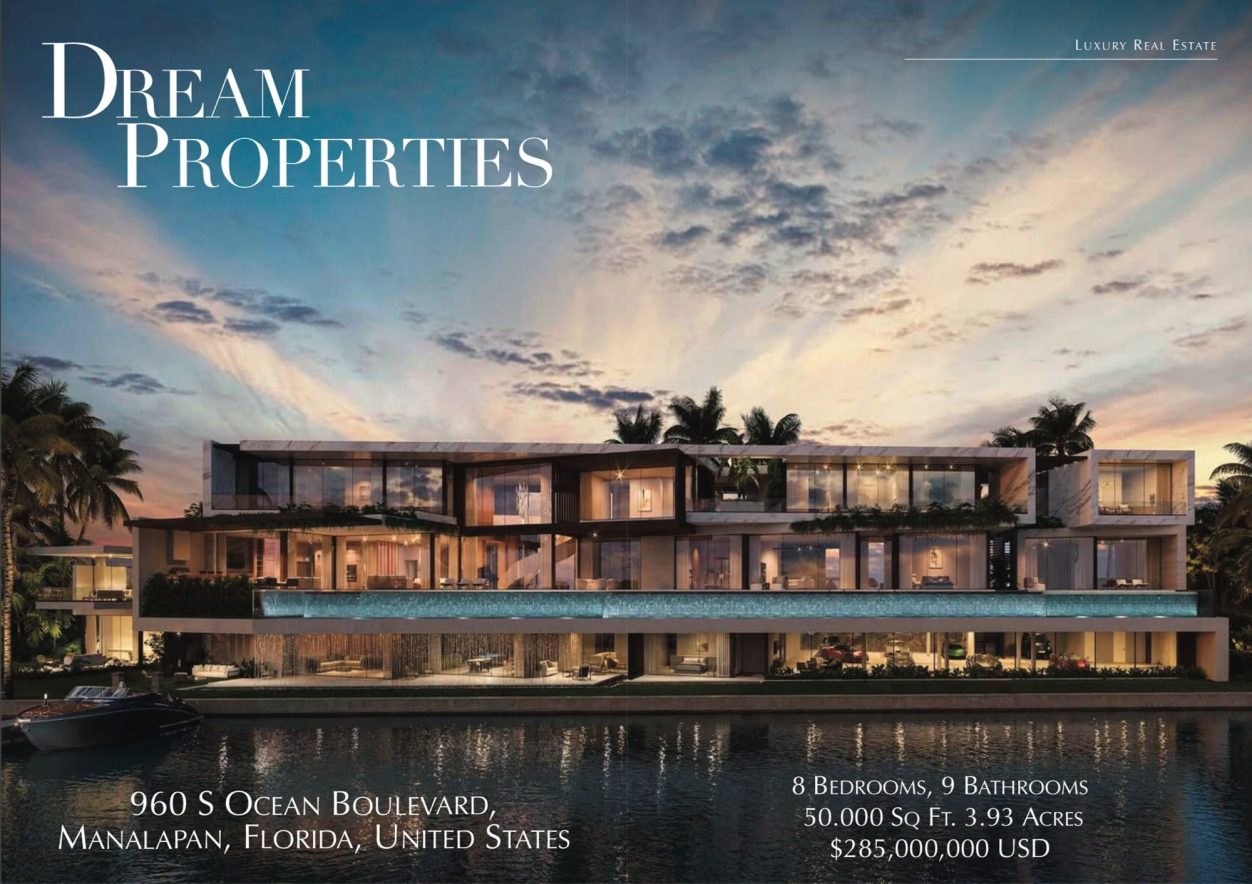
DREAM PROPERTIES
960 S OCEAN BOULEVARD, MANALAPAN, FLORIDA, UNITED STATES
This Ocean-to-Intracoastal masterpiece represents an unprecedented real estate offering in the United States, redefining luxury and sophis- tication on a scale never before achieved. Envisioned by acclaimed architect Choeff Levy Fishman, crafted by renowned builder Robert W. Burrage of RWB Construction Management, and impeccably designed by
Marc-Michaels Interior Design, Inc., this architectural triumph spans over
50,000 total square feet...
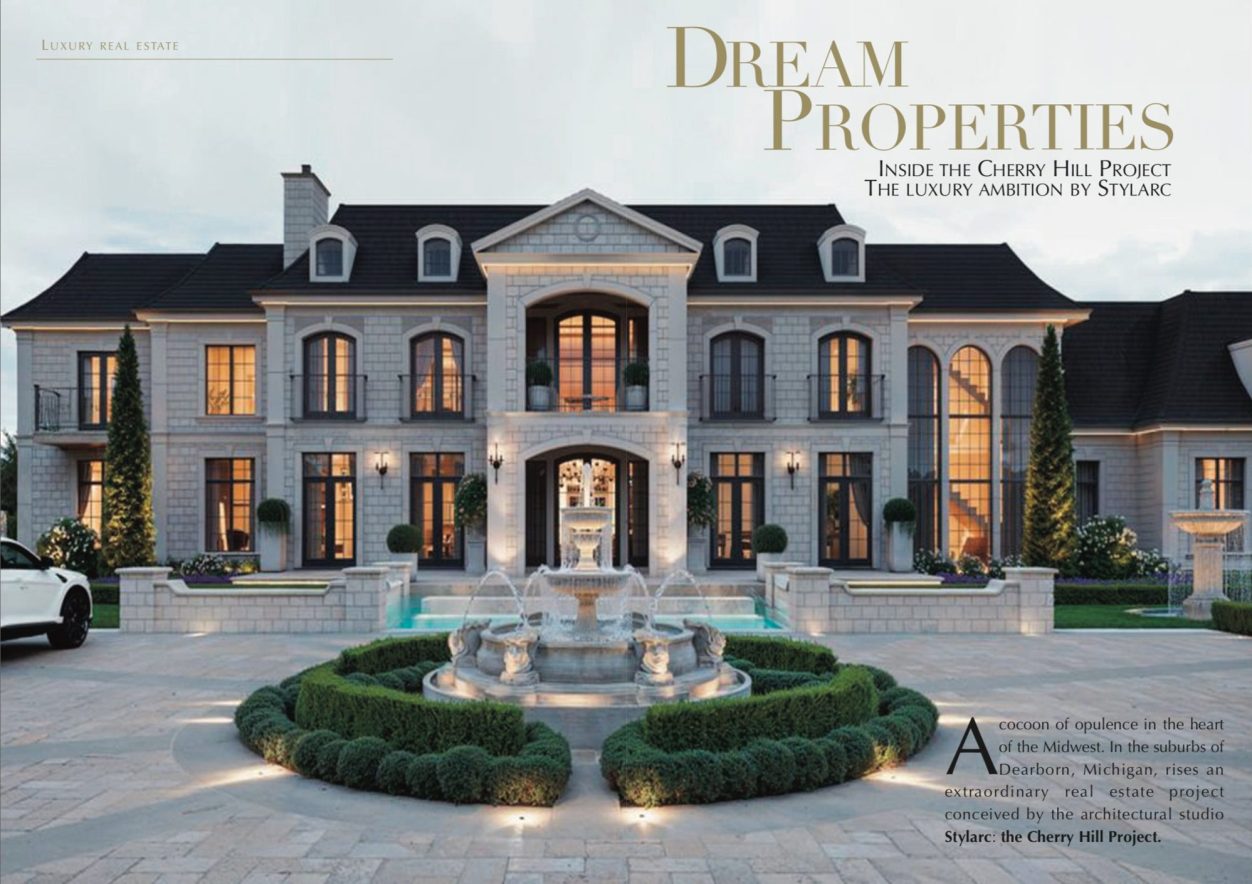
DREAM PROPERTIES
INSIDE THE CHERRY HILL PROJECT THE LUXURY AMBITION BY STYLARC
A cocoon of opulence in the heart of the Midwest. In the suburbs of Dearborn, Michigan, rises an extraordinary real estate project conceived by the architectural studio Stylarc: the Cherry Hill Project...
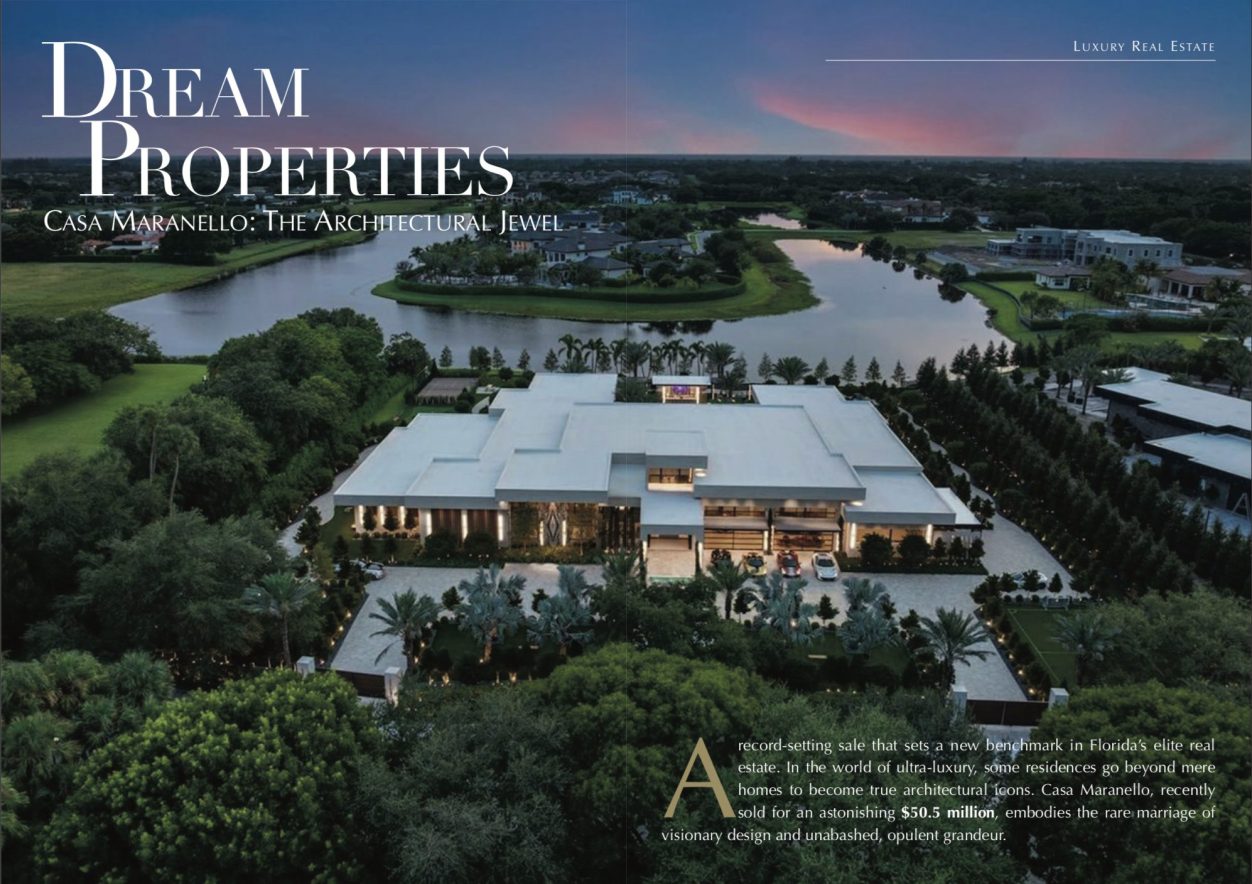
DREAM PROPERTIES
CASA MARANELLO: THE ARCHITECTURAL JEWEL
A record-setting sale that sets a new benchmark in Florida’s elite real estate. In the world of ultra-luxury, some residences go beyond mere homes to become true architectural icons. Casa Maranello, recently sold for an astonishing $50.5 million, embodies the rare marriage of visionary design and unabashed, opulent grandeur...
DREAM PROPERTIES
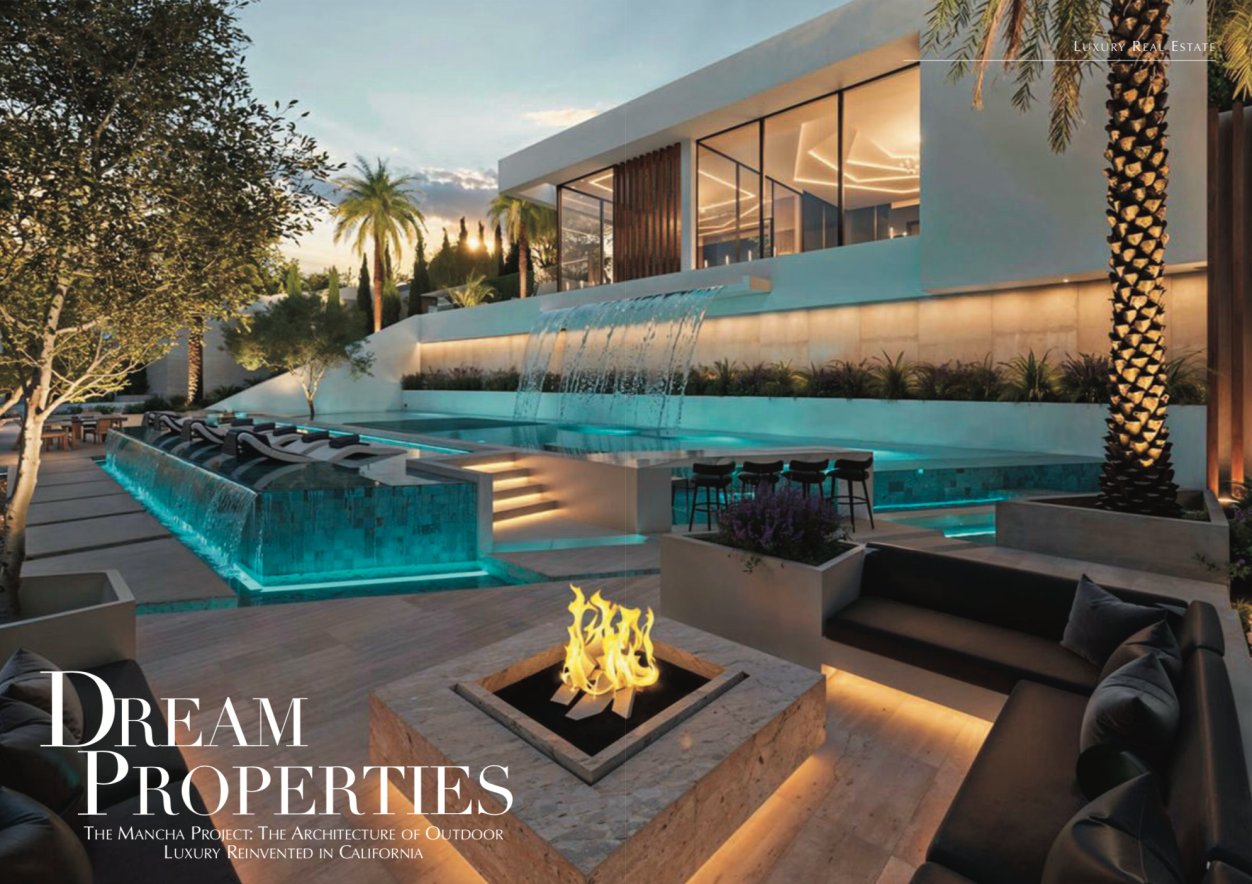
THE MANCHA PROJECT: THE ARCHITECTURE OF OUTDOOR LUXURY REINVENTED
IN CALIFORNIA
In the heart of the golden hills of San Luis Obispo, California, an exceptional development is poised to redefine the codes of residential luxury. Known as Mancha, this three-acre estate stands as an ode to natural beauty and architectural sophistication. Conceived as a retreat where every space celebrates the harmony between comfort, design, and nature, it promises to become one of the most emblematic expressions of 21st-century Californian living...
DREAM PROPERTIES
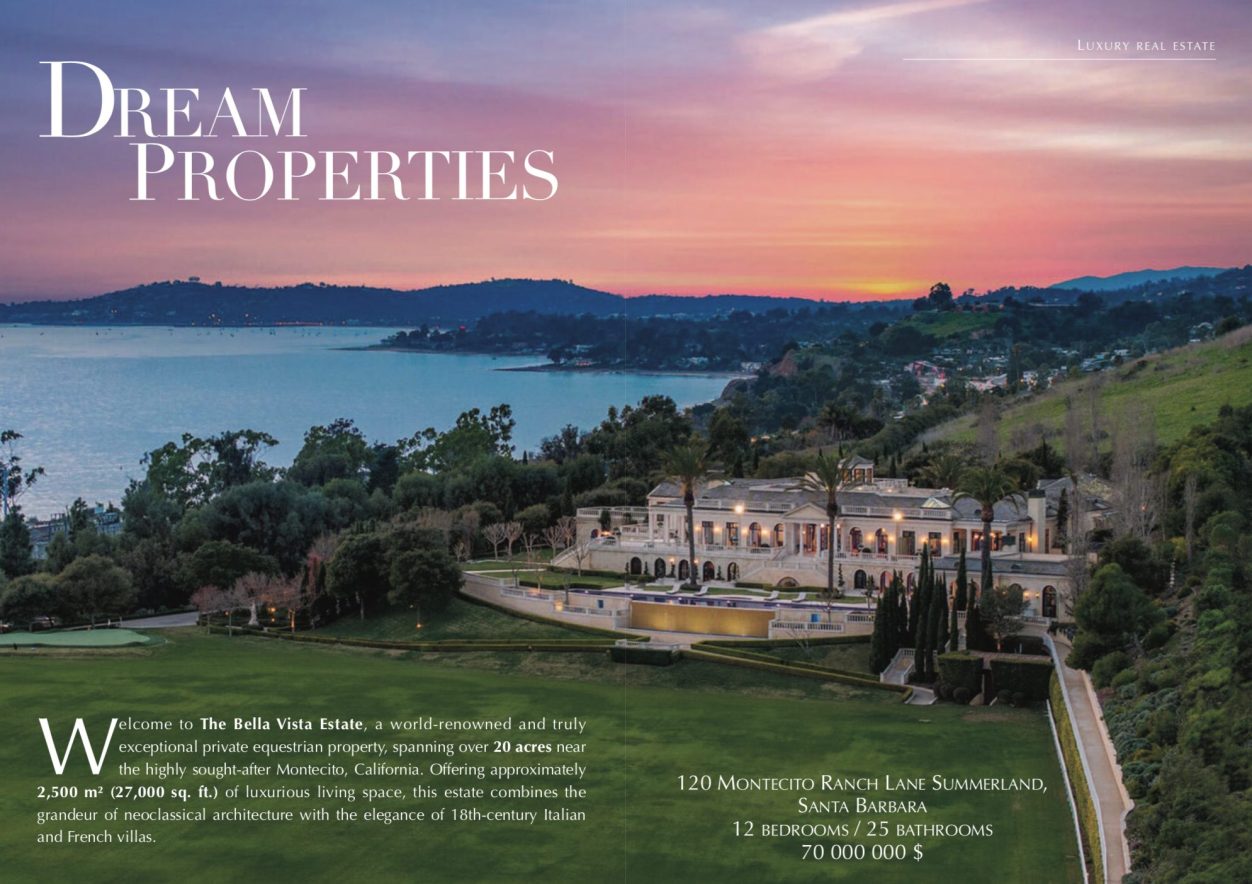
120 MONTECITO RANCH LANE SUMMERLAND,
SANTA BARBARA
12 BEDROOMS / 25 BATHROOMS
70 000 000 $
Welcome to The Bella Vista Estate, a world-renowned and truly exceptional private equestrian property, spanning over 20 acres near the highly sought-after Montecito, California. Offering approximately 2,500 m2 (27,000 sq. ft.) of luxurious living space, this estate combines the grandeur of neoclassical architecture with the elegance of 18th-century Italian and French villas...
DREAM PROPERTIES
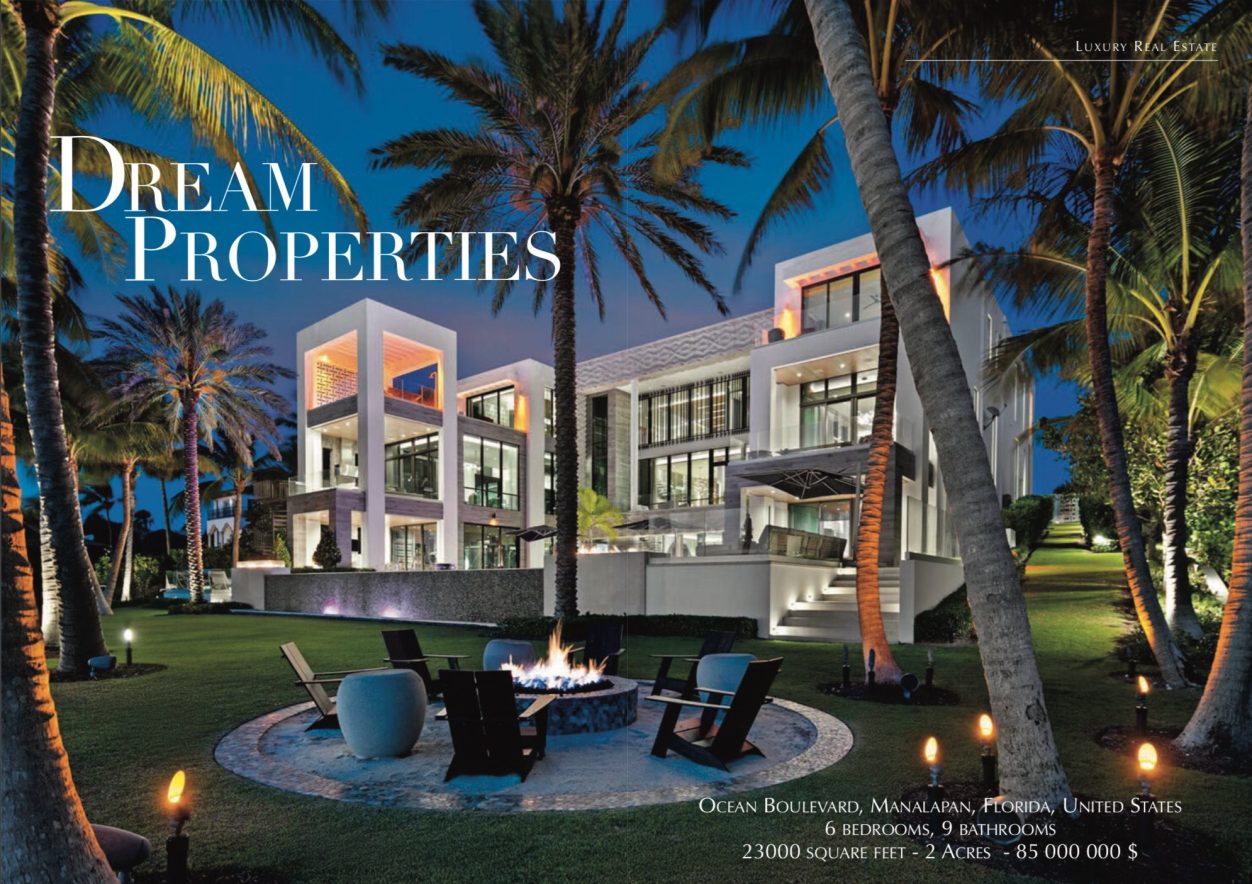
OCEAN BOULEVARD, MANALAPAN, FLORIDA, UNITED STATES 6 BEDROOMS, 9 BATHROOMS
23000 SQUARE FEET - 2 ACRES - 85 000 000 $
An Exceptional Property in Manalapan: Luxury and Sophistication in the Heart of Florida. In the stunning setting of Florida, at 1940 South Ocean Boulevard in Manalapan, lies an exceptional property that few can imagine: a contemporary three-story residence spanning nearly 23,000 square feet, offering breathtaking views of the Intracoastal Waterway and the pristine Atlantic beaches...
DREAM PROPERTIES
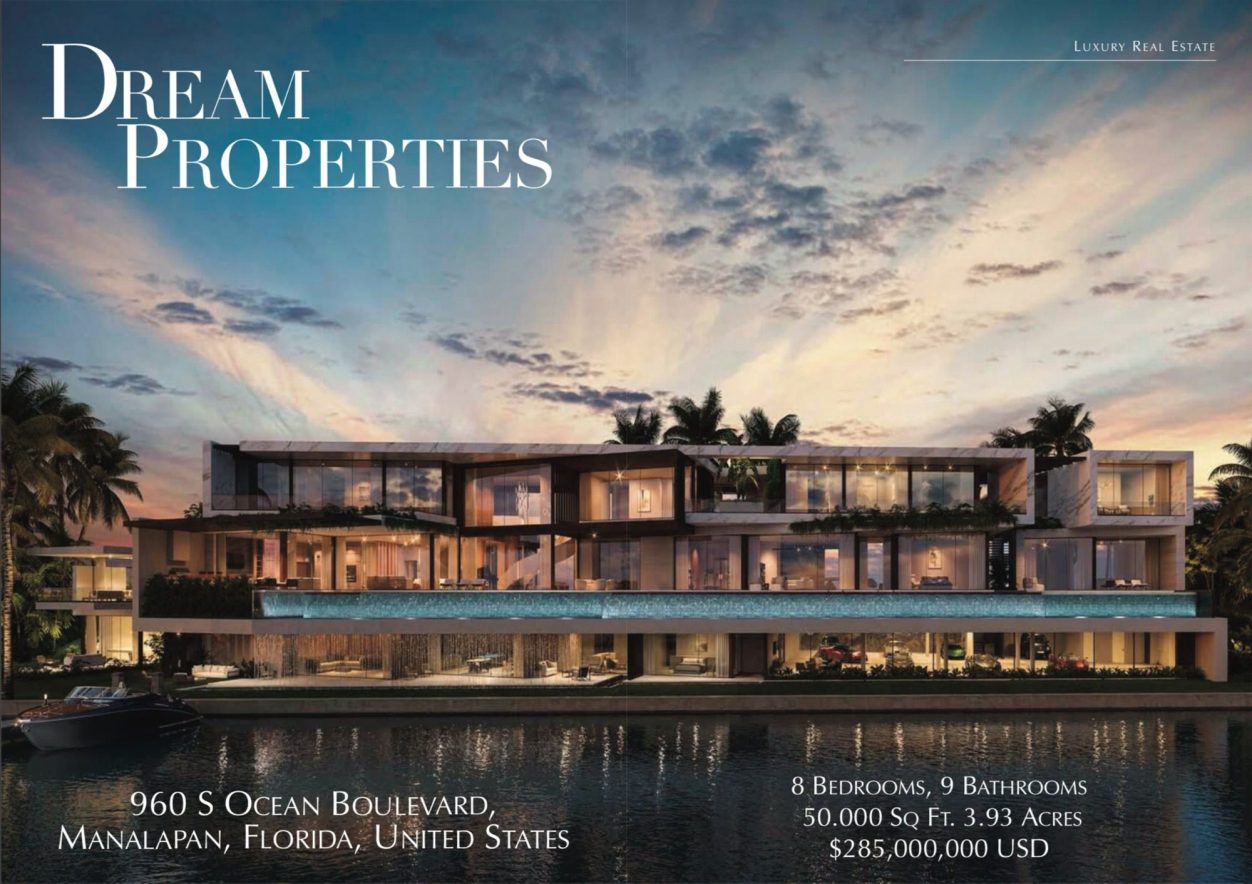
960 S OCEAN BOULEVARD, MANALAPAN, FLORIDA, UNITED STATES 8 BEDROOMS, 9 BATHROOMS 50.000 SQ FT. 3.93 ACRES $285,000,000 USD
This Ocean-to-Intracoastal masterpiece represents an unprecedented real estate offering in the United States, redefining luxury and sophistication on a scale never before achieved. Envisioned by acclaimed architect Choeff Levy Fishman, crafted by renowned builder Robert W. Burrage of RWB Construction Management, and impeccably designed by Marc-Michaels Interior Design, Inc., this architectural triumph spans over 50,000 total square feet...
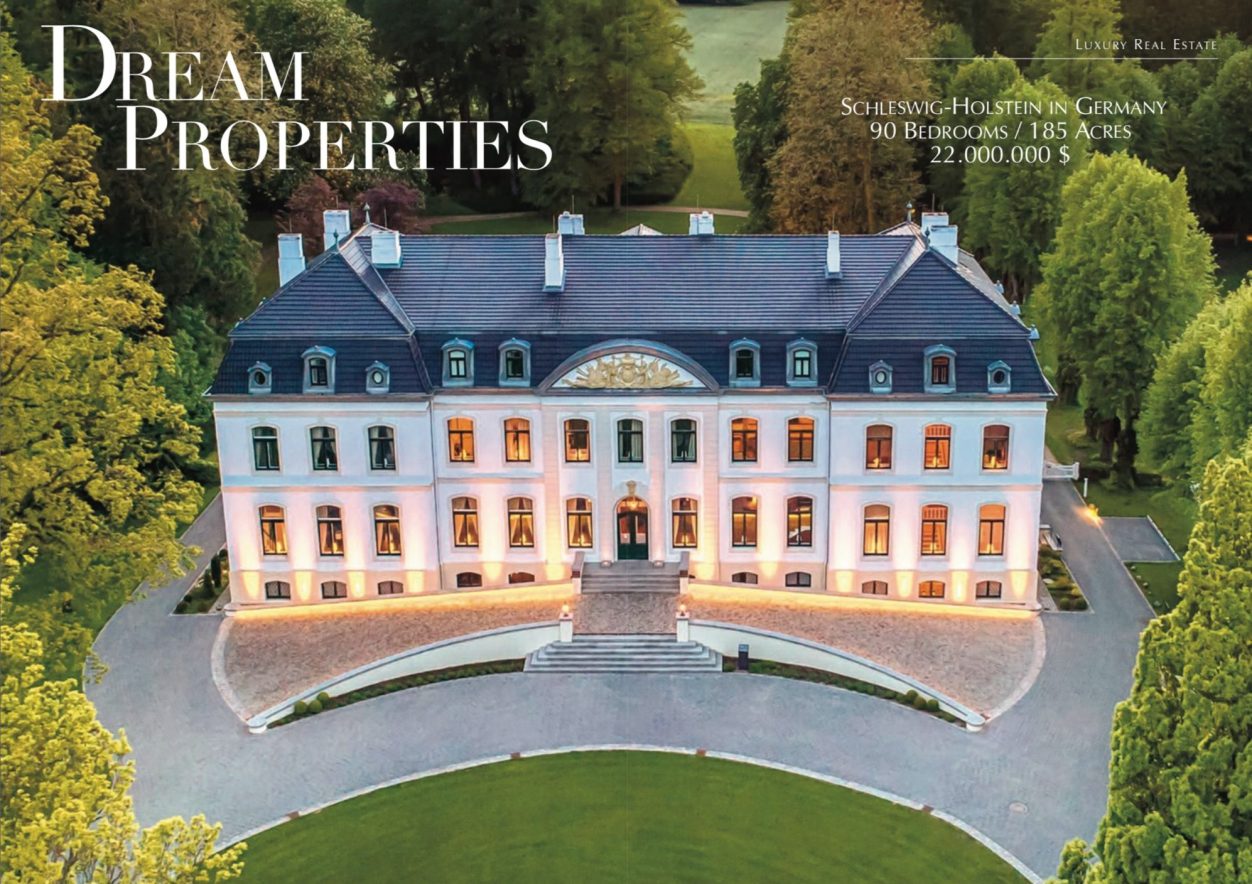
DREAM PROPERTIES
SCHLESWIG-HOLSTEIN IN GERMANY 90 BEDROOMS / 185 ACRES : 22.000.000 $
Germany’s Most Exclusive Private Coastal Estate – A Masterpiece of Heritage. A once-in-a-lifetime opportunity to acquire one of Europe’s most exclusive private estates: Weissenhaus, an ultra-private, fully gated coastal sanctuary spanning 180 acres (approx. 74.87 hectares) along the pristine Baltic Sea...
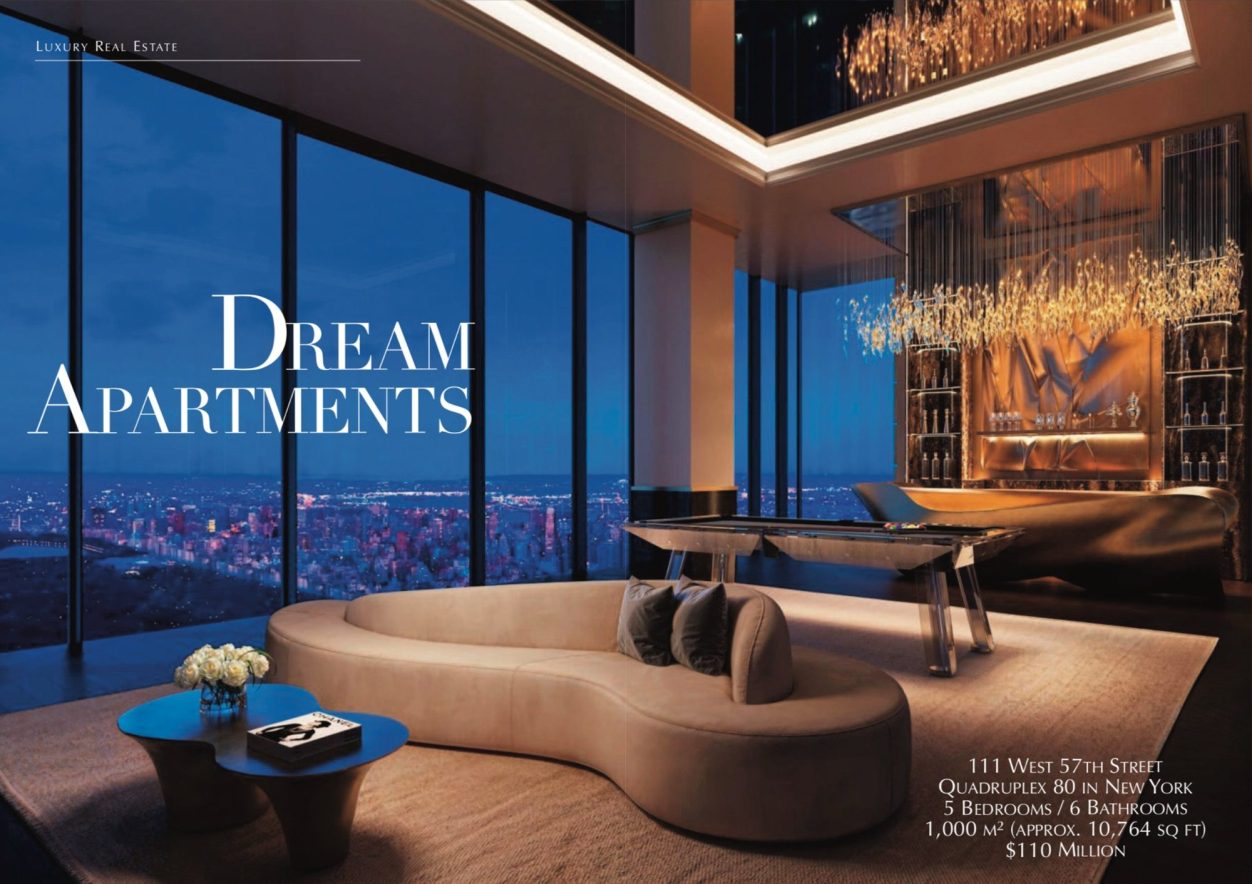
DREAM APARTMENTS
111 WEST 57TH STREET QUADRUPLEX 80 IN NEW YORK 5 BEDROOMS / 6 BATHROOMS 1,000 M2 (APPROX. 10,764 SQ FT) $110 MILLION
Manhattan’s Most Iconic Address Now Hosts Its Grandest Residence Yet. Perched atop 111 West 57th Street, Manhattan’s most extraordinary residential offering is now available. This architectural masterpiece by SHoP Architects, with interiors designed by Studio Sofield, redefines luxury in the heart of New York City. Spanning four full floors, Quadruplex 80 boasts over 1,090 square meters (11,730 sq ft) of meticulously crafted interior space and 56 square meters (600 sq ft) of breathtaking south-facing outdoor terraces. A private internal elevator and a custom circular staircase lead to a realm of refined elegance, where sweeping 360- degree views capture Central Park in perfect alignment, the dazzling city skyline, and a panorama stretching from river to river. Soaring 4.2-meter (14-foot) ceilings combined with expansive floor-to-ceiling windows flood the home with natural light, highlighting exquisite bespoke design details throughout...
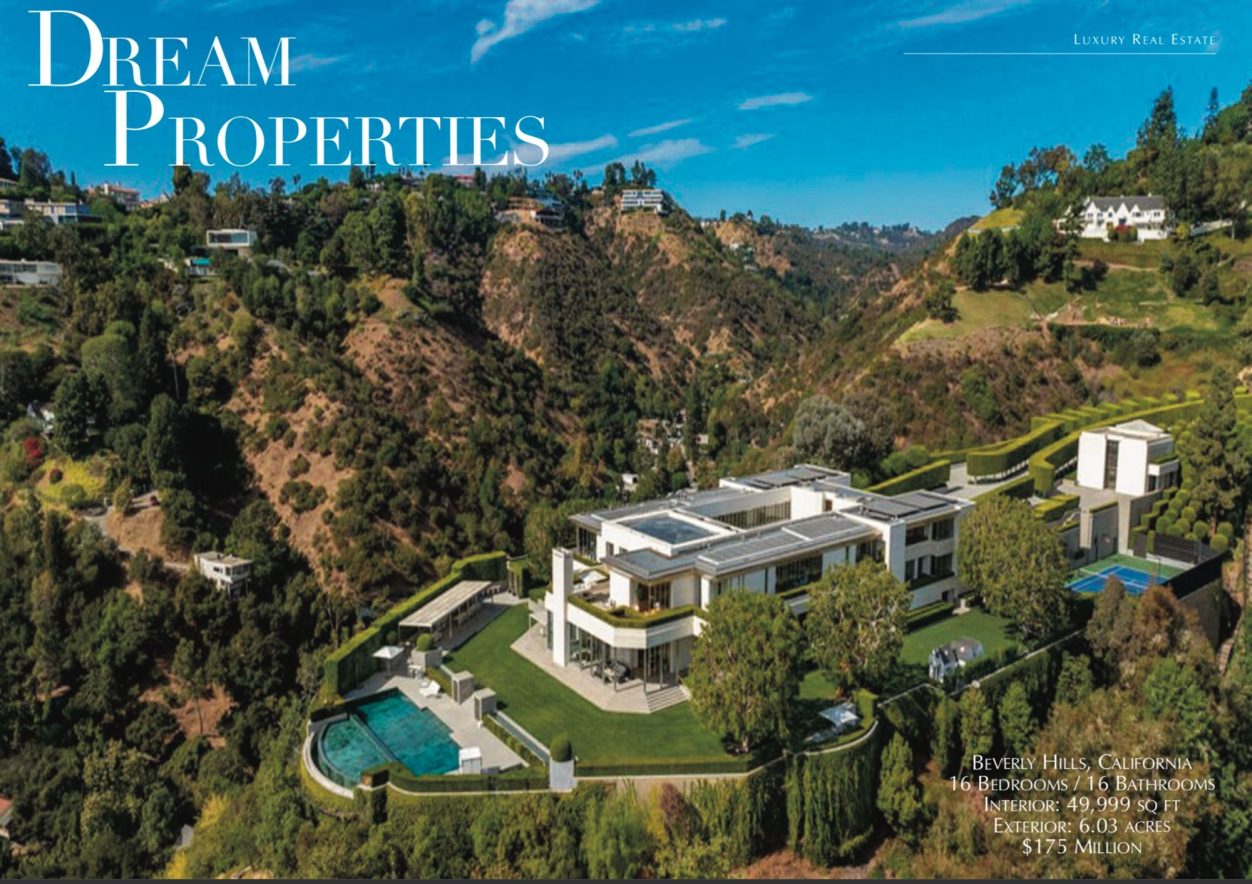
DREAM PROPERTIES
BEVERLY HILLS, CALIFORNIA 16 BEDROOMS / 16 BATHROOMS INTERIOR: 49,999 SQ FT EXTERIOR: 6.03 ACRES $175 MILLION
Angelo Estate, designed by the renowned master architect Ed Tuttle, is the most spectacular contemporary estate in Los Angeles and one of the most prestigious in America. Perched atop a 6.03-acre promontory, it offers breathtaking panoramic views of the entire Los Angeles Basin, from Downtown to the ocean.
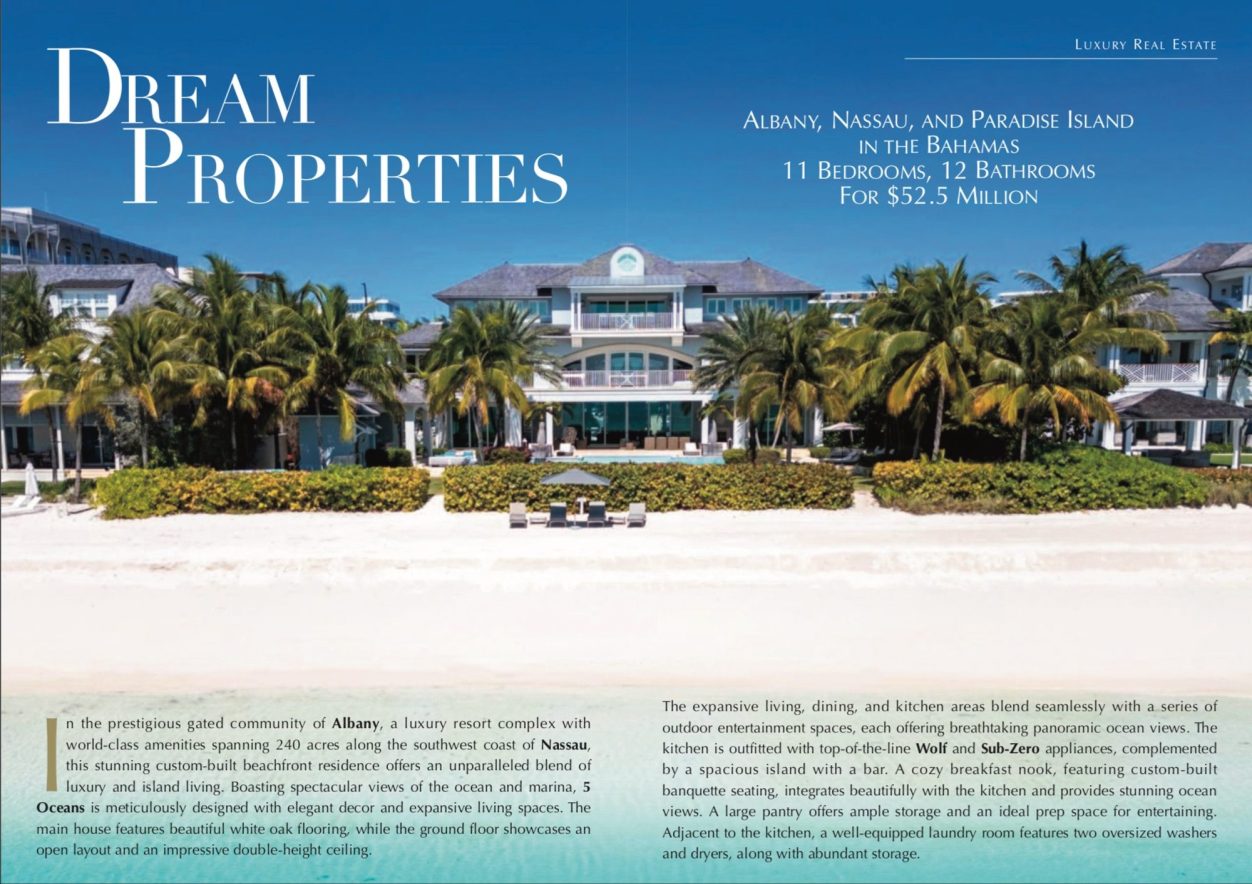
DREAM PROPERTIES
ALBANY, NASSAU, AND PARADISE ISLAND IN THE BAHAMAS
11 BEDROOMS, 12 BATHROOMS FOR $52.5 MILLION
In the prestigious gated community of Albany, a luxury resort complex with world-class amenities spanning 240 acres along the southwest coast of Nassau, this stunning custom-built beachfront residence offers an unparalleled blend of luxury and island living. Boasting spectacular views of the ocean and marina, 5 Oceans is meticulously designed with elegant decor and expansive living spaces. The main house features beautiful white oak flooring, while the ground floor showcases an open layout and an impressive double-height ceiling...
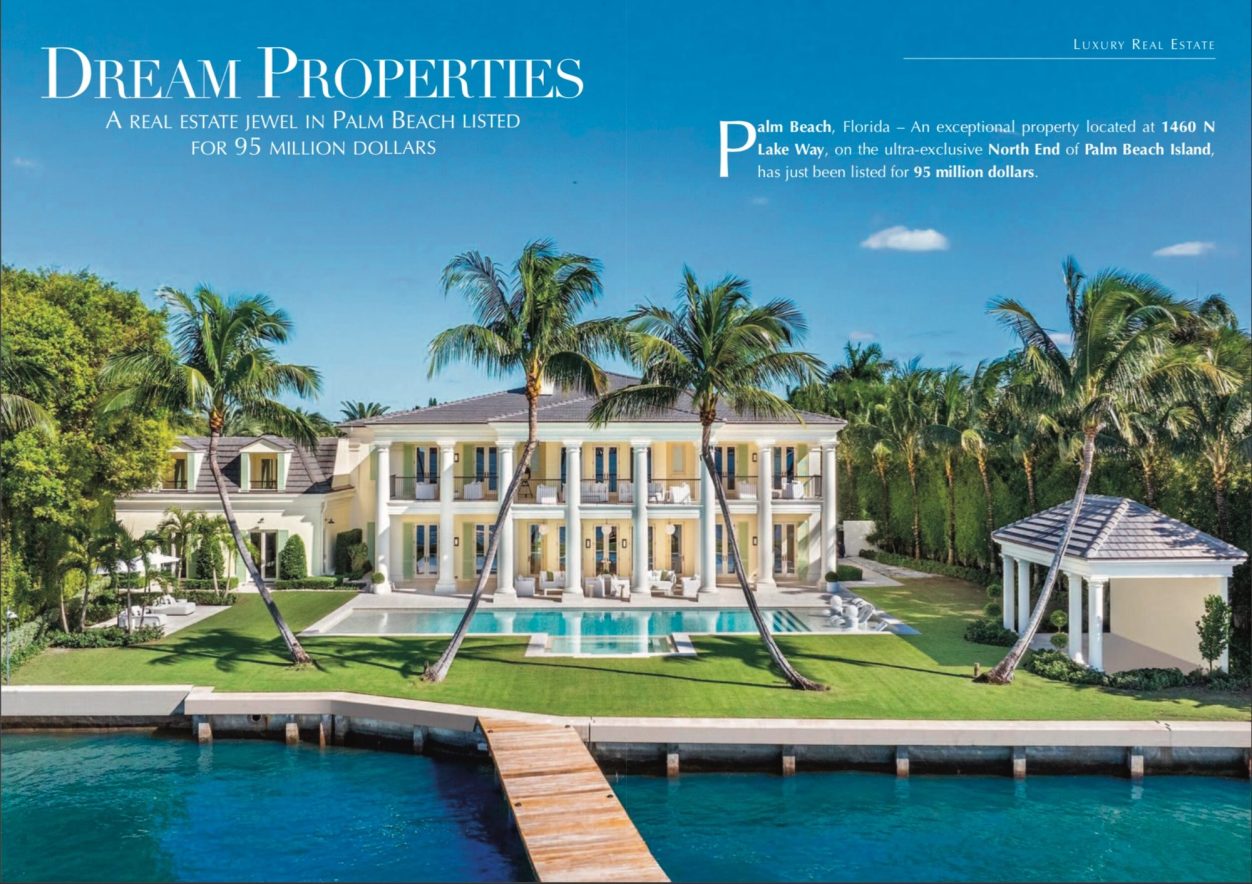
DREAM PROPERTIES
A REAL ESTATE JEWEL IN PALM BEACH LISTED FOR 95 MILLION DOLLARS...
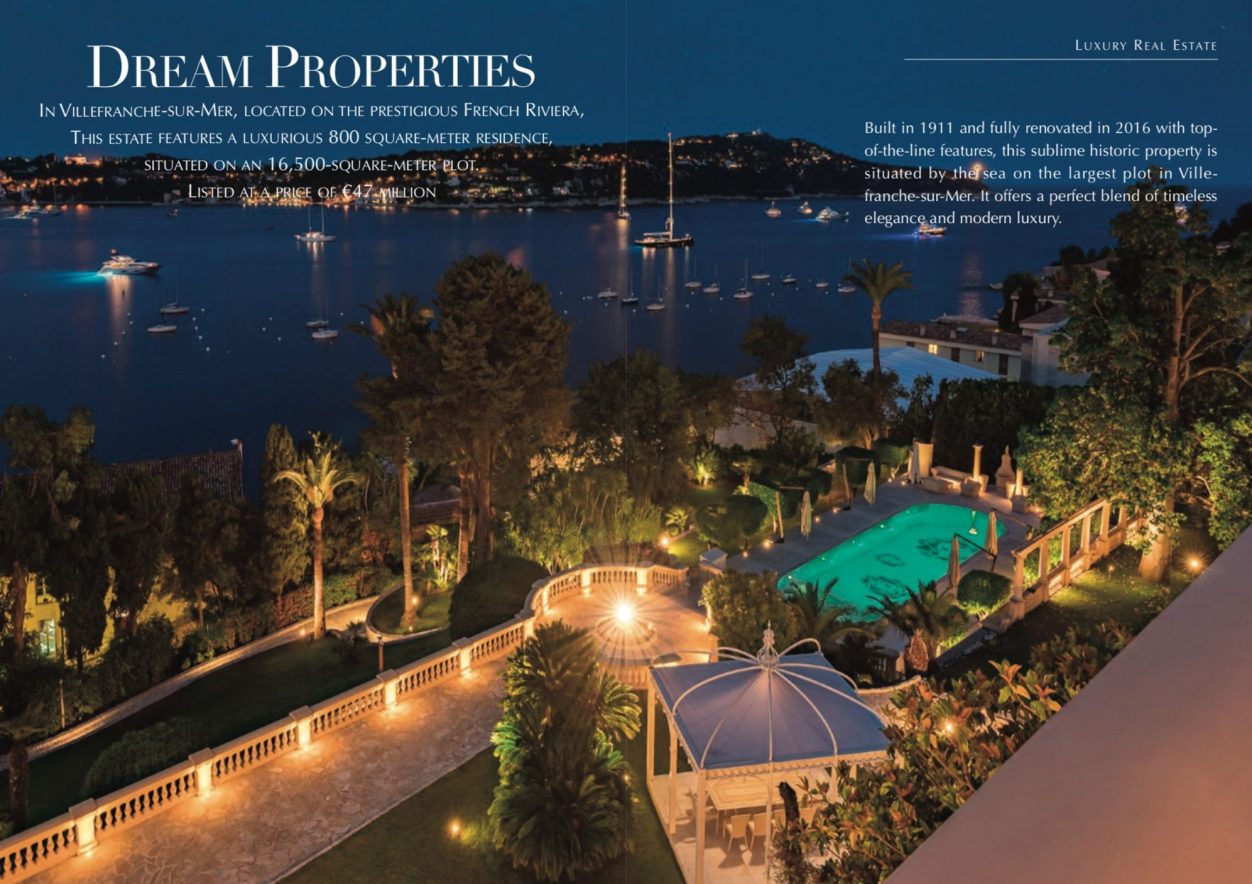
DREAM PROPERTIES
In Villefranche-sur-Mer, located on the prestigious French Riviera, This estate features a luxurious 800 square-meter residence, situated on an 16,500-square-meter plot. Listed at a price of
€47 million...
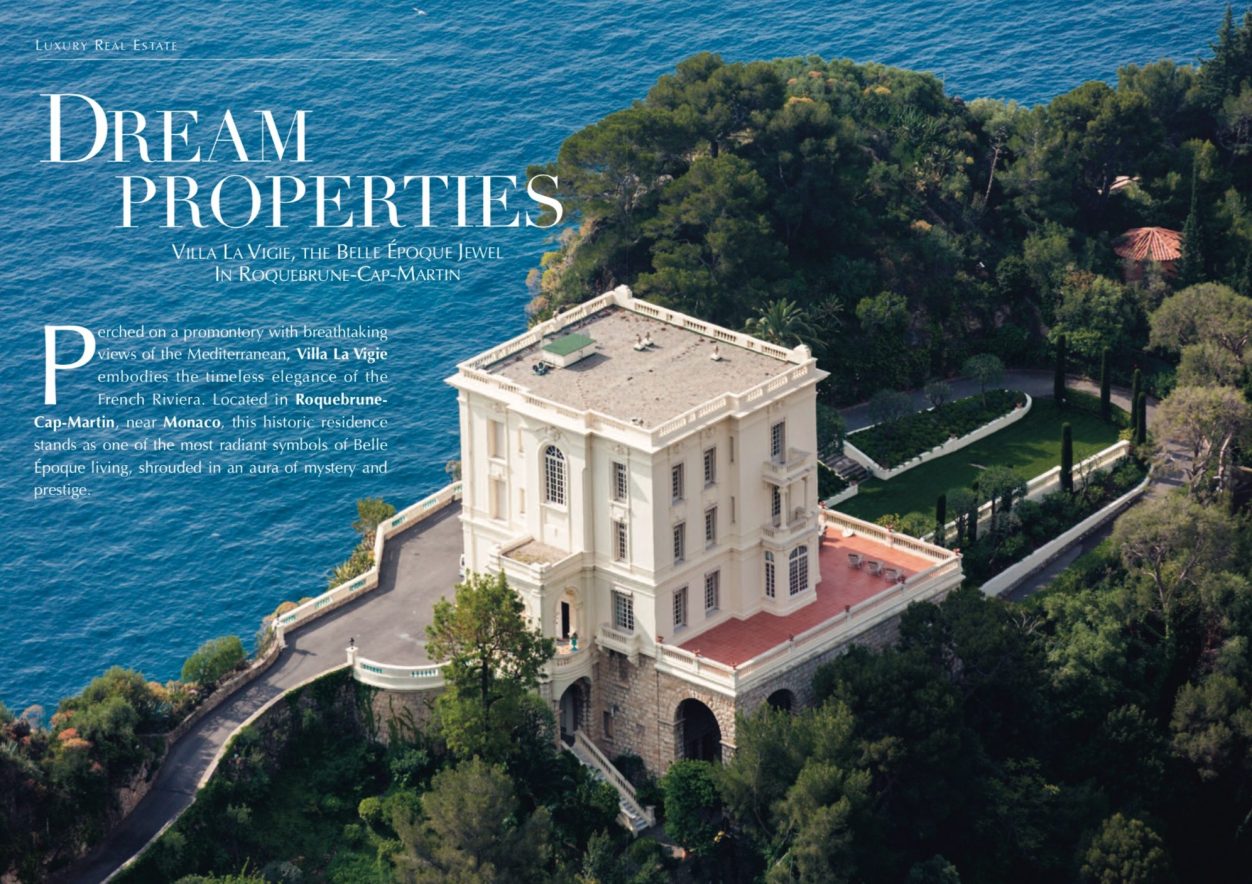
DREAM PROPERTIES
VILLA LA VIGIE, THE BELLE ÉPOQUE JEWEL IN ROQUEBRUNE-CAP-MARTIN
The Perched on a promontory with breathtaking views of the Mediterranean, Villa La Vigie embodies the timeless elegance of the French Riviera. Located in Roquebrune- Cap-Martin, near Monaco, this historic residence stands as one of the most radiant symbols of Belle Époque living, shrouded in an aura of mystery and prestige...
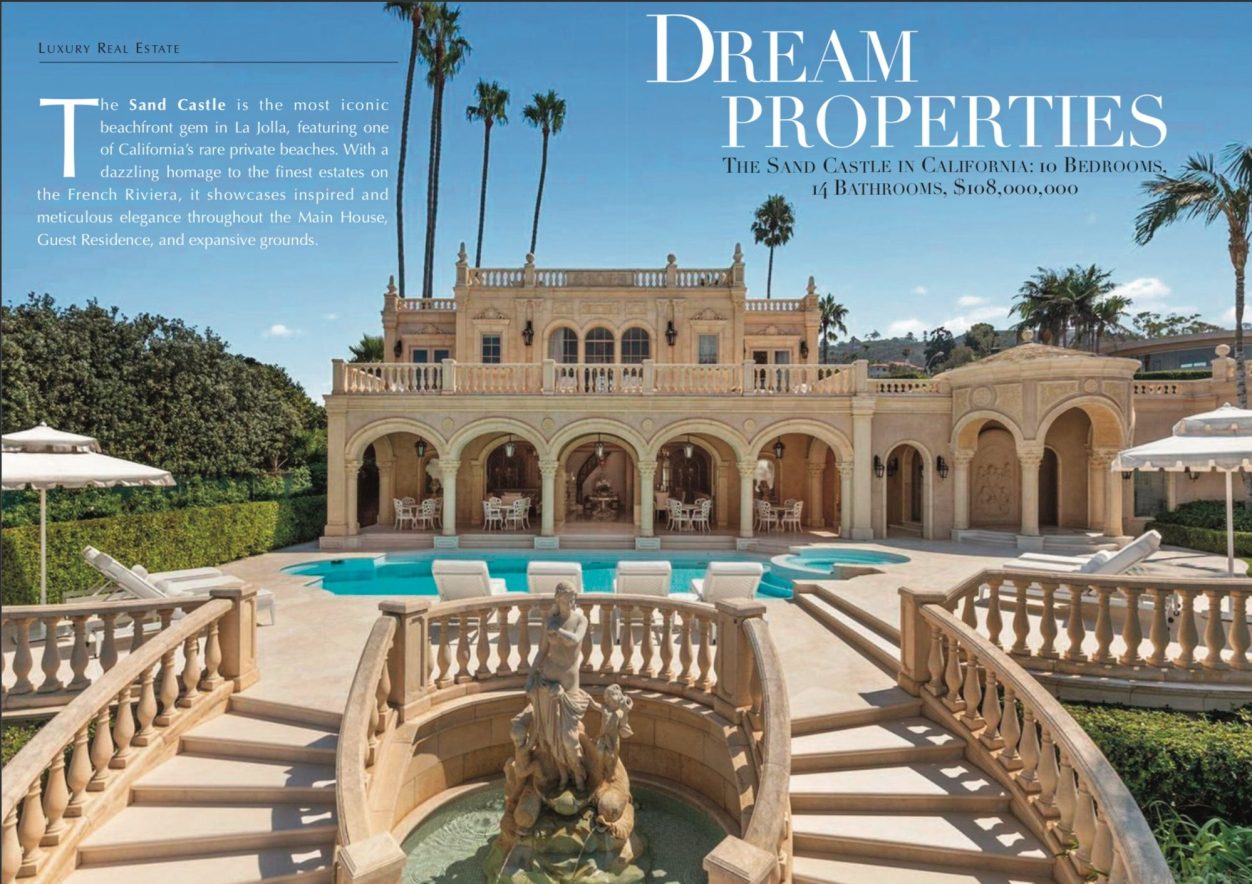
DREAM PROPERTIES
THE SAND CASTLE IN CALIFORNIA: 10 BEDROOMS, 14 BATHROOMS, $108,000,000
The Sand Castle is the most iconic beachfront gem in La Jolla, featuring one of California’s rare private beaches. With a dazzling homage to the finest estates on the French Riviera, it showcases inspired and meticulous elegance throughout the Main House, Guest Residence, and expansive grounds...
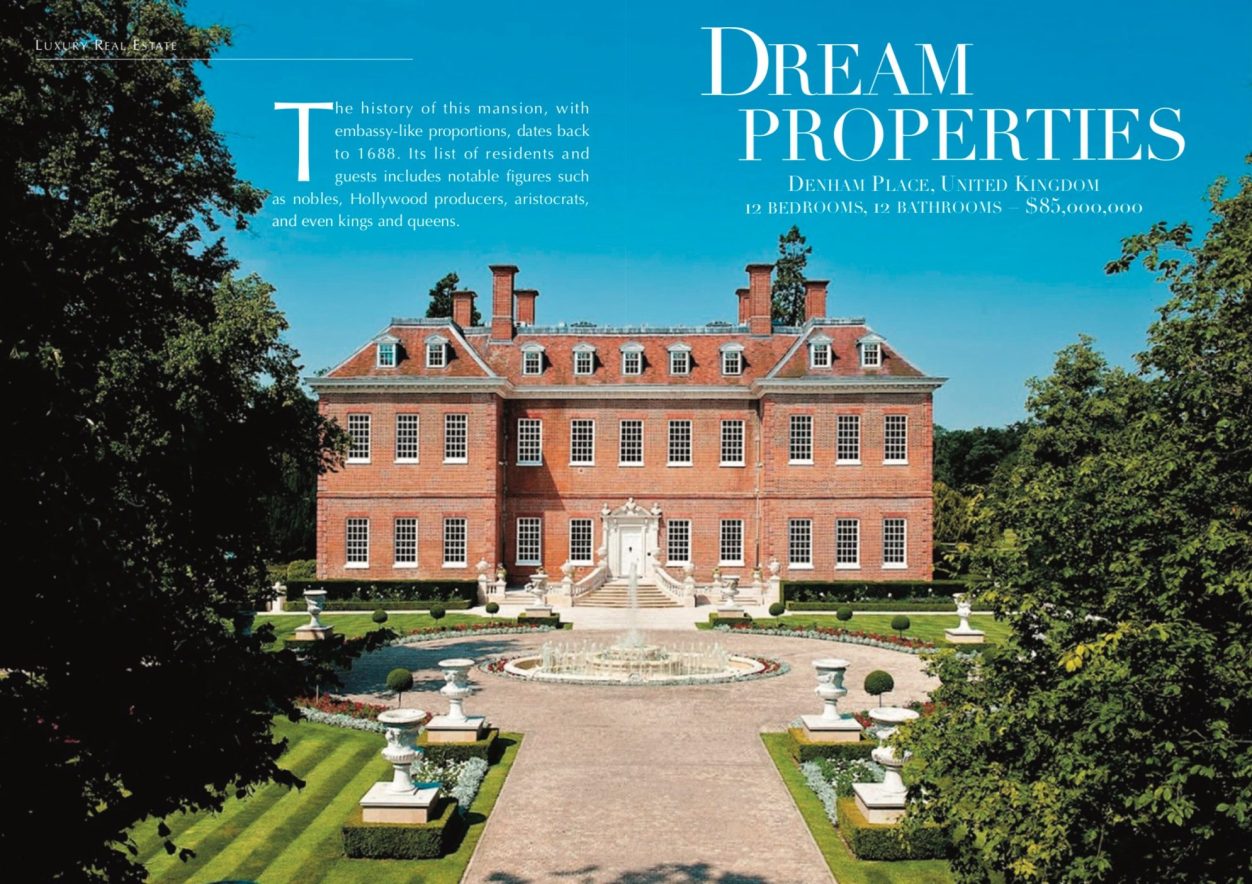
DREAM PROPERTIES
DENHAM PLACE, UNITED KINGDOM 12 BEDROOMS, 12 BATHROOMS – $85,000,000
The history of this mansion, with embassy-like proportions, dates back to 1688. Its list of residents and guests includes notable figures such as nobles, Hollywood producers, aristocrats, and even kings and queens...
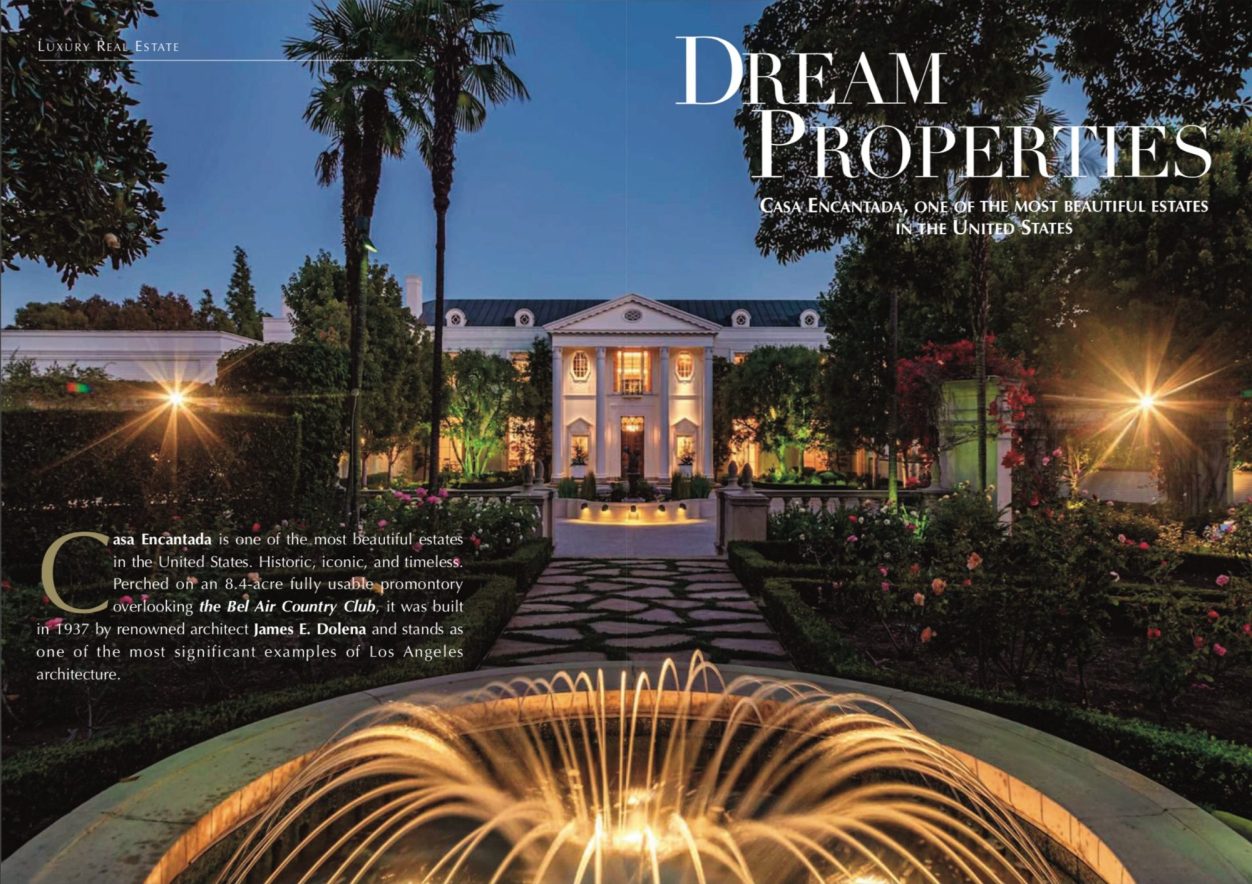
DREAM PROPERTIES
Sasa Encantada is one of the most beautiful estates in the United States. Historic, iconic, and timeless. Perched on an 8.4-acre fully usable promontory overlooking the Bel Air Country Club, it was built in 1937 by renowned architect James E. Dolena and stands as one of the most significant examples of Los Angeles architecture...
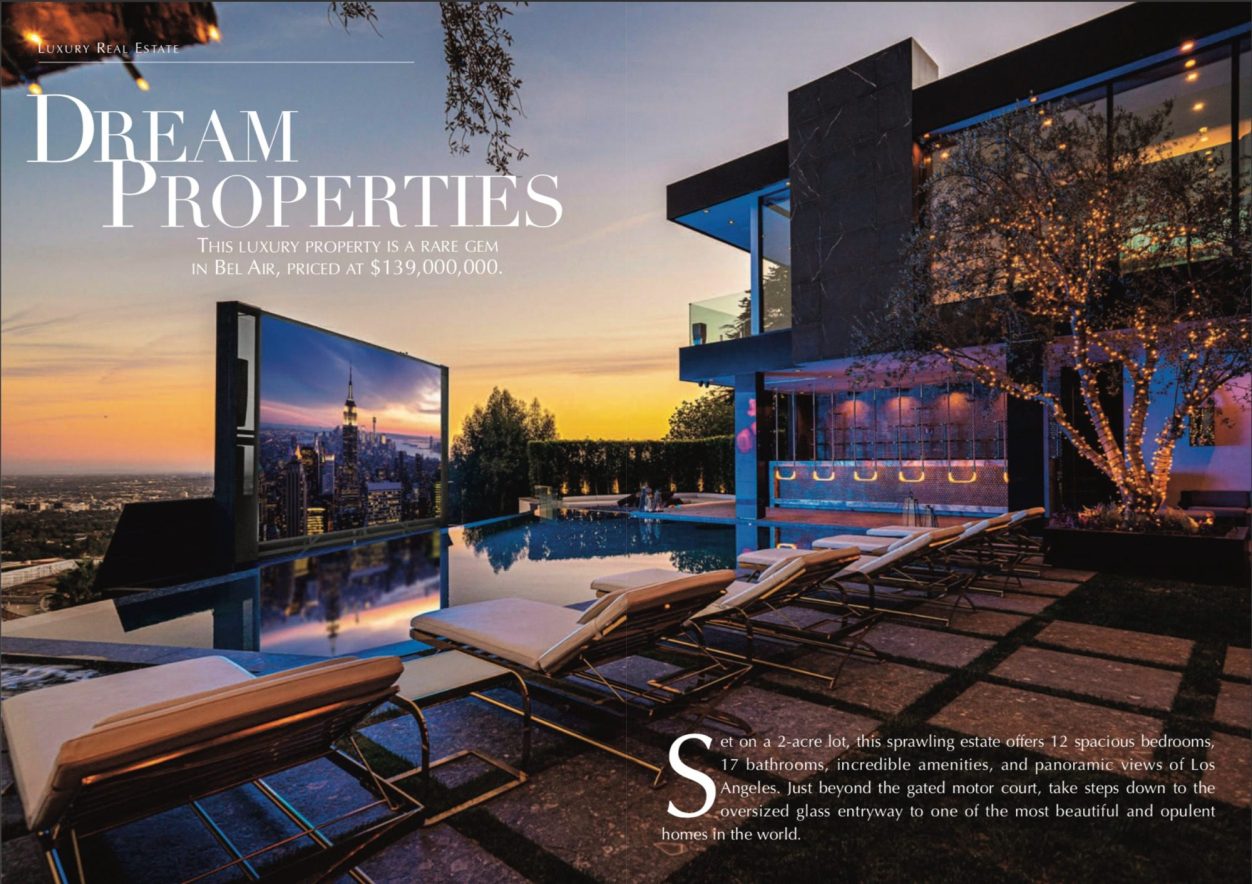
DREAM PROPERTIES
Set on a 2-acre lot, this sprawling estate offers 12 spacious bedrooms, 17 bathrooms, incredible amenities, and panoramic views of Los Angeles. Just beyond the gated motor court, take steps down to the oversized glass entryway to one of the most beautiful and opulent homes in the world...
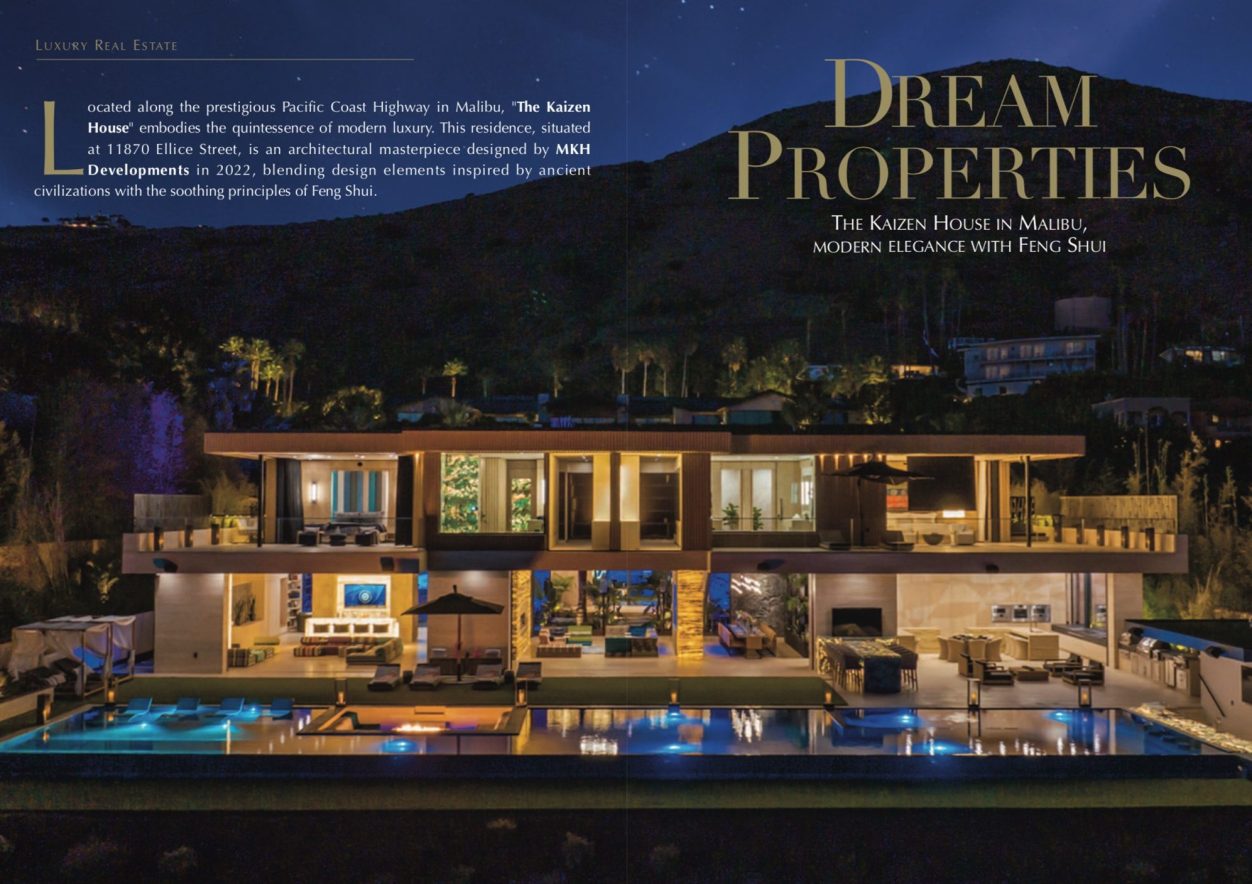
DREAM PROPERTIES
Located along the prestigious Pacific Coast Highway in Malibu, "The Kaizen House" embodies the quintessence of modern luxury. This residence, situated at 11870 Ellice Street, is an architectural masterpiece designed by MKH Developments in 2022, blending design elements inspired by ancient civilizations with the soothing principles of Feng Shui...
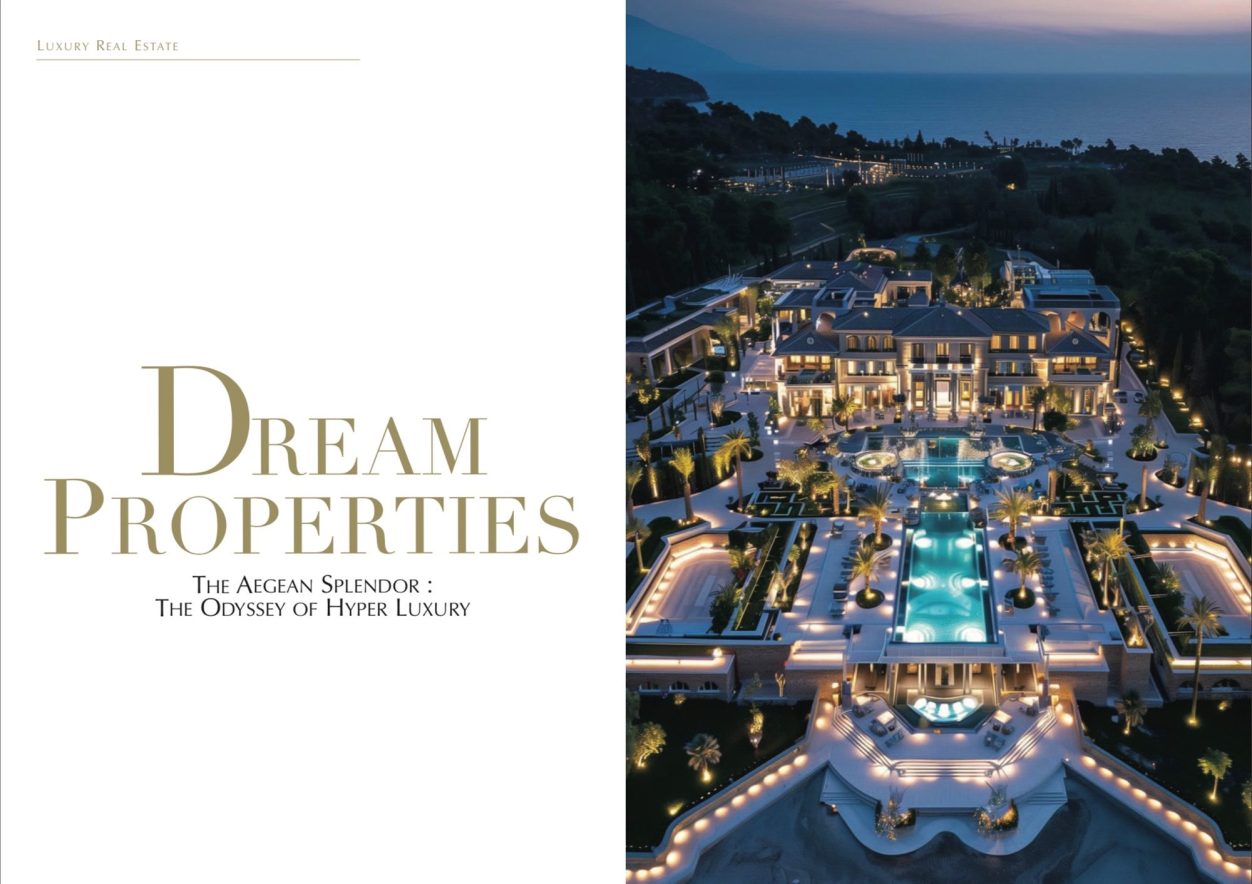
DREAM PROPERTIES
In the enchanting landscape of Greece, where myths and legends dance to the rhythm of the azure waves of the Aegean Sea, emerges an exceptional residence, a true modern palace in the heart of antiquity, known as "The Aegean Splendor"...
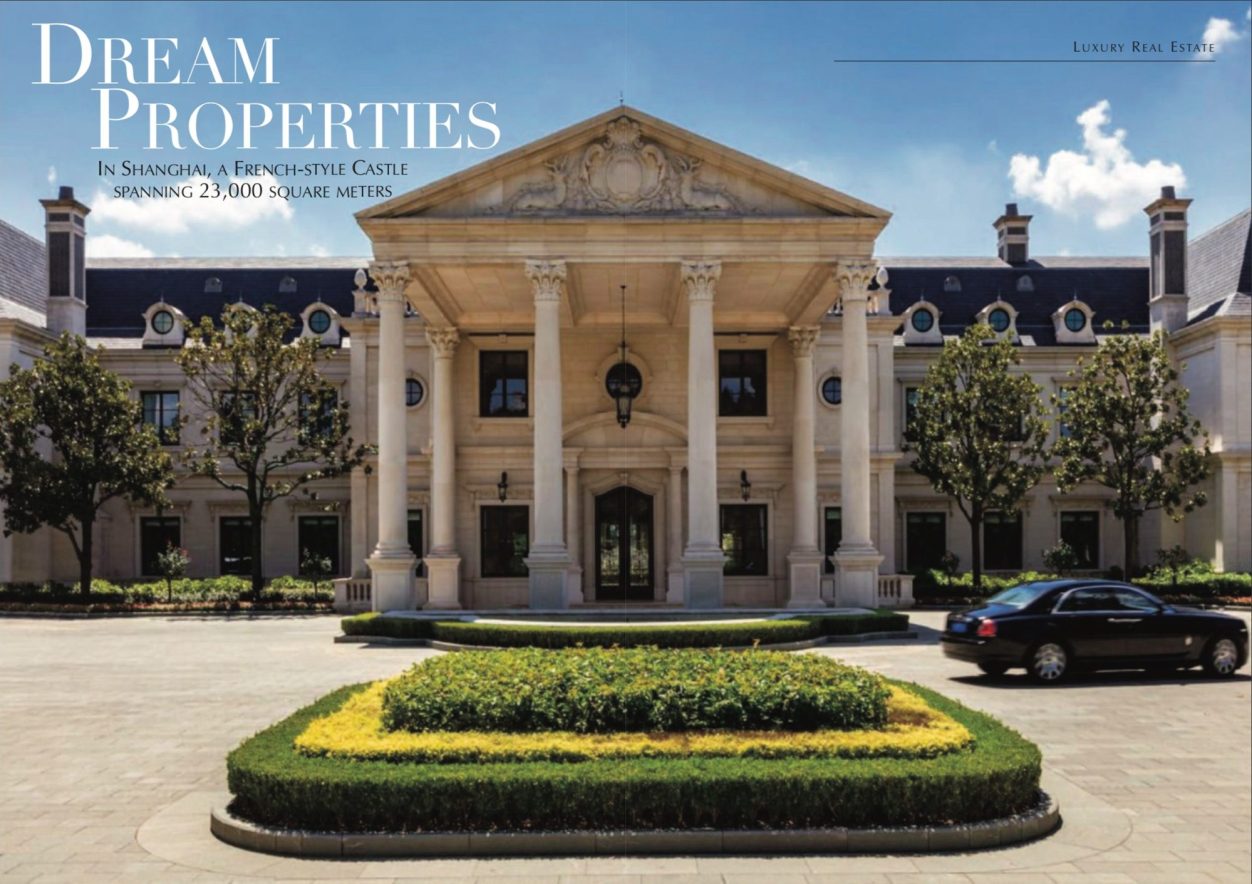
DREAM PROPERTIES
In Shanghai, a French-style Castle spanning 23,000 square meters. This 23,000 square meter palace is one of the most magnificent residences in the world. A collaboration between design geniuses Geoffrey Bradfield and Richard Landry has given birth to a contemporary expression of classicism...
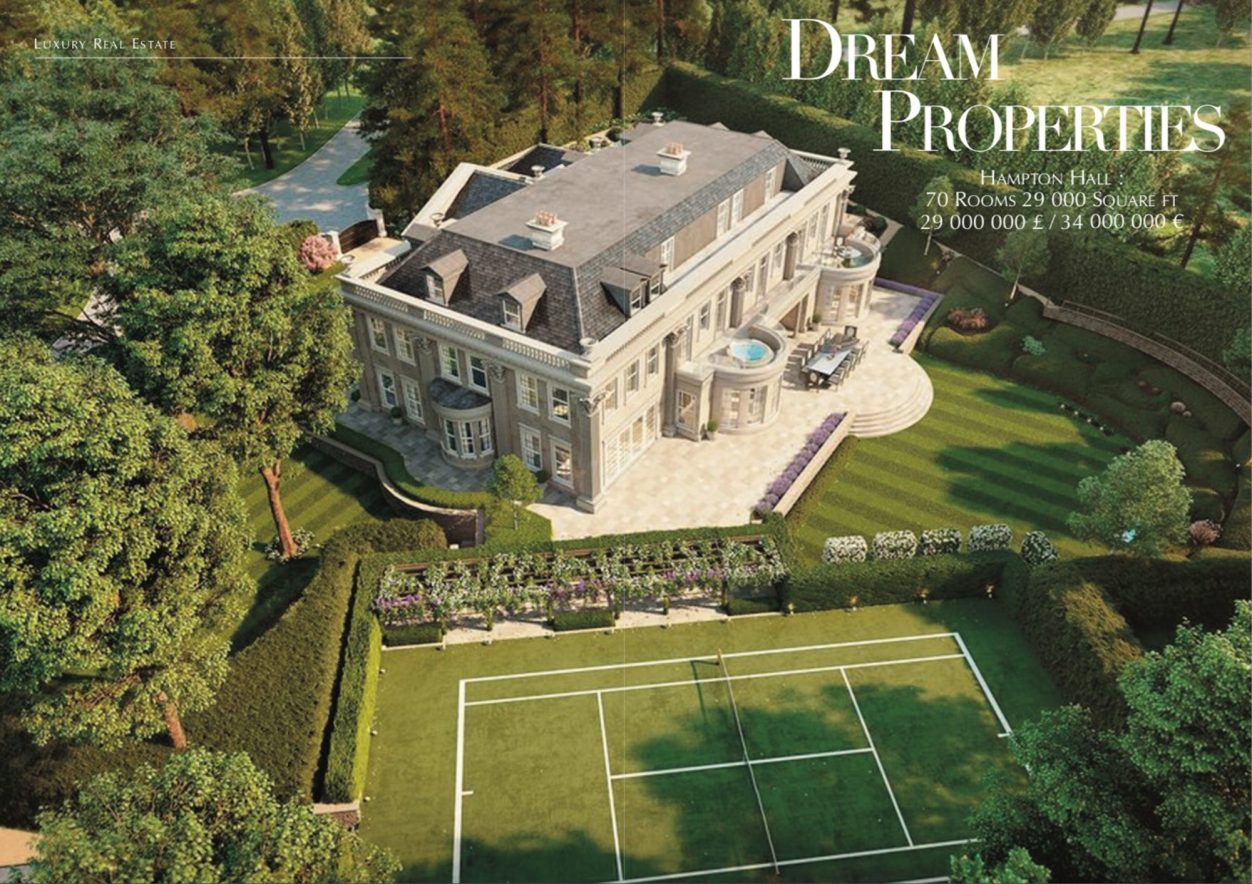
DREAM PROPERTIES
A MAGNIFICENT PRESTIGIOUS RESIDENCE, NESTLED
IN THE HEART OF THE ENGLISH COUNTRYSIDE IN OXSHOTT, A WONDERFUL VILLAGE IN SURREY, ENGLAND
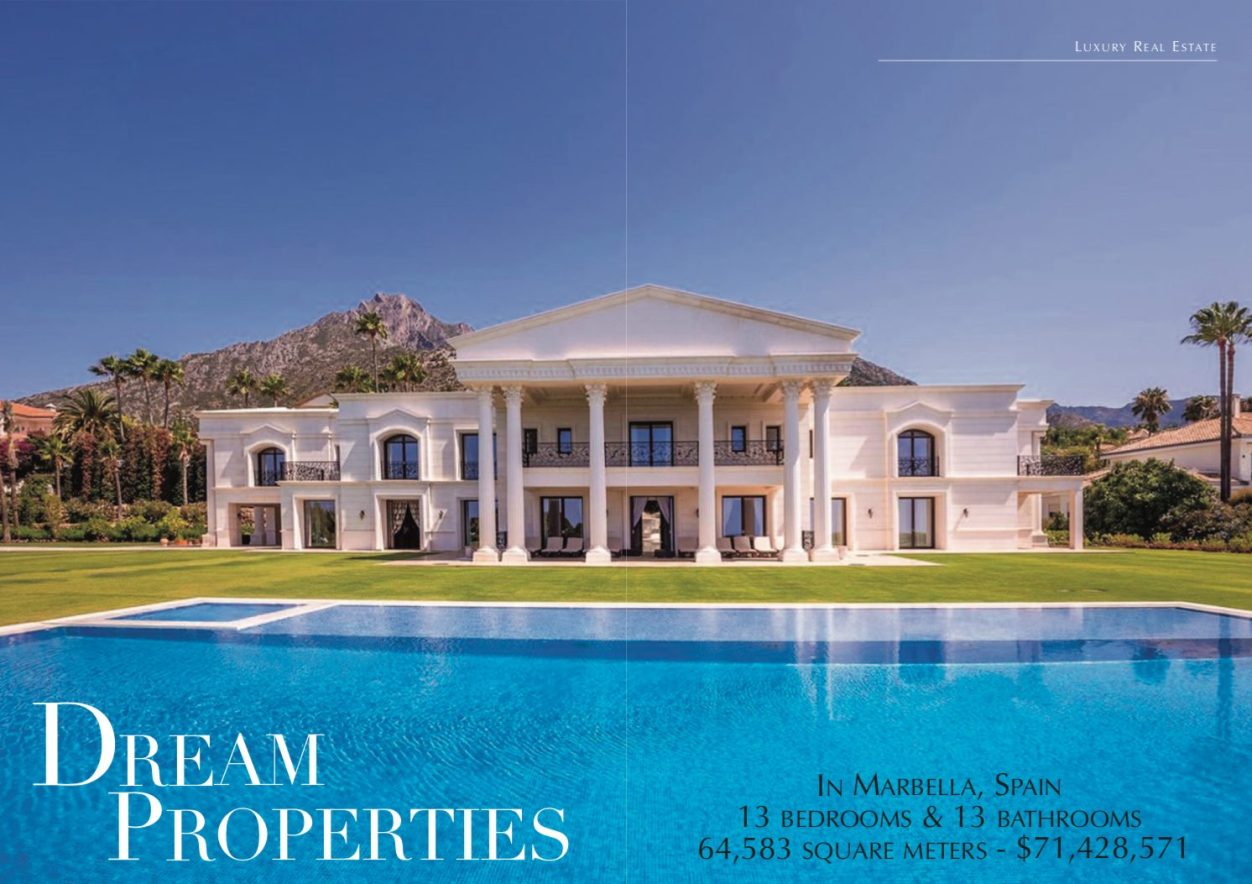
DREAM PROPERTIES
This impressive property, with 6,000 m2 of built area spread over three floors, is located on an 11,000 m2 plot in one of Marbella's most prestigious gated communities. It offers 13 designer bedrooms with private bathrooms, walk-in closets, sitting areas, and private terraces, making it an ideal choice for the most discerning connoisseurs of fine living…
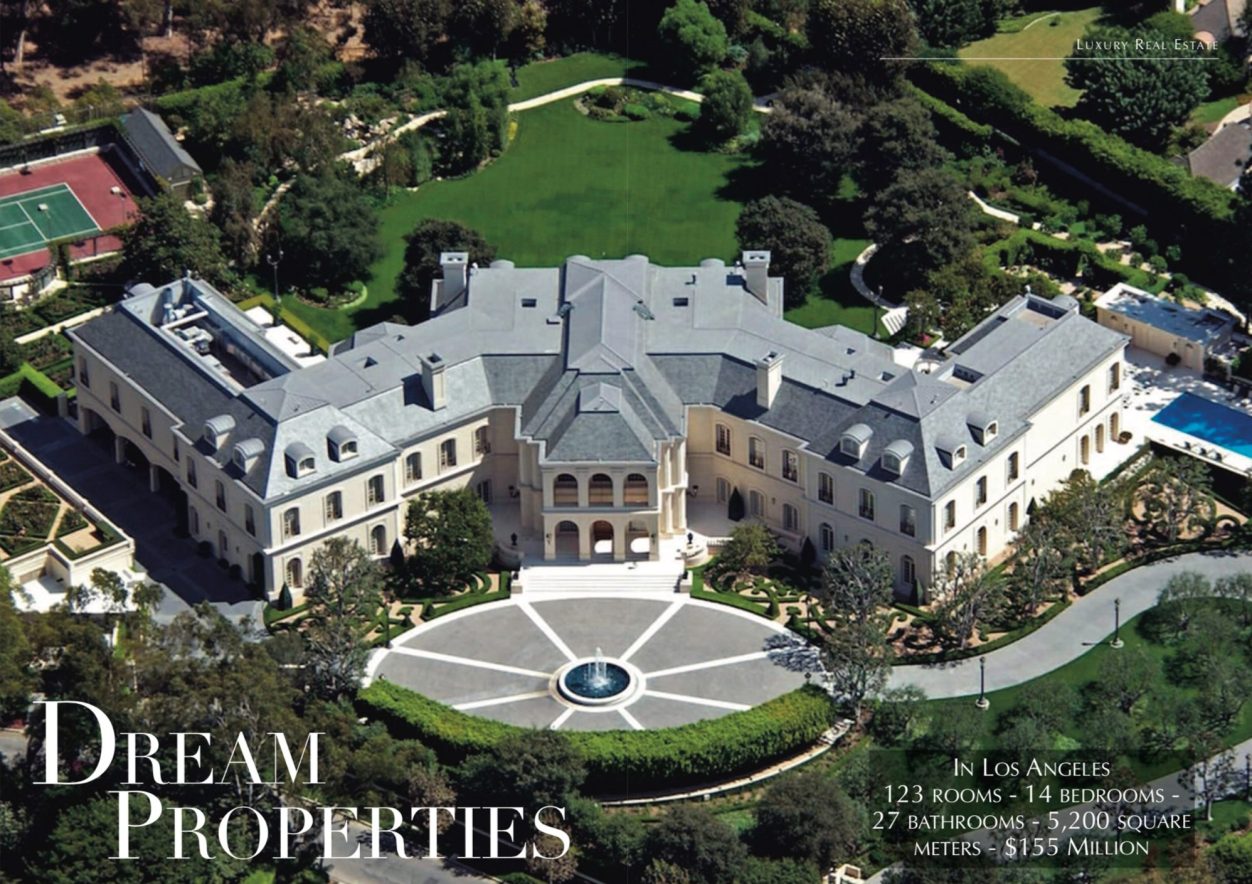
DREAM PROPERTIES
A mansion straight out of Aaron Spelling's dreams. In the United States, Aaron Spelling is famous for being the producer of major successful TV series during the last three decades of the 20th century. At the peak of his fame in 1991, he had an enormous estate built in the Holmby Hills neighborhood of Los Angeles…
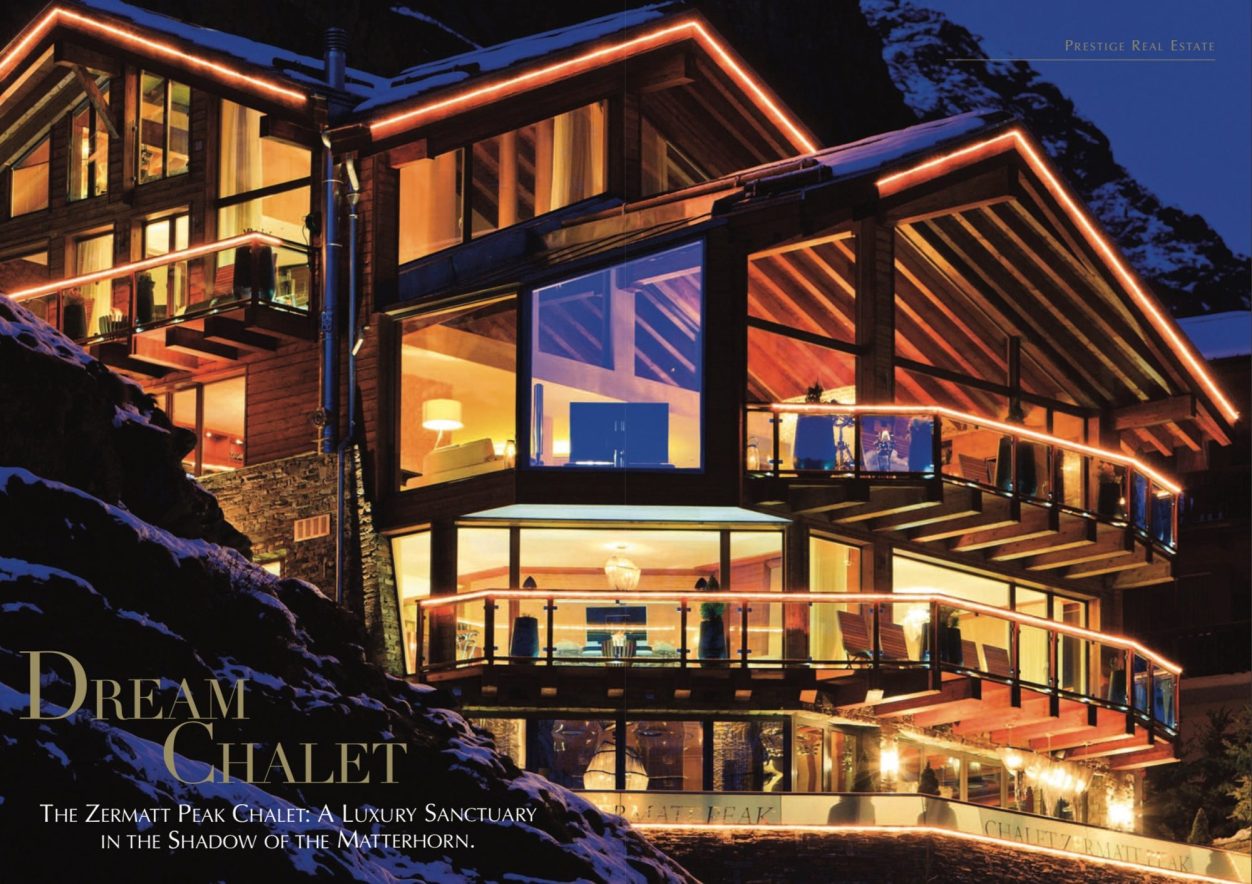
DREAM CHALET
THE ZERMATT PEAK CHALET: A LUXURY SANCTUARY IN THE SHADOW OF THE MATTERHORN
Nestled in the heart of the majestic Swiss Alps, Chalet Zermatt Peak stands as a jewel of Alpine hospitality. Wrapped in the magic of the Matterhorn, this mountain retreat embodies the quintessence of Alpine luxury, providing an unforgettable experience for those seeking to escape the hustle and bustle
of the modern world...
CHALET DE REVE
LE CHALET ZERMATT PEAK UN SANCTUAIRE DE LUXE
À L'OMBRE DU CERVIN
Niché au cœur des majestueuses Alpes suisses, le Chalet Zermatt Peak se dresse en tant que joyau de l'hospitalité alpestre. Enveloppé par la magie du Cervin, ce refuge de montagne incarne la quintessence du luxe alpin, offrant une expérience inoubliable à ceux qui cherchent à échapper à l'agitation du monde moderne...
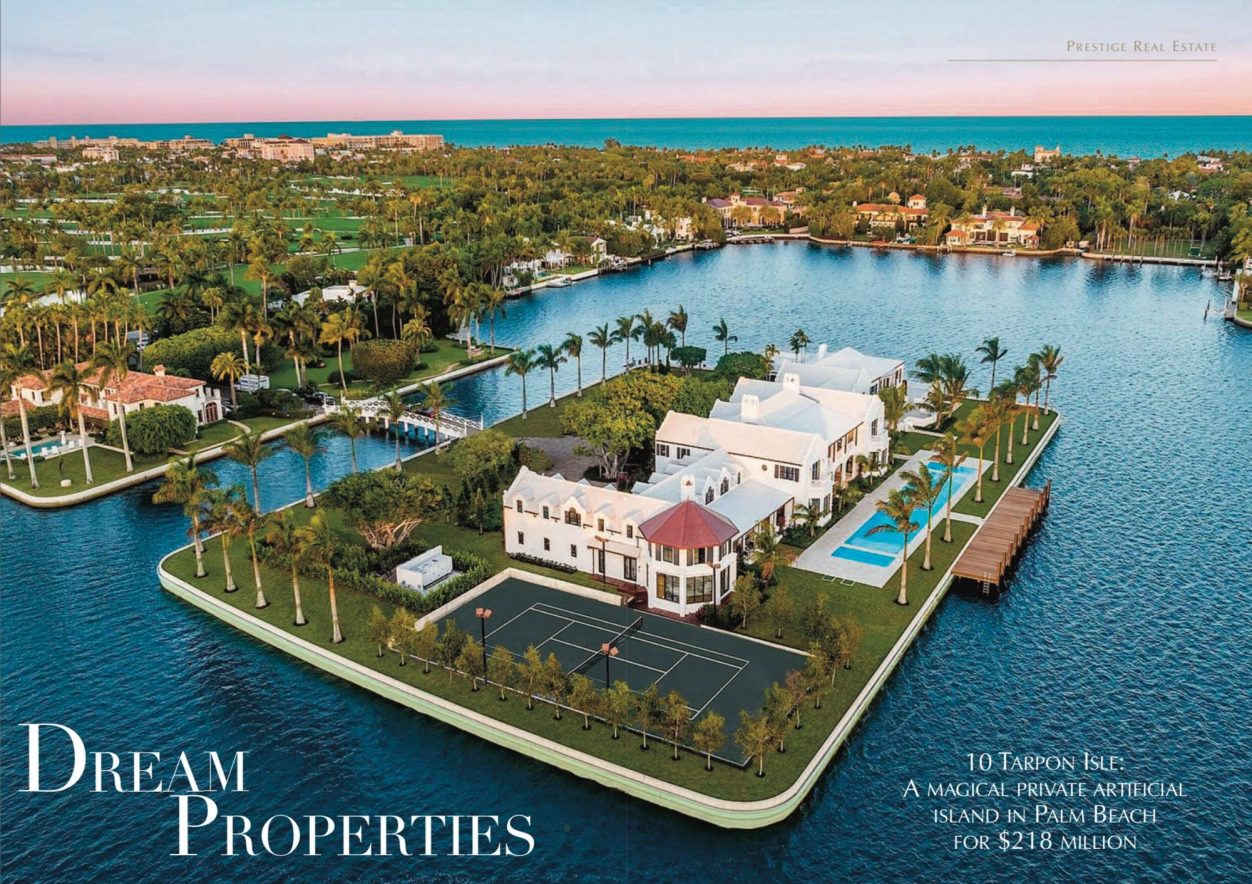
DREAM PROPERTIES
10 TARPON ISLE: A MAGICAL PRIVATE ARTIFICIAL ISLAND IN PALM BEACH FOR $218 MILLION …
PROPRIÉTÉS DE RÊVE
10 TARPON ISLAND : UNE ÎLE PRIVÉE ARTIFICIELLE FÉERIQUE À PALM BEACH POUR 218 MILLIONS DE DOLLARS
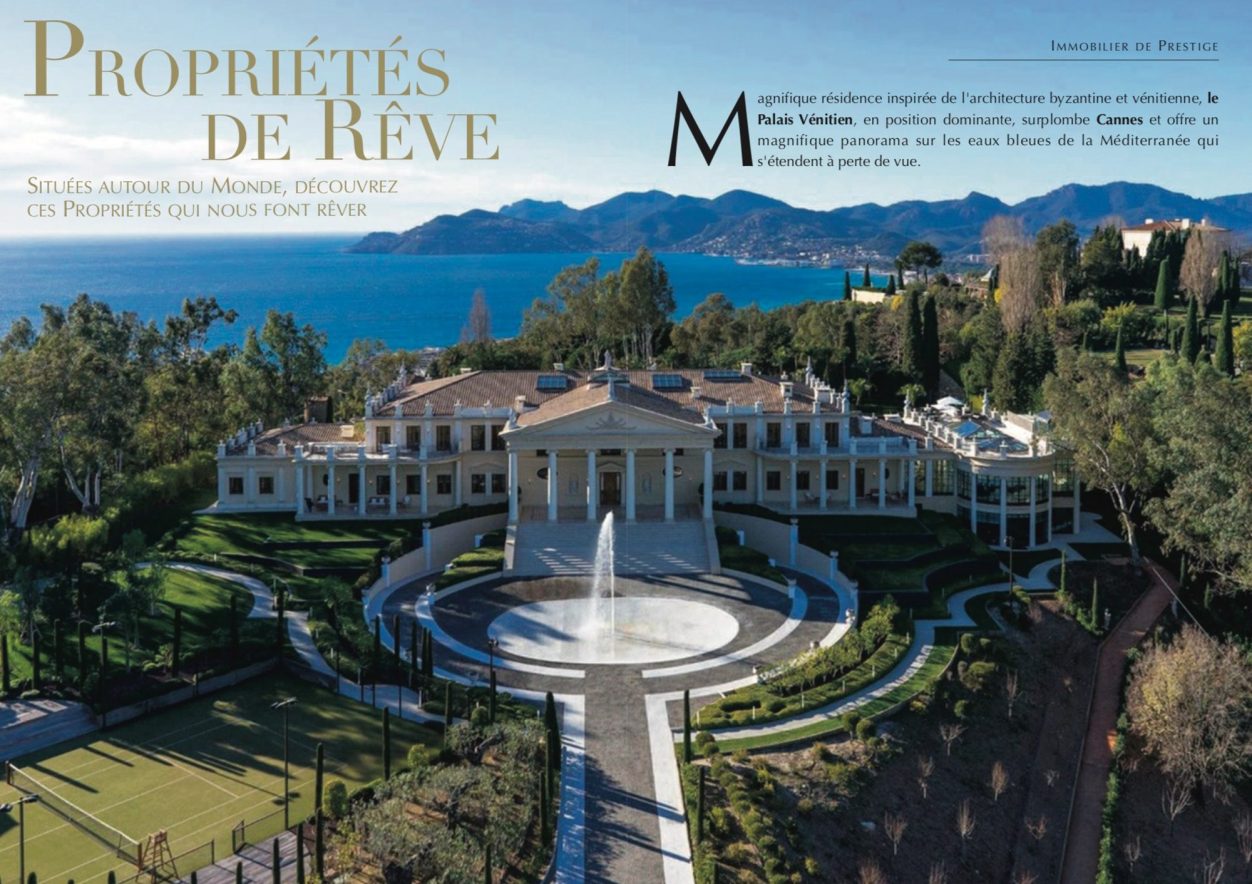
PROPRIÉTÉS DE RÊVE
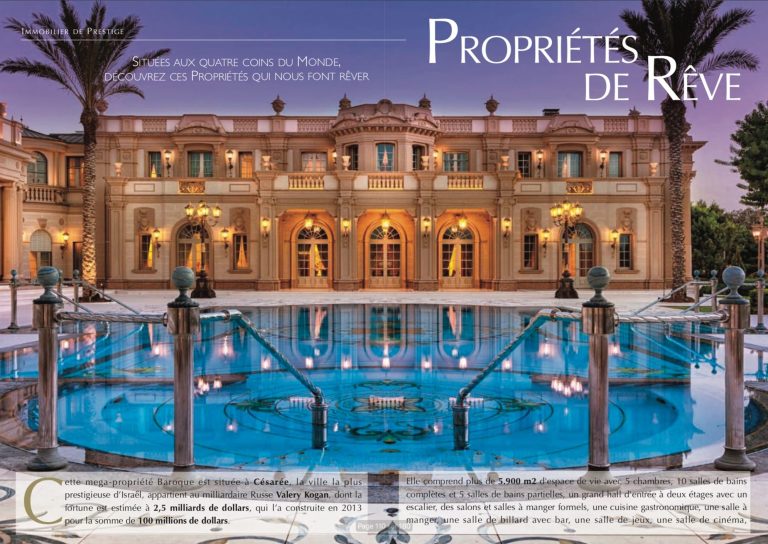
Situées aux quatre coins du monde, découvrez
ces propriétés qui nous font rêver
Magnifique résidence inspirée de l'architecture byzantine et vénitienne, le Palais Vénitien, en position dominante, surplombe Cannes et offre un magnifique panorama sur les eaux bleues de la Méditerranée qui s'étendent à perte de vue…
DREAM PROPERTIES
Located in the four corners of the world, discover these properties
that make us dream
Magnificent residence inspired by Byzantine and Venetian architecture, the Venetian Palace, perched in a commanding position, overlooks Cannes and offers a splendid panorama of the endless blue waters of the Mediterranean…
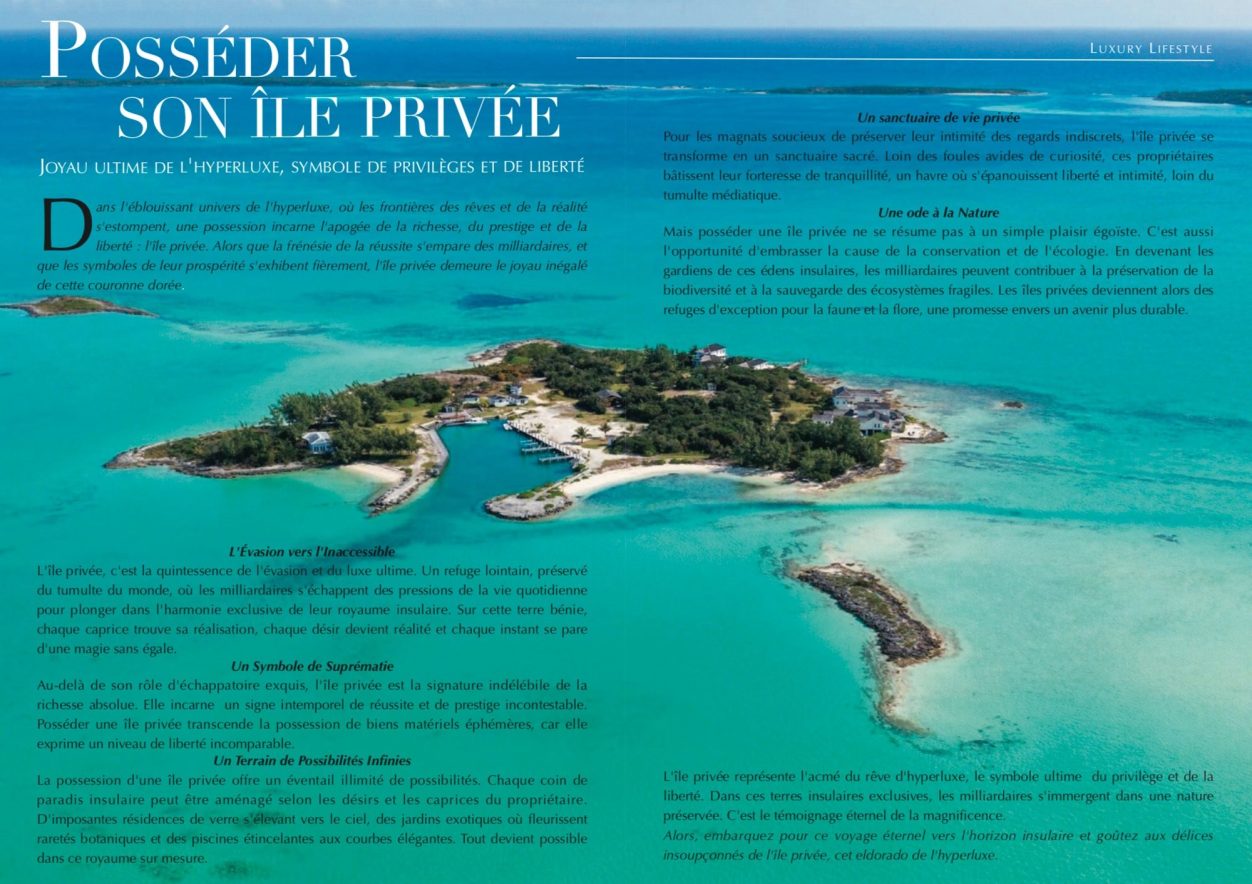
POSSÉDER SON ÎLE PRIVÉE
Joyau ultime de l’hyper-luxe, symbole
de privilèges et de liberté.
Dans l'éblouissant univers de l'hyper-luxe, où les frontières des rêves et de la réalité s'estompent, une possession incarne l'apogée de la richesse, du prestige et de la liberté : l'île privée.
Alors que la frénésie de la réussite s'empare des milliardaires,
et que les symboles de leur prospérité s'exhibent fièrement, l'île privée demeure le joyau inégalé de cette couronne dorée…
TO OWN ONE'S PRIVATE ISLAND
The ultimate jewel of Hyper-luxe, a symbol of freedom.
In the dazzling world of hyper-luxury, where the boundaries between dreams and reality blur, one possession embodies the pinnacle of wealth, prestige, and freedom: the private island. As the frenzy of success grips billionaires, and the symbols of their prosperity are proudly displayed, the private island remains the unmatched jewel in this golden crown…
PROPRIÉTÉS DE RÊVE
Situées aux quatre coins du monde, découvrez ces propriétés qui nous font rêver
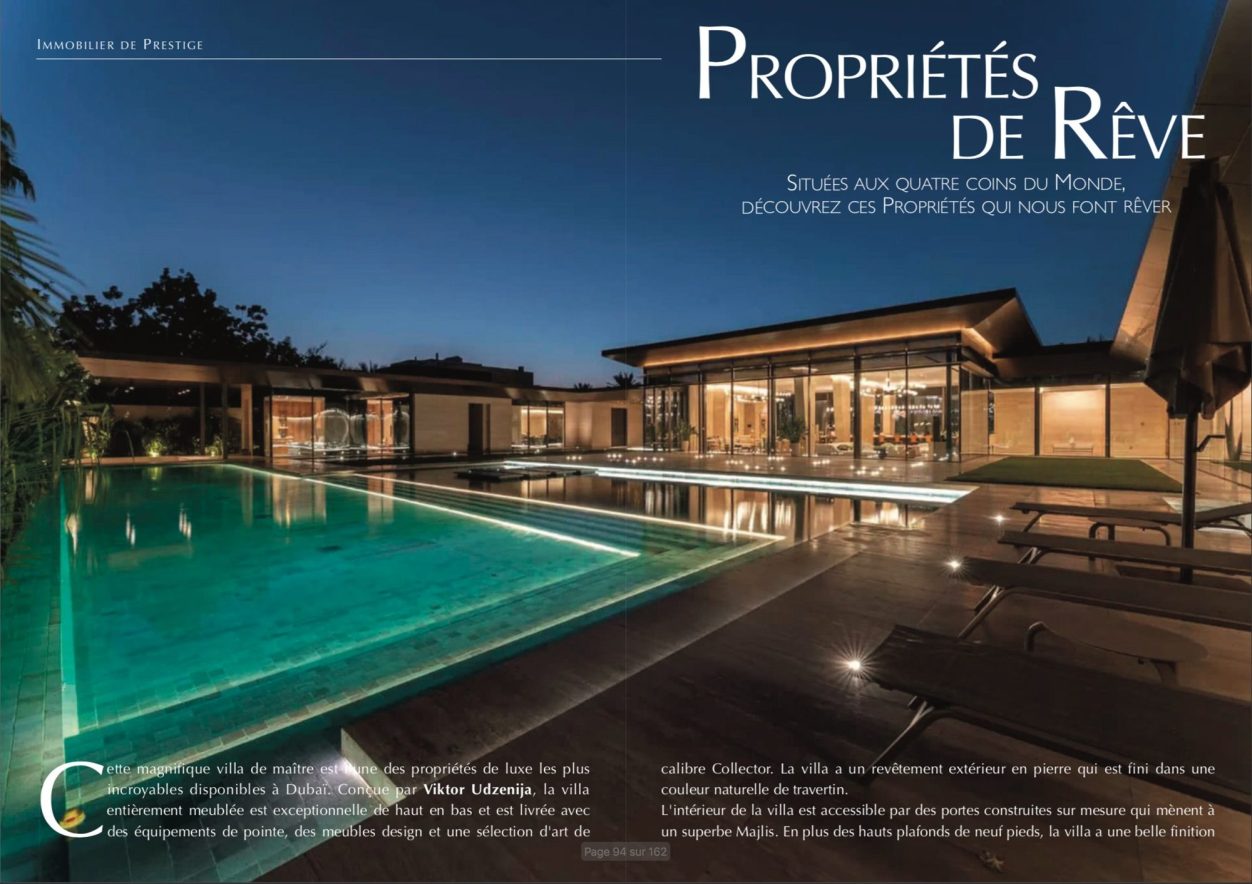
Cette magnifique villa de maître est l'une des propriétés de luxe les plus incroyables disponibles à Dubaï. Conçue par Viktor Udzenija, la villa entièrement meublée est exceptionnelle de haut en bas et est livrée avec des équipements de pointe, des meubles design et une sélection d'art de calibre Collector. La villa a un revêtement extérieur en pierre qui est fini dans une couleur
naturelle de travertin…
DREAM PROPERTIES
Located in the four corners of the world, discover these properties
that make us dream
This magnificent master villa is one of the most incredible luxury properties available in Dubai. Designed by Viktor Udzenija, the fully furnished villa is exceptional from top to bottom and comes with
state-of-the-art amenities, designer furniture, and a collection
of museum-quality art…
PROPRIÉTÉS DE RÊVE
Situées aux quatre coins du monde, découvrez ces Propriétés qui nous font rêver…
DREEAM PROPERTIES
Located in every corner of the world, discover these properties that make us dream…